"The Girl to Whom Nothing Will Happen" by Kira Bulychev, summary
 Automatic translate
This book is a collection of short fantasy stories about Alisa Selezneva’s preschool years, written in 1965. The plot is told through the diary entries of the girl’s father, a biology professor, who records incredible events involving his daughter on the eve of her entering first grade. The stories about Alisa Selezneva have been extremely successfully adapted for the screen. The most famous adaptations are the animated film "The Mystery of the Third Planet" and the television series "Guest from the Future," which have gained widespread popularity among audiences across generations.
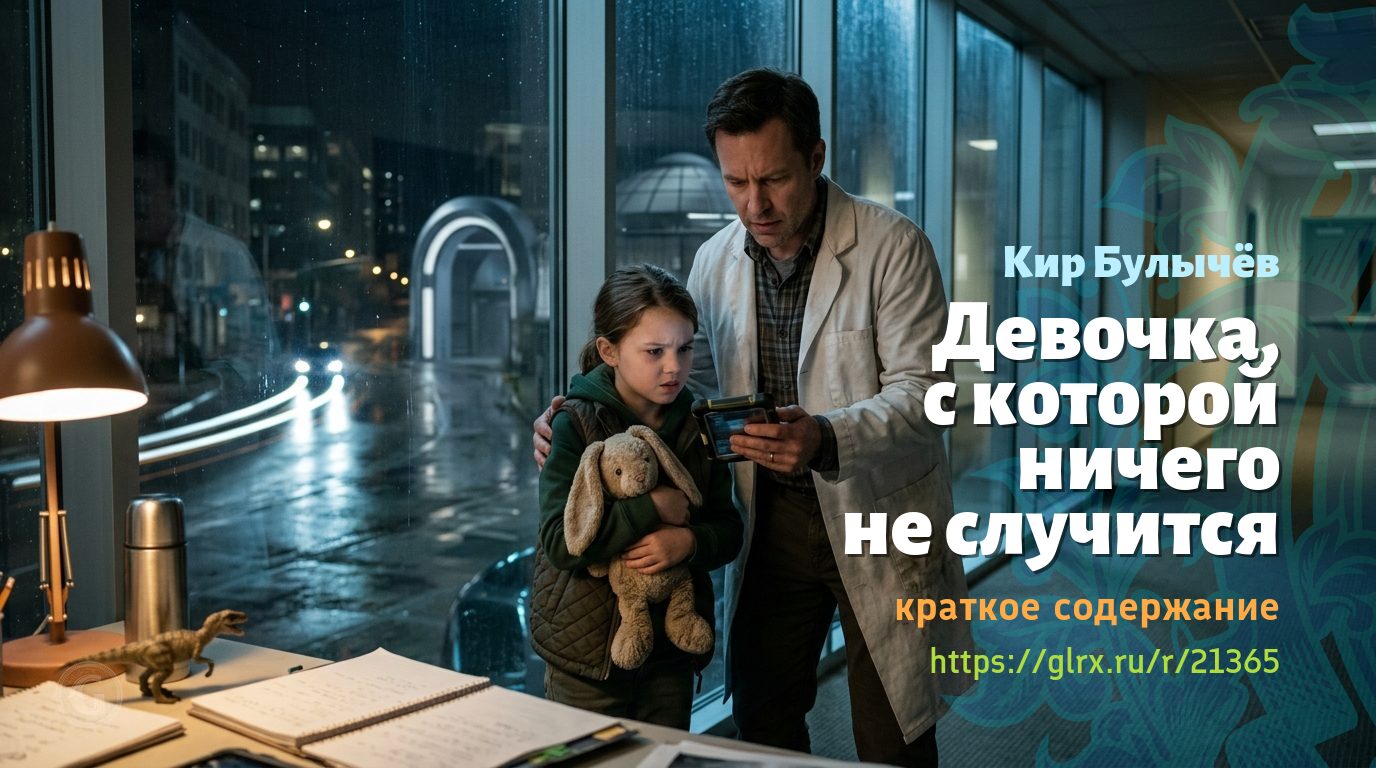
The book opens the famous "Alice’s Adventures" series and is considered the first installment in this extensive cycle. The author subsequently wrote numerous sequels, among which the most notable are "Alice’s Journey," "One Hundred Years Ahead," and "A Million Adventures." The story begins with a foreword by the girl’s father. Tomorrow, Alice will start school for the first time, and many friends, including the Martian Boos, congratulate her. The father decides to dictate several true stories from his daughter’s life for her future teacher. He hopes to prepare the teacher for encounters with a child who easily disappears at inopportune moments and accidentally makes unimaginable scientific discoveries.
The incident with the videophone and the Martians
In the first story, Alice refuses to go to sleep. Her father threatens to call Baba Yaga to punish his naughty daughter. He randomly presses buttons on the videophone, hoping to fake a call, but unexpectedly ends up at the Martian embassy. A young Martian with green, eyelashless eyes answers the phone. The girl calmly greets the alien and asks about Baba Yaga. The Martian plays along with the biologist and advises the child to go to sleep. Late at night, the alien calls back. It turns out that the entire embassy is searching encyclopedias for information about Baba Yaga’s whereabouts, to no avail.
Saving Bronti
A brontosaurus egg, discovered by Chilean tourists in the permafrost on the banks of the Yenisei River, is brought to the Moscow Zoo. The eighty-story Venera Hotel on Tverskaya Street fills with scientists, and eight Turkish paleontologists spend the night in the Seleznevs’ dining room. Under the biologists’ watchful eye, the egg hatches. Alisa boldly enters the incubator with the heroic cosmonauts and meets the newborn. The brontosaurus grows rapidly, reaching a length of two and a half meters, and is moved to a special pavilion with a pool.
Suddenly, Brontosaurus loses its appetite and prepares to die, and the world’s best doctors are powerless. The girl learns of the tragedy on television and immediately runs to the zoo. She climbs over the barrier and offers the animal a plain white bun. The brontosaurus eagerly accepts the treat from its savior, and the crisis is safely averted. The enormous beast becomes completely tame and regularly gives Alisa rides on its back throughout the pavilion.
Lost on Mars and the Mystery of the Tutexes
A father takes his daughter to a scientific conference on Mars. During the flight, the fidgety child flutters around the cabin and tries to press the red emergency brake button. On the planet, the professor leaves the child in a local domed boarding school, but on the third day, the girl disappears without a trace. The entire city, students, rescuers, and robots search for Alice in vain. The oxygen in her spacesuit is running low. Soon, a Martian in a blue tunic reports on a pocket TV that she has been found missing, two hundred kilometers from the dome.
It turns out that Alice climbed inside the mail rocket to retrieve a letter from her mother. The doors closed, the craft took off, and the girl had to press the emergency landing button. In the desert, she hid in a small stone pyramid. Scientists are extremely excited, as the child accidentally discovered the structures of the ancient Martian civilization of the Tutex. Later, a magazine publishes a photograph of the pyramid with a perfectly preserved portrait of a Tutex. Her father, horrified, recognizes himself in the picture — Alice simply scratched his face with a stone out of boredom.
Shusha’s Secret Talents
The first expedition returns from a planet in the Sirius system. The cosmonauts bring back to Earth some shush. These are small, six-legged mammals, resembling penguins or baby kangaroos, with large, dragonfly-like eyes. At the crew meeting, Alisa presents a bouquet to Captain Poloskov and returns home with a red bag. Inside is a small shush, a gift from the stern cosmonaut. The little creature settles in a basket next to the girl’s bed and quickly grows to the size of its owner. They walk together in the neighboring garden without a leash.
One evening, Alice asks her father to read her a sound microfilm about Doctor Aibolit. The biologist is busy with work and sternly refuses. A minute later, he hears a voice from the next room — the microprojector is working. The girl claims that Shusha is performing the story. Her father goes into the bedroom to verify this bold claim and finds the little creature at the projector. It turns out that Shushas are excellent at speaking and reading. This particular specimen remained silent for a long time solely due to its natural shyness.
Tokyo professor under the apple tree
A family spends the summer at a dacha in Vnukovo. A greedy boy named Kolya lives in the village, along with his grandmother and three singing twins. Alice tells her father that a real ghost hides under an old apple tree. The biologist doesn’t believe such fantasies. That evening, the girl goes into the garden to meet the ghost. The man notices a glowing blue silhouette, becomes frightened for his daughter, and quickly runs down the stairs. A sudden rush of air causes the mysterious shadow to instantly dissolve. Distraught, Alice gives her father a scrap of paper from the vanished spirit.
On the back of the Red Krums feeding schedule, a letter in English is discovered. The ghost is a Japanese professor, Kuraki. He was conducting a teleportation experiment, but the fuses in the lab suddenly blew. The scientist dispersed into space, and his concentrated portion became trapped under Vnukovo’s apple tree, a meter away. The father immediately calls Tokyo on the monorail videophone. Soon, the Japanese physicist solidifies, delicately eats semolina porridge from a saucepan, and heartily thanks his saviors.
Tiny Aliens from Labucille
Earth is busily preparing to welcome visitors from a distant star. The Sheremetyevo-4 Cosmodrome is lavishly decorated with flowers, and journalists are spending the night in the buffet. The Labucille spacecraft reports landing in a forest near Moscow, after which all communication is lost. Thousands of vehicles and helicopters are combing the area. Radio stations are broadcasting the aliens’ signal. The aliens have sent a group to search for the humans and are extremely surprised by the lack of contact. A hypothesis arises that the visitors are completely invisible. Neighboring summer residents form chains and wander through the forests by touch.
Alice calmly climbs onto the terrace with a basket of strawberries. The girl honestly confesses to her father that she found aliens in a forest clearing. She shows the basket to the astonished biologist. Inside, perched on a single berry, are two tiny figures in juice-stained spacesuits. Alice mistook the space envoys for fairytale gnomes.
A Visit to the Twentieth Century
A time machine is being tested in the Small Hall of the House of Scientists. An institute employee is demonstrating the device. He explains that the first experiment was extremely unsuccessful. The kitten sent traveled back in time and exploded near the Tunguska River, giving rise to the famous legend of the Tunguska meteorite. Physicists can now safely transport people back to the 1970s. The lecturer asks for a volunteer to come on stage to try on the chronokine belt. Alice breaks her promise to behave properly, runs onto the podium, quickly puts on her headphones, and runs into the cabin.
The girl instantly vanishes before the eyes of the shocked audience. The scientist reassures the frightened father, firmly promising the child’s return in exactly three minutes. A reliable contact is supposed to meet Alice in the past. Soon, the traveler returns with a thick, ancient book in her hands. She recounts her adventure to the audience. Alice finds herself in a small room where the writer Arkady sits at a table. He shows her the low-rise Moscow of the past and presents her with a first edition of his novel, "Spots on Mars." A distinguished academician from the audience asks the girl to give him this unique literary artifact. Alice firmly replies, "No. I’ll soon learn and read it myself."
You cannot comment Why?