"The Old Woman Izergil" by Maxim Gorky, summary  Automatic translate
This book is a classic example of Maxim Gorky’s early romantic prose, published in 1895. The text’s composition unites three independent plot lines through the figure of the main narrator, contrasting extreme egoism, a passionate earthly life, and absolute altruism. The events unfold in Bessarabia, on the seashore near Ackerman. The protagonist, from whose perspective the story is told, labors in the grape harvest. In the evening, a group of Moldovans departs for the sea. Men and women sing and laugh, their silhouettes gradually dissolving into the blue haze of the night. The narrator remains under the dense shade of the vines in the company of an old woman, Izergil.
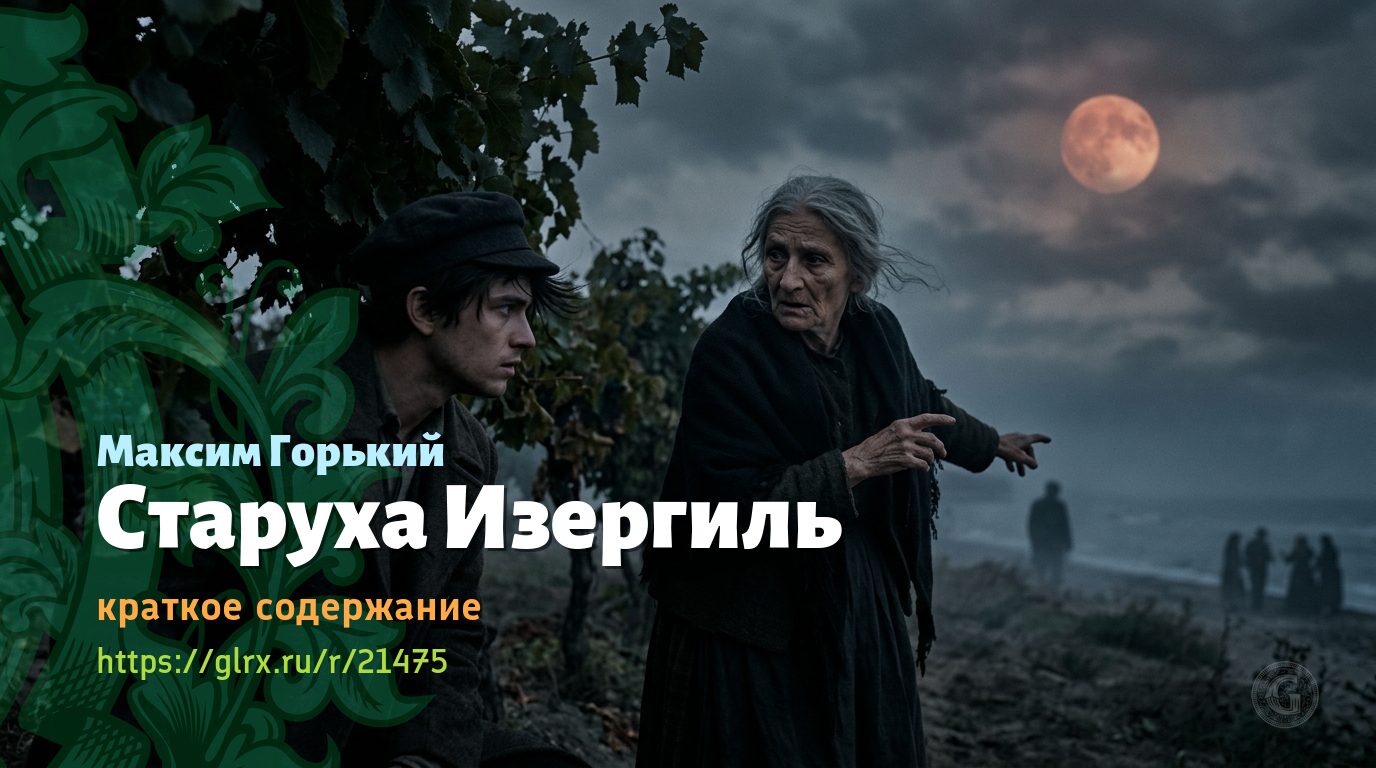
Time has bent the old woman’s body in half, her black eyes have grown dim. Her voice sounds dry, like the cracking of bones. She is surprised by the young man’s reluctance to join in the general merriment. A huge red moon appears in the sky. Cloud shadows drift across the steppe. Izergil points with a trembling hand to a dark shadow and calls it Larra. The narrator sees only an ordinary shadow, but the old woman begins her first story.
The Legend of the Proud Youth
Many centuries ago, a mighty tribe of shepherds and hunters lived in a hot country. During a feast, an eagle swooped down from the sky and carried off a black-haired girl. The men’s arrows fell back to earth, missing their target. The tribe searched in vain for the abducted girl until the memory of her was completely erased.
Twenty years later, the woman returned, exhausted and withered. A handsome, strong young man walked beside her. She told her tribesmen the story of her life in the mountains. The eagle became her husband and the father of this young man. As the bird began to age, the eagle soared high into the sky, folded its wings, and fell to its death on the sharp rocks.
The eagle’s son had a cold and arrogant gaze. He interacted with the elders as an equal, responding only when he wanted to. The people were outraged by this behavior and chased him away. The young man laughed and approached the beautiful daughter of one of the judges. The girl pushed him away out of fear of her father. The rejected young man struck her, stamping on her chest, and she died.
Witnesses to the crime tied up the murderer. They spent a long time devising a fitting execution. A local sage suggested first questioning the criminal about his motives. The young man demanded to be untied and declared that he was taking only what he needed. He refused to pay for his actions with his wits, strength, or life, desiring to preserve his own integrity.
People realized the terrifying extent of his loneliness. The sage pronounced his sentence: the punishment would be absolute freedom. The heavens confirmed the decision with a powerful clap of thunder. The youth was given the name Larra, meaning outcast. He began to live as a free bird, stealing cattle and women from the tribe. Arrows could not pierce his body, protected by an invisible cloak of punishment.
Decades later, Larra voluntarily approached the people. He didn’t defend himself, expecting death. The crowd laughed and refused to kill the enemy. Larra tried to stab himself, but the blade broke on his chest as if it had hit a stone. He slammed his head into the ground, but the earth recoiled from the blows. Larra was left to wander the world forever, eventually turning into a shadow.
The life story of an old woman
Singing from the shore interrupts the narrator’s thoughts. Izergil asserts that only strong people know how to love life. She recalls her wild youth, when she worked as a weaver and sneaked out at night to meet people. She always had enough health for love.
At fifteen, she lived with her mother on the banks of the Byrlad River. There, she met a tall, black-mustached fisherman. They went boating at night. Soon, Izergil grew bored with these secret encounters. A band of Hutsuls operated in those parts. The girl met a red-haired bandit. He was sometimes sad, sometimes ferocious. One day, he struck Izergil, and she bit into his cheek, leaving a deep scar that will last her life.
The abandoned fisherman joined a band of Hutsuls. Both men were later captured by the authorities. Izergil attended their execution in Dobruja. The fisherman went to the gallows pale and weeping, while the Hutsul calmly smoked his pipe. Izergil mourned the red-haired bandit for a whole year. She and other friends of the executed men took revenge on the Romanian who had betrayed the bandits. They burned his farm and all the grain he had harvested.
Izergil then lived in the harem of a wealthy elderly Turk in Scutari. She found life among women incredibly boring. The Turk treated her with respect, but her heart was drawn to his sixteen-year-old son. Izergil fled with the boy to Bulgaria. There, a local woman stabbed Izergil in the chest.
During her long convalescence at the monastery, she was cared for by a Polish woman. This nun’s brother, a small Polish boy, constantly fussed over the sick woman. After recovering, Izergil left with him. The little Turk died of melancholy and an excess of love. Izergil wept for a long time over the body of her young lover.
The relationship with the Pole proved to be torturous. He was cowardly and caustic. One day, on the riverbank, the Pole hurtfully insulted Izergil. The enraged woman picked him up and threw him into the water. She left, never seeing her former lovers again.
Izergil reached Poland. Life forced her to sell herself to save money for her return home. A wealthy nobleman showered her with gold coins, but she expelled him for his unattractive appearance. Her heart was captured by a nobleman with a scarred face who fought for the Greeks. Izergil valued people willing to perform heroic deeds.
Izergil met her last love in Krakow. He was a handsome and arrogant nobleman named Arkadek. The woman was already around forty years old. She resisted his advances for a long time, but eventually gave in. Having gotten what he wanted, the Pole quickly cooled off and began to mock her. Soon, he went to fight against the Russians and was captured.
Izergil decided to save her lover. Disguised as a beggar, she snuck into the village where Polish prisoners were being held. At night, she crawled through the mud. A sentry blocked her path. Izergil pleaded with the soldier to let her through, citing maternal feelings. Her pleas were ineffective. Then she pushed the sick little sentry into a puddle and pressed his face into the mud. The soldier suffocated under the weight of her arms.
Izergil helped Arkadek and his three comrades escape. In the forest, the rescued nobleman haughtily declared, "My queen!" The disappointed woman kicked him and left the Poles forever. She realized it was time to settle down. Izergil left for Galicia, then Dobrudja. A year ago, her Moldavian husband died. Now she whiles away her days among young workers, telling them stories.
The Legend of the Burning Heart
A heavy black cloud rolls in from the sea. Tiny blue lights flicker in the distant steppe. The old woman explains that these are sparks from Danko’s blazing heart. She begins her final tale.
In ancient times, there lived a brave and cheerful tribe. Other peoples drove them deep into the impenetrable forest. They were surrounded by swamps and ancient trees on three sides, and powerful enemies on the fourth. The swampy stench destroyed them one by one. The tribe could not go to battle for fear of violating their ancient covenants. Anguish and terror paralyzed their will. They were ready to join the enemy and accept slavery.
The handsome young Danko urged his tribesmen to stop their fruitless meditations. He suggested they walk through the forest to find a way to the light. The people believed the living fire in the young man’s eyes and followed him.
The journey proved incredibly difficult. The swamps swallowed them, tree roots entangled their legs. Their strength waned, and the tribe began to grumble against the young leader. A terrible thunderstorm erupted. The trees creaked ominously under the cold flashes of lightning. The exhausted people stopped. Ashamed of their weakness, they vented their wrath on Danko.
They accused the guide of failing to lead the tribe and sentenced him to death. Danko reminded them that they had agreed to go but had failed to conserve their strength. The crowd grew even more enraged. They formed a tight circle around the young man.
Indignation flared in Danko’s heart, quickly replaced by deep pity and great love for his tribe. A desire to save the lost lit his eyes with a bright light. His tribesmen assumed Danko was enraged and prepared for a fight. The young man understood their fear. Danko cried out loudly, "What will I do for the people?!"
Then he tore his chest open with his hands. He tore out his flaming heart and held it high above his head. The heart burned brighter than the sun. Great love illuminated the dark forest, forcing the darkness to retreat into the rotten swamps. The astonished people froze like stones.
Danko called the tribe to follow him. He ran forward, lighting the way with his burning heart. Enchanted, the people followed. The forest parted, leaving them behind. The tribe emerged onto a wide steppe, bathed in the rays of the sunset. The grass glistened with rain, the river sparkled gold.
The proud daredevil looked at the clearing, laughed joyfully, and fell dead. The rescued people didn’t notice their leader’s death. Only one cautious man saw the glowing heart next to the corpse. Frightened by something, he stepped on it. The heart disintegrated into a multitude of blue sparks and died out. Since then, these mysterious lights have appeared in the steppe before a thunderstorm.
The story ends. The old woman falls asleep. The narrator covers her withered body and lies down on the ground next to her, reflecting on the great daredevil and the power of human imagination.
You cannot comment Why?