"Time, Forward!" by Valentina Kataeva, summary
 Automatic translate
Written in 1932, the novel covers exactly twenty-four hours of life on a massive Ural construction site during the First Five-Year Plan. The author masterfully conveys the constant movement of people and machines, synchronizing the characters’ internal clocks with the clanking of machinery, transforming a dry industrial process into a tense human drama. The book impresses with its unique cinematic narrative rhythm.
In 1965, director Mikhail Shveitser made a two-part film of the same name based on the work. The film gained fame largely thanks to the poignant music of Georgy Sviridov, whose orchestral theme became an enduring symbol of television news and the primary sonic image of Soviet progress.
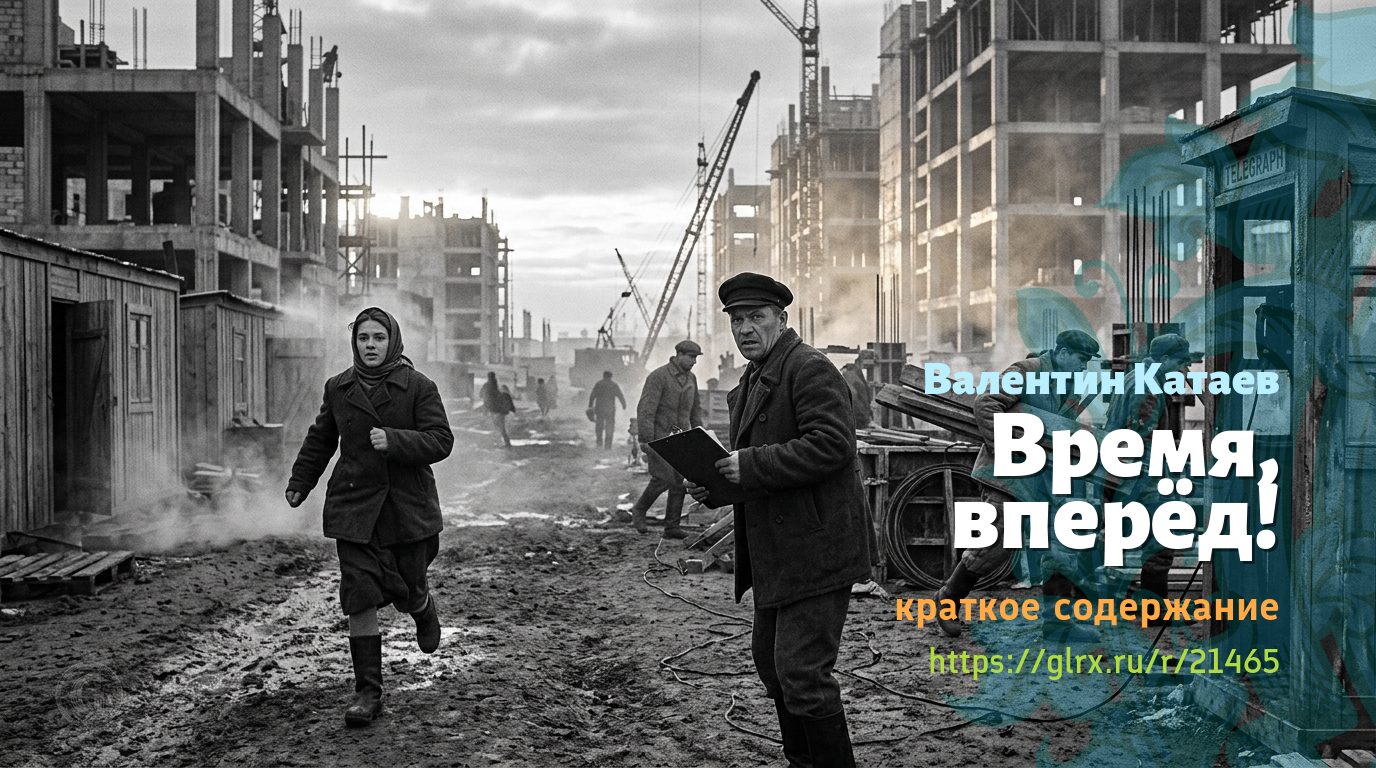
Morning at the construction site and a call from Kharkiv
On a gray, hot morning, the hotel awakens to stunning news. Kharkiv concrete workers completed 306 concrete batches during their shift. Engineer David Margulies, head of the sixth section, quickly crunches the numbers in his head. Until now, two hundred batches had been considered an excellent standard. He realizes the possibility of surpassing this new result. Margulies hurriedly calls the station and orders a call to Moscow. He instructs his sister Katya to find Professor Smolensky and obtain a precise analytical calculation. The frantic speed of the laying must not compromise the strength of the monolith.
Katya takes off running through the streets of Moscow. She sees the golden dome of the Christ the Savior Cathedral being dismantled and the monument to Minin and Pozharsky being moved. Moscow is changing its appearance. Smolensky dictates a recent newspaper article to Katya. A technical detail is revealed: accelerated mixing of concrete is permissible, but it requires the mandatory addition of cement to maintain the strength. Katya relays these figures to her brother over a long-distance phone call.
The arrival of his wife and Zagirov’s escape
The previous evening, Fenya unexpectedly arrives at the home of the short, stocky foreman, Konstantin Ishchenko. His wife traveled several days from Kyiv. She is in the final stages of her pregnancy. The train stops in the middle of the scorched steppe. There’s no real city yet, just tents, wooden barracks, and bottomless pits. Fenya finds a husband on the advice of fellow villagers. Ishchenko is shocked by her arrival, but feels a strong sense of masculine pride in front of his men.
The workers clear a corner, pull on a shawl with pink fringe, and hammer together boards for the newlyweds. Early in the morning, the bustling Fenya runs to wash her dirty clothes and sets off with the local activists to build a crèche. There, carrying heavy boards, she overestimates her strength and becomes ill. With great difficulty, she is carried back to the family barracks, where she lies down on a cot and groans, waiting for her husband.
Far from the noisy playgrounds, among the twisted metal of old cars, the truant Saenko idly plays cards with the trusting Zagirov. Saenko behaves wildly: he shouts homemade poems, has fits, and makes faces. Zagirov gambles away all his savings and his brand-new shoes. Saenko tosses a crumpled piece of paper to his defeated comrade and taunts him viciously. That afternoon, they go for a walk in a green Cossack village. Saenko buys pickles and moonshine from a one-eyed old man.
In a dark barn, surrounded by new pine coffins, Saenko gets the inexperienced Zagirov drunk. The drunk Saenko pulls out a letter from his exiled kulak father, which directly calls for the harm and killing of livestock. Zagirov, with piercing horror, understands Saenko’s alien nature. Despair and fear drive Zagirov forward. He calls his drinking companion a kulak dog, runs out the gate, and runs away, engulfed by the advancing black cloud of steppe dust.
Observations of the construction site and Korneev’s drama
Writer Georgy Vasilyevich suffers from the unbearable heat in a cramped hotel room. He peers through prismatic binoculars at the site and sees an incomprehensible optical puzzle of tiny human figures. A lack of coherence plagues him. ROSTA correspondent Vinkich helps the writer. Vinkich clearly calls objects by their proper names. Excavators acquire the brand names "Marion" and "Busaires." Concrete workers become concrete, tangible characters. The writer begins to clearly discern the language of mechanisms.
Vinkich persuades Georgy Vasilyevich to support the upcoming assault on the Kharkiv record with his authoritative literary voice. Journalists from the traveling editorial office of the Komsomolskaya Pravda newspaper — Kutaysov, Triger, and Slobodkin — are drawing up a five-pronged plan. They assume operational management of the stone quarries, electricity, and water supply. Deputy Construction Manager Georgy Nalbandov has a strong dislike for Margulies. Nalbandov considers the records to be sheer technical illiteracy and a dangerous waste of imported American machinery. Margulies, however, insists on a counter-plan, relying entirely on the rationalization of manual labor.
Nalbandov drives tourist Rai Rup and translator Darley in a long car. They explore the artificial lake created by the enormous Margulies Dam. Rai Rup mournfully reflects on the destruction of pristine nature, the decline of religion, and the demise of patriarchal traditions. The American finds an old, worn-out bast shoe in the green grass and laughs at the contrast between the new Babylon and the peasant footwear. Nalbandov sternly proves the superiority of human genius. Meanwhile, the American, Foma Yegorovich, mentally calculates the currency he keeps in his Chicago account.
Foreman Korneev is suffering from an unbearable personal tragedy. His wife, Klava, is packing her suitcase and heading back to Moscow. She’s dead tired of the steppe winds, chlorinated water, and constant dislocation. Klava urgently wants to take their sick daughter south, to the seaside town of Anapa. Korneev begs her to stay. In the stuffy compartment of an international sleeper car, Klava sobs convulsively, but she doesn’t change her mind. The warning bell rings. The foreman, wearing white slippers, jumps out of the car. The train starts moving. Korneev has no time to mourn. He runs to the warehouse to fight for new barrels of cement for the upcoming record-breaking concrete paving.
A record-breaking assault and a steppe blizzard
At four o’clock, the third shift reports for duty. Just before the start, Ishchenko takes the groaning Fenya in a cart to the maternity hospital. Margulies and Triger had already decided to cover the ground with a solid plank floor. The wheelbarrows no longer slip off the narrow planks but move freely. The speed of delivery increases sharply. The truants, Saenko and Zagirov, are absent from laying crushed stone. Journalist Triger picks up a shovel and does the work of two. Foreman Mosya Vainshtein blows his whistle. The drum of the concrete mixer tips over with unprecedented frequency. Korneev checks the time on his watch, and the timekeeper makes notes.
It starts to rain. The wooden platform is covered in cement mud, and people slip. Writer Georgy Vasilyevich and Vinkich grab a canvas fire hose and wash away the sticky slush with a powerful stream of water. Following the rain, a terrible hurricane hits. The wind tears down telephone wires, blows off roofs, and rolls empty barrels. A huge elephant escapes from the circus, dragging a torn-off pole behind it. The elephant collides nose to nose with a steam excavator at the bottom of the excavation pit.
The high-quality Volsk cement is running low. The poet Slobodkin, shouting obscenities, drives a shunting locomotive to the warehouse. Korneyev forces the warehouse foreman to release the material. The loaded train stops right at the crossing, completely blocking the way for heavy wheelbarrows. The platforms are urgently uncoupled. Suddenly, the water stops flowing from the hoses. The mixer stops. An enraged Margulies jumps into the deep gangway. It turns out that reporter Semechkin ordered the pipes to be dismantled to install a water meter. Margulies calls for armed guards. A shooter arrests the journalist and locks him in a dark fire shed.
Worker Smetana pushes a wheelbarrow across the railroad tracks. The cars suddenly shift under the force of the wind. The buffers collide with a crash. Smetana suffers a severe open injury to his left hand. Artist Shura Soldatova takes him to a bright outpatient clinic. Zagirov runs from the village on foot, grabs Smetana’s discarded shovel, and stands on the crushed stone.
Results of the shift and the birth of a son
Despite the wind and losses, the speed of concreting continues unabated. Floodlights flicker on in the twilight. A crowd of workers counts the thundering concrete mixes in unison. Trigger methodically thrusts his shovel into a mountain of stone. Midnight approaches. Ishchenko’s shift is officially over. Korneyev loudly announces the count: four hundred and one mixes. The Kharkiv achievement is just a hair’s breadth away. Ishchenko, in utter despair, abandons his work. Nalbandov smiles slyly into his black beard. To the brassy strains of a brass band, the first shift of snub-nosed foreman Khanumov ceremoniously arrives.
Margulies imperiously stops the departing people. He calculates the exact downtime due to Semechkin, the warehouse, and Smetana’s accident. The total comes to thirty-three minutes. Margulies orders the engine to be started and the legal time to be worked off. Ishchenko, roaring with unexpected joy, ushers the people back. Half an hour later, the counter shows 429. Mosya, wild with delight, tears up the old poster. Shura Soldatova nails a new roll to the boards, announcing the victory of the Kuznetsk shock workers.
Khanumov demands his men be allowed to use the concrete mixer. He intends to do 500 batches at once. Margulies strictly limits the quota to four hundred. Further acceleration without laboratory testing threatens to collapse the multi-ton slab. Khanumov tears off his prize watch and new shoes. He threatens to leave the construction site forever. Nalbandov publicly takes Khanumov’s side, loudly accusing Margulies of opportunism. Margulies writes a note with a clear order regarding the minimum mixing time. Khanumov picks up the discarded items and reluctantly complies.
A quiet night falls before dawn. American Foma Yegorovich reads in the latest issue of an illustrated magazine about the total collapse of a Chicago bank. The directors have committed suicide. The American’s twenty thousand dollars have vanished without a trace. Foma Yegorovich drinks cognac. In a wild hysteria, he trashes the hotel room, breaks chairs, tramples the glossy pages, and falls delirious onto the iron bed. Rai Roop looks from the terrace at the bright lights of the nighttime construction site and mournfully contemplates his approaching death.
Denouement
The chronicle jumps forward seven days. Margulies, Mosya, and the journalists gather in the damp basement of a construction laboratory. A steel press crushes cubes of fresh concrete. The pressure gauge needle steadily climbs. The concrete easily withstands a colossal pressure of 120 kilograms per square centimeter. Margulies has won. Nalbandov learns the results over the work phone. He crumples up the completed denunciation and files a statement declaring his own illness. Mosya and Georgy Vasilyevich send a telegram with the names of the true heroes to distant Moscow.
Ishchenko looks through the sparkling hospital window at the baby held by a smiling Fenya. Journalist Vinkich joyfully waves a fresh newspaper. At the Chelyabinsk Tractor Plant, concrete workers have just completed 504 batches. The grueling socialist competition continues.
- Валентин Серов: русский портретист и импрессионист
- Американские скульпторы (1850 — настоящее время)
- Мелькиты во время крестовых походов
- История Христианства, от 30 года н.э. по настоящее время
- Русская и советская культура во время первой мировой войны
- Лучшие жанровые художники: 1600-настоящее время
- Лучшие исторические художники: 1400-настоящее время
- Лучшие художники-пейзажисты: с 1600 г. по настоящее время
- Лучшие художники-портретисты: с 1400 г. по настоящее время
You cannot comment Why?