A summary of "Vampire Hunt" by Elena Topilskaya
 Automatic translate
This St. Petersburg detective story with mystical elements, published in 2003, is part of a multi-volume series about district prosecutor Maria Sergeevna Shvetsova. Elena Topilskaya is a former investigator herself, and her books are distinguished by their rare professional authenticity in describing investigative routines, while legal conflicts are analyzed with impeccable precision.
A series about Masha Shvetsova
"Vampire Hunt" is part of the "Secrets of the Investigation" series, which includes over twenty books, and is one of the earlier installments. Other books in the series include "Sheep’s Skin" (2003), "Investigative Mania" (2004), "Dark Forces" (2005), and others. It was based on this series that Topilskaya wrote the scripts for the first eight seasons of the popular television series "Secrets of the Investigation."
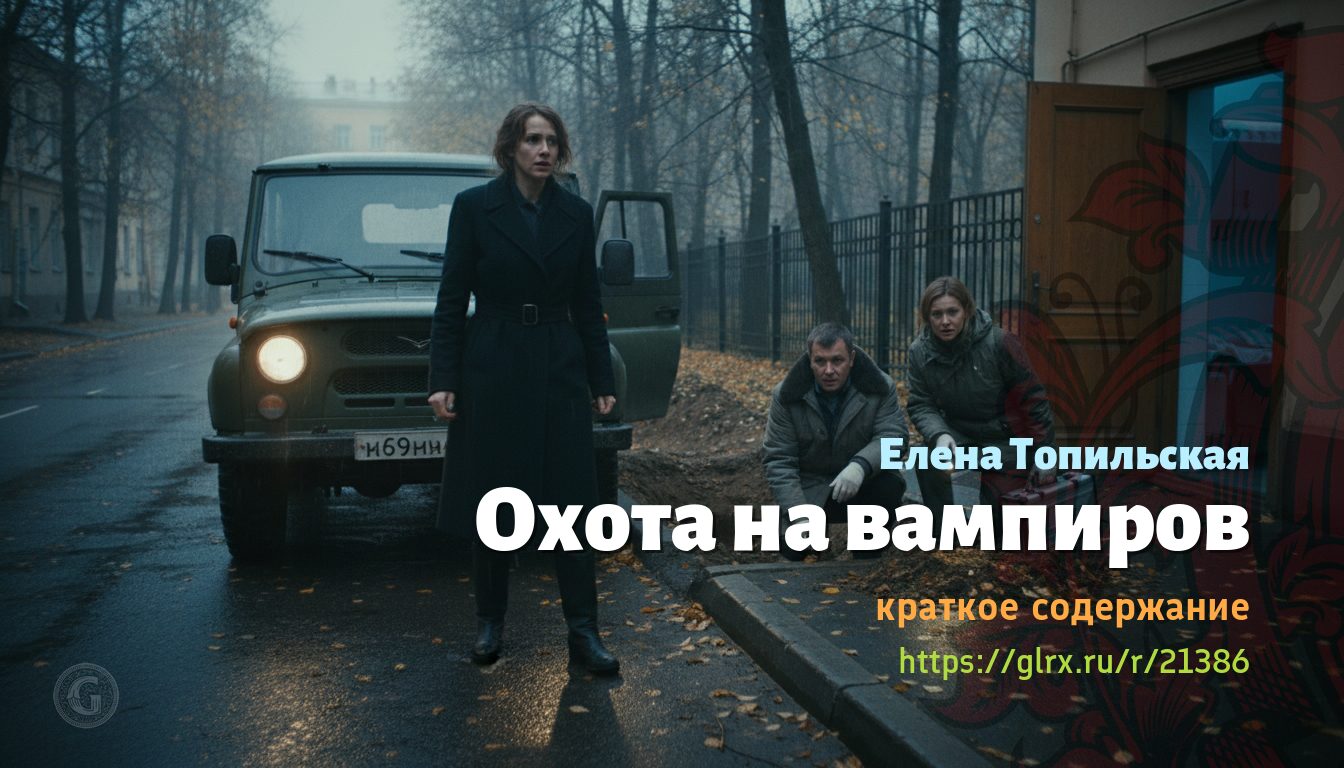
An ordinary autumn day for investigator Masha Shvetsova begins unsuccessfully: on her way to work, she stumbles into a dark spot near an excavated sewer trench in the yard of her own home. Her mood quickly sours, and for the rest of the day, Masha, sitting down to write an indictment with a promised deadline "word for word and day for day," tries not to snap at her colleagues. Her colleague Gorchakov, however, manages to notice that the stain on her boot looks more like blood than fuel oil.
That evening, prosecutor Vladimir Ivanovich reports that workers have discovered a body in that very ditch. Shvetsova goes to the scene along with an unfamiliar forensic expert, Georgy Georgievich, and a forensic scientist. It turns out the deceased is a man in his thirties or thirty-five, dressed all in black, wearing luxurious high-heeled boots, and completely naked, despite the cold. The examination proceeds under difficult conditions: the battery in the official UAZ is dead, the radio is broken, and the expert’s cell phone goes dead.
When the workers lift the body and Georgy Georgievich begins examining it in the fading light of the headlights, a horrific scene emerges: a planed wooden stick about four centimeters in diameter protrudes from the left side of the corpse’s chest — a stake driven precisely toward the heart. Long, curled nails, tangled hair, a dark, wrinkled face covered in ulcers, and bared teeth complete the picture. The doctor adds that the stake is made of aspen.
Night in the morgue
They continue the examination right at night, heading to the morgue without waiting until morning. Shvetsova admits she can’t wait until the autopsy. In the autopsy room, with the lights dimming, and then using a blue OLD-41 ultraviolet lamp and a candle, the experts discover that the corpse’s teeth and gums retain traces of blood, and the pupils and canines glow red under the ultraviolet light — a phenomenon for which Georgy Georgievich cannot provide a scientific explanation.
A drunken orderly who grew up in the Carpathians, appearing in the dark, explains to his colleagues with the unwavering conviction of a Carpathian: the stake was an aspen one, and it hit the heart dead on, otherwise the dead man would have risen during the night. According to him, in his native land, entire villages "would become ghouls" — one would turn into a vampire, begin sucking the blood of relatives, and the farm would fall into ruin. The orderly’s stories, simultaneously convincing and terrifying, make even the most skeptical investigator shudder.
Two more bodies with distinctive puncture wounds on their necks are discovered in the morgue corridor: a middle-aged man in a padded jacket and a young woman in faded jeans. According to the orderly, they are victims of a "vampire." The examiner notes that the bodies have been drained of blood. Realizing that something is operating near her home and her child, Masha begins to seriously consider where to evacuate her son.
The investigation is underway
Returning to the Gorchakovs’ in the early morning — having stopped home on the way to make sure her son was asleep — Masha discusses her plan of action with her friend and colleague, Alexei Gorchakov. The case is unfolding: a mysterious corpse with a stake in the chest and human blood in the stomach; two bloodless bodies with marks on their necks; attacks on living people with the same intent; an old man named Bendery and his neighbor with bite marks; a strange drunkard from the morgue, allegedly found dead in the woods long ago, only to reappear alive. And against this backdrop is the victimized forensic scientist, whom Masha feels indirectly responsible for what happened.
At the same time, the novel unfolds a medical case: Shvetsova investigates the death of a maternity hospital patient caused by the drunken anesthesiologist Pinchuk, a professor and doctor of science. Numerous attempts at intubation while intoxicated, a damaged trachea, death on the operating table, and then falsification of medical records, tracheal severance during an autopsy, and sophisticated substitution of test results. Shvetsova secures an exhumation, proves intent, and takes the case to court — only to see Pinchuk immediately released under an amnesty.
Tone and atmosphere
The novel exists in a constant tension between the mundane and the inexplicable. Masha, a realist and skeptic who has spent her entire life convincing herself that mysticism doesn’t exist, discovers how ancient superstitions rise from the depths of ancestral memory precisely when logic fails. Topilskaya’s humor remains dry and self-deprecating even in the darkest scenes: Masha’s discussions of how to classify a murder "associated with vampirism" and what statute to use for prosecution sound completely serious.
- "New Painting" with the latest works of Peter Shvetsov presented ANNA NOVA
- "White, Black, Scarlet…" by Elena Topilskaya, summary
- "Heroes Are Not Killed" by Elena Topilskaya, summary
- "Investigative Mania" by Elena Topilskaya, summary
- "The Life of the Honest and the Dishonest" by Elena Topilskaya, summary
- “House Arrest” by K.A. Holt
You cannot comment Why?