Mikhail Lermontov’s "Mtsyri," a summary
 Automatic translate
This book is a classic work of romantic literature, written in 1839. The plot is based on the true story of a young highlander, which the author heard while wandering along the old Caucasian roads. The boy grew up among strangers, retained a rebellious spirit, and attempted to return home.
Monastery walls
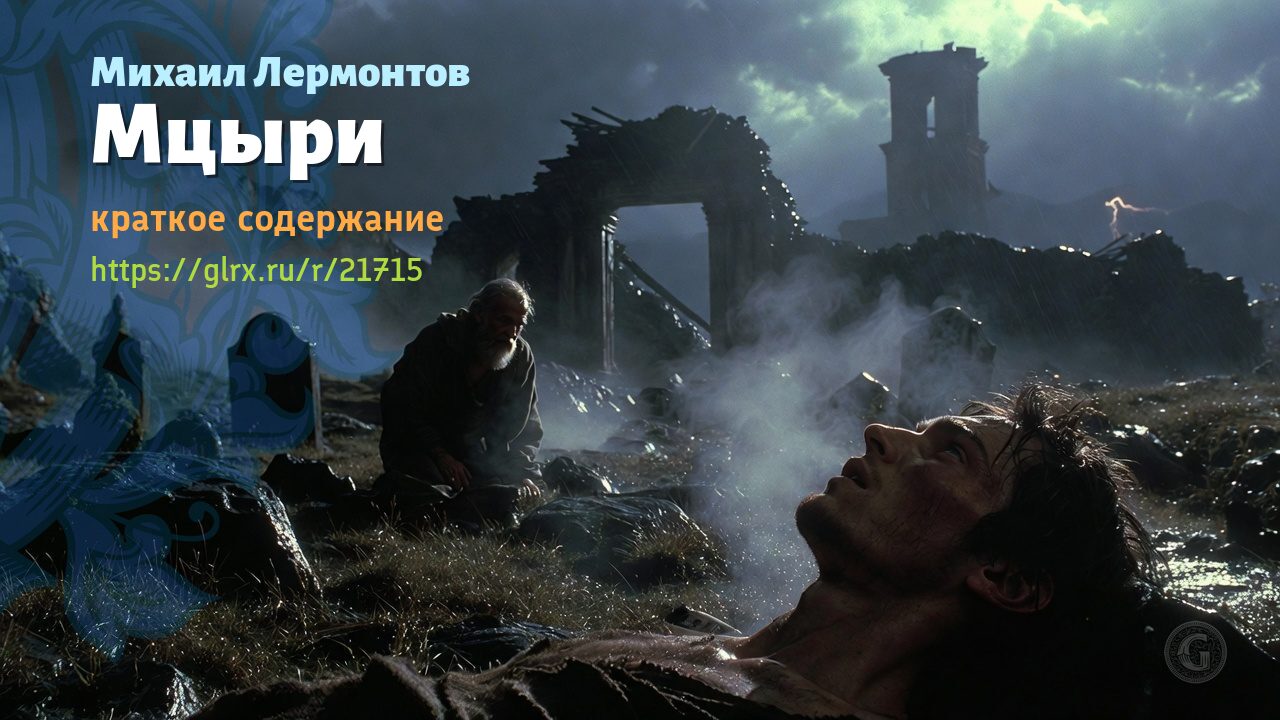
The events unfold where the Aragvi and Kura rivers converge. A monastery once flourished on this site. Now, a casual traveler can see only the ruins of a gate, towers, and a collapsed church vault. A lone gray-haired old man tends the tombstones. One of the inscriptions proclaims the surrender of the Georgian people to the protection of their powerful northern neighbor for the sake of peace and grace.
One day, a Russian general was passing through the mountains toward Tiflis, carrying a six-year-old child captive. The boy couldn’t survive the long journey and fell gravely ill. The child grew up timid and wild, like a mountain chamois. The little one refused food, dying quietly and without a groan. A compassionate monk took pity on the captive and nursed him back to health.
At first, the rescued man avoided people, wandered alone, and yearned for his native land. Gradually, he mastered a foreign language, was baptized, and prepared to take monastic vows. Suddenly, one autumn night, the hero disappeared. The search lasted three days. The fugitive was found unconscious in the steppe, emaciated and pale. The young man refused to answer questions, his strength fading. An old monk came to the dying man with a plea, after which the sick man gathered his remaining strength and began his confession.
The beginning of confession
The sick man begins his monologue with gratitude. He wants to unburden his soul, though he doesn’t hide his anger from others. Mtsyri regrets only that he lived too short a life and spent those years in captivity. The hero’s only burning passion was the thirst for freedom. This dream beckoned him from the stuffy cells to the world of battle, where people are as free as eagles. He confesses his feelings to heaven and earth, refusing to ask for forgiveness.
The young man turns to the monk who saved him. The hero grew up within dark walls, a child at heart and a prisoner of fate. He never uttered the sacred words "father" and "mother." Observing others, the hero saw their families, while he didn’t even have the graves of his ancestors. It was then that he swore an oath to at least once press his burning chest to the chest of a loved one. Now those dreams are irrevocably lost.
The grave doesn’t frighten the dying man. A cold, eternal silence reigns there, but he regrets parting with life. The young man asks the old man about memories of his wild youth. The monk himself has lived and has a past, whereas the novice was deprived of the joys of youth. The hero recounts the three days he spent in freedom. These brief moments proved more intense than his entire previous life.
Caucasian Memories
Having escaped from the monastery, the fugitive saw lush fields and hills crowned with dense trees. In the distance, the gray, unwavering Caucasus gleamed through the fog. At the sight of the mountains, the young man’s heart began to beat more steadily. Memory began to return images from his early childhood. He recalled his native village, spread out in the shadow of a gorge, the evening hum of herds, and the distant barking of dogs.
The hero’s mind conjured up the faces of the dark-skinned old men sitting in the moonlight on the porch of his father’s house. He recalled the gleam of their mounted scabbards, the clank of his father’s chainmail, and his proud, unwavering gaze. His sisters and their songs above the cradle appeared before his eyes. The young man recalled playing on the golden sand by the stream, watching the swallows fly before the rain.
The escape took place during the worst of the night storm. While the monks prayed in fear at the altar, Mtsyri ran out into the darkness. He was glad to embrace the storm, catching lightning with his hands and greedily breathing the fresh forest air. Tired from running, the fugitive lay down in the tall grass. The storm died down, giving way to peace. A jackal screamed in the distance, a snake slithered between the rocks, but the hero felt no fear, becoming like a wild beast himself.
At the mountain stream
At dawn, the fugitive found himself at the edge of an abyss. Below, a mountain stream roared, eternally at odds with the rocks. Nature around him blossomed in the sun’s rays. Plants retained drops of the night’s tears, grape vines twined between the trees. Birds sang, welcoming the new day. The sky was strikingly clear. The novice sank into this blueness until the midday heat forced him to seek water.
Clinging to the bushes, the fugitive began to descend the rocks toward the river. Rocks fell, leaving a trail of smoke. Having quenched his thirst, he heard light footsteps and a woman’s voice. The young man instantly hid in the bushes. A young Georgian woman, carrying a jug on her head, was walking down the narrow path toward the shore. The girl walked lightly, throwing back the folds of her long chador.
The summer heat cast a golden shadow over her face. The darkness of her eyes was so deep that the young man’s thoughts became confused. He remembered only the ringing of a pitcher filling with water and a soft rustling sound. When his consciousness cleared, the Georgian woman had already left. She walked gracefully under her burden, like a poplar. The girl disappeared into the saklya, from which blue smoke rose. The hero deliberately remains silent about his melancholy, hiding his sorrow within.
Wandering in the Dark
The exhausted hero fell asleep in the shade. In his dreams, he again saw the image of the Georgian woman. Awakening in the night, the young man continued on his way. The moon shone in the sky, and the peaks of the snowy mountain range glittered in the distance. A single light burned in the familiar saklya. Mtsyri wanted to come closer, but resisted the urge. His only goal was to return to his native land.
Having suppressed his hunger, the fugitive pressed on. Soon the mountains disappeared from view. The young man lost his way, finding himself in a dense forest. Thorns and ivy blocked the path. The trees grew denser, and the darkness stared at him with millions of black eyes. The hero began to climb the trees, but saw only an endless, jagged forest. Falling into a frenzy, he fell to the ground and burst into tears.
Even at that moment, the novice didn’t want human help. He felt alien to them, like a steppe beast. Mtsyri swears he would tear out his tongue if it uttered even a single cry for help. As a child, the hero had never known tears, but here he wept shamelessly, hidden from prying eyes by the darkness.
Mortal combat
Suddenly, a desert visitor — a mighty leopard — sprinted out into the moonlit clearing. The predator gnawed on a raw bone, squealing joyfully and wagging its tail. The beast’s fur shone silver. Mtsyri grabbed the horned branch, expecting a fight. The young man’s heart burned with bloodlust. He felt he could become one of the greatest daredevils in the land of his fathers.
The snow leopard sensed the enemy, let out a drawn-out howl, and began digging in the sand with its paw. The predator prepared to leap, but the fugitive forestalled it. A sturdy branch sliced the beast’s broad forehead. The snow leopard groaned and lunged at its opponent’s chest. The young man managed to plunge his weapon into the predator’s throat. Entwined like a pair of snakes, the fighters fell to the ground.
The youth glowed and screamed, forgetting human words. A wild cry erupted from his chest. The enemy began to weaken, having crushed the victor for the last time. The leopard’s pupils flashed menacingly, then closed in eternal sleep. The beast met death face to face.
Return to prison
Deep claw marks remained on the victor’s chest. Gathering his remaining strength, the young man trudged further through the dense forest. Finally, he emerged from the woods. A village appeared in the distance, and a vague rumble echoed through the valley. Looking around, Mtsyri recognized the familiar outlines with horror. Before him stood the very monastery from which he had fled.
Realization struck the hero like a heavy blow. All his suffering had been in vain. The monastery bell rang in the distance. Since childhood, this ringing had driven away vivid visions of his dear family and the wild freedom of the steppes. The young man dimly realized that the path to his homeland was forever closed.
Mtsyri compares himself to a prison flower. Growing up in the darkness of damp slabs, it awaited life-giving rays. When a kind hand carried the flower to the rose garden, the first rays of dawn scorched it. So too, the scorching daylight incinerated the exhausted fugitive. The earth breathed fire. A snake with a yellow back, like an inscribed blade, slithered across the sand.
Vision at the bottom of the river
Despair sapped the fugitive’s last strength. The dying man lay in a death-daze. He felt as if he were resting on the damp bottom of a deep river. A cold stream gurgled and flowed into his chest, quenching his eternal thirst. Wave after wave pressed against wave, and the sun shone sweeter than the moon through the crystal water. Schools of colorful fish played around him.
One of the golden-scaled fish swam closer. Its green eyes were sad and tender. Its silvery voice whispered strange words. The fish beckoned the young man to remain at the bottom, promising coolness, a comfortable life, and the company of its sisters. It sang of its love for him, offering a soft bed of water. The young man listened to this voice until the divine light faded from his eyes.
The Hero’s Testament
Concluding his confession, Mtsyri tells the old man that he doesn’t care whether his words are believed. The youth’s only sorrow is that his body will rot in a foreign land. No one will pay any sorrowful attention to the story of his bitter torment. The flame that lived within his chest has burned through its prison and is ready to return to the Creator.
A dying man asks to be taken to a garden before his death, to a place where two white acacia bushes bloom. The grass there is thick, and the air is fresh and fragrant. From this place, the Caucasus Mountains are visible. The hero hopes that his native mountains will send him a farewell greeting with a cool breeze. He will imagine a brother or friend wiping the sweat from his face and softly singing about his beloved country. With this bright thought, the restless spirit is ready to fall asleep forever, without cursing anyone.
You cannot comment Why?