A Hunter’s Sketches by Ivan Turgenev, summary
 Automatic translate
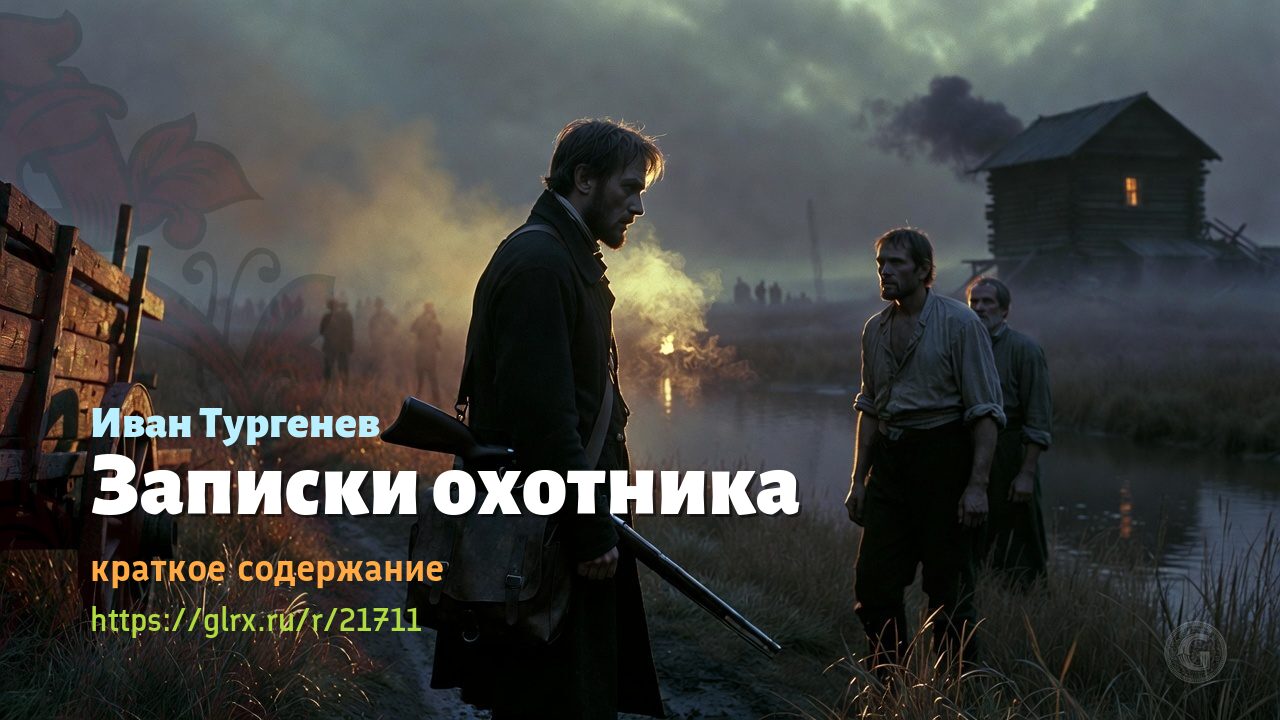
The work consists of a series of essays, united by the figure of a hunter-narrator. The book was created in 1852. For the first time in Russian literature, peasants are depicted as complex, profound individuals with a rich inner world, which stands in stark contrast to the institutionalized cruelty of serfdom. In 1937, director Sergei Eisenstein made the film "Bezhin Meadow" based on one of the stories. The film was lost, and only a few stills survive. In the 1970s, Soviet studios adapted several other stories from the series for the screen.
First meetings on the road
The story is told from the perspective of Pyotr Petrovich. Wandering through the provinces with a gun and his faithful companion, Yermolai, he observes the lives of different classes.
In the story "Khor and Kalinych," a hunter meets two peasants belonging to the landowner Polutykin. Khor is a practical, wealthy realist who has established a solid farm. Kalinych is a dreamy idealist with a keen sense of nature. The two characters complement each other.
The story "Yermolai and the Miller’s Wife" follows. The hunters spend the night at the miller’s, where Pyotr Petrovich recognizes his wife, Arina. She had previously served as a maid to the despotic mistress Zverkova. The mistress ruined Arina’s life by cruelly punishing her for her secret love for her footman, Petrushka.
Near the "Raspberry Water" spring, the narrator listens to old Tuman. The former butler recalls the eccentric count of Catherine the Great’s time. Nearby sits the peasant Vlas, whose life has been shattered by the heavy tax and the heartlessness of his young heir.
Confessions and dramas
In a provincial town, doctor Trifon Ivanovich shares his personal tragedy. The story "The Provincial Doctor" describes the physician’s hopeless attempts to save the gravely ill Alexandra Andreyevna. Before her death, the girl confesses her love to the doctor, wishing to experience this joyful feeling at least once.
Visiting the landowner Radilov, the hunter sees a man grief-stricken after the death of his wife. Radilov lives with his elderly mother and sister-in-law, Olga. A week later, Radilov suddenly runs away with Olga, leaving his mother alone.
"The Single-Estate Ovsyanikov" introduces the reader to Luka Petrovich, a sensible old man. Ovsyanikov criticizes the arbitrary rule of the old-time landowners and the ostentatious, empty education of the new gentry. Luka Petrovich lives the old-fashioned way, maintaining his dignity.
In the story "Lgov," a hunter, along with Yermolai, a local resident named Vladimir, and an old peasant nicknamed Suchok, set out to shoot ducks. Suchok has held numerous ridiculous jobs at the whim of his masters, including stints as an actor and a fisherman. Their leaky boat sinks in shallow water, and the heroes barely make it to shore.
Children’s fears and the laws of the forest
Lost at night, the narrator comes to a campfire in the story "Bezhin Meadow." Five peasant boys are herding horses. Fedya, Pavlusha, Ilyusha, Kostya, and Vanya tell terrifying tales of mermaids, wood spirits, and water spirits. Pavlusha displays rare courage by galloping into the darkness after the dogs. Soon, the brave boy dies in a fall from his horse.
"Kasyan of the Beautiful Sword" describes an encounter with a dwarf cultist. Kasyan rejects the killing of animals, seeing every living creature as a divine being. The dwarf possesses mystical authority among the animals and carefully guards the girl Annushka.
Landowner Arkady Penochkin from the story "The Bailiff" is considered a civilized man. In reality, he entrusts the management of his estate to the bailiff Sofron. Sofron robs the peasants, conscripts their sons without waiting in line, and impoverishes those he deems undesirable, all while remaining unpunished.
"The Office" depicts the workings of Mrs. Losnyakova’s estate. The chief clerk, Nikolai Yeremeyev, weaves intrigues and takes bribes from merchants. Yeremeyev ruins the happiness of the clerk Pavel by banishing his beloved Tatyana to the barnyard.
The forester Foma, nicknamed Biryuk, lives in poverty with his two children. The peasants hate Biryuk for his incorruptibility. A hunter witnesses Foma catching a hungry peasant chopping down a tree. In despair, the peasant scolds the forester, and the stern Biryuk unexpectedly releases the poor man.
Cruelty and Art
"Two Landowners" paints portraits of their neighbors. General Khvalynsky despises the petty gentry and is obsequious to his superiors. Mardariy Stegunov is a hospitable old man. Stegunov brutally whips his servant Vasya, softly uttering words as the blows fall. Vasya accepts the punishment as his due.
A horse fair is described in Lebedyan. Pyotr Petrovich buys a horse from the sycophantic old man Chernobai. The purchase turns out to be lame. It’s impossible to get the money back. Also present is the retired lieutenant Khlopakov, who lives off his wealthy patrons through empty jokes.
The modest woman in the story "Tatyana Borisovna and Her Nephew" suffers from her ward’s egotism. Her nephew, Andryusha, who fancies himself a great artist, lives at her expense. Andryusha behaves insolently, scaring away all the old friends of the house.
The story "Death" explores the Russian people’s calm attitude toward death. The peasant Maxim, crushed by a tree, methodically settles his debts before his death. The consumptive intellectual Avenir Sorokoumov fades away in poverty, maintaining a good spirit until his last breath.
A competition is taking place in the tavern in the village of Kolotovka ("The Singers"). A Zhizdrinsky tradesman sings skillfully and cheerfully. Factory worker Yakov Turok sings a sad song with incredible sincerity and power, bringing the audience to tears. Yakov wins, but that evening he drinks himself into oblivion.
Broken destinies
Landowner Pyotr Petrovich Karatayev tells the story of his love for a serf girl, Matryona. Karatayev kidnapped Matryona from her cruel mistress. The mistress launched legal proceedings. Matryona voluntarily surrendered to the authorities to save her beloved. Karatayev lost his estate and became a drunkard in Moscow.
A bystander in a birch grove ("Rendezvous") witnesses a couple’s breakup. The peasant woman Akulina weeps sincerely as she gives a bunch of cornflowers to her lover. The spoiled footman Victor carelessly tosses the flowers aside, dismissively rejecting the girl in favor of a trip to St. Petersburg.
While visiting a wealthy landowner, the hero spends the night in the same room as Vasily Vasilyevich ("Hamlet of the Shchigrovsky District"). Vasily confesses his own insignificance. His in-depth study of German philosophy abroad has detached him from real life. Vasily acknowledges his unoriginality and voluntarily retreats into the shadows.
"Chertopkhanov and Nedopyuskin" is the story of the friendship between the impoverished nobleman Pantelei Chertopkhanov and the meek Tikhon Nedopyuskin. Pantelei defends Tikhon from ridicule at the reading of his will. The two characters move in together. Chertopkhanov lives with a gypsy woman, Masha, and behaves provocatively toward his neighbors.
Loss and humility
"The End of Chertopkhanov" concludes the proud nobleman’s story. Masha leaves him forever. Then Nedopyuskin dies. Chertopkhanov’s only consolation is his magnificent horse, Malek-Adel. The horse is stolen during the night. Chertopkhanov finds a similar horse at a fair. Later, he realizes he made a mistake and bought someone else’s nag. Unable to bear the shame, Panteley kills the horse and soon dies himself.
The hero of the story "Living Relics" meets the former beauty Lukerya. The girl fell from the porch and became paralyzed. Lukerya has been withering away in a barn for seven years. She rejects pity, experiences mystical dreams, sings songs, and humbly accepts her fate. Lukerya dies in the autumn, hearing bells ringing from the sky.
During a nighttime trip for shot ("It’s Knocking!"), the hunter and coachman Filofey hear the clatter of wheels. A cart full of drunken peasants overtakes them. The travelers prepare to die at the hands of robbers. A huge peasant simply asks for two rubles for a drink and rides off. Filofey rejoices at his lucky escape.
The essay "Forest and Steppe" concludes the book with a lyrical description. The hunter extols the beauty of nature at different times of the year. Spring sunrises, July heat, autumn fogs, and winter frosts merge into a single picture of his homeland.
The unfinished fragments describe a meeting with the reformer Yevgeny Ladygin. Ladygin wants to restructure the peasants’ lives by mechanically applying new methods. The peasants complain of pointless interrogations and unreasonable demands. The final fragment ends with a description of the pedantic German manager.
You cannot comment Why?