A summary of "Perfume:
The Story of a Murderer" by Patrick Süskind
 Automatic translate
The novel "Perfume: The Story of a Murderer" was written by Swiss novelist Patrick Süskind in 1985. This work is a fictional biography of the genius perfumer Jean-Baptiste Grenouille, who possesses a perfect sense of smell but lacks his own human scent. The narrative centers on the phenomenology of perception, the ways in which scents emotionally subjugate people, and the genius’s total alienation from society.
In 2006, German director Tom Tykwer successfully adapted the novel into a film.
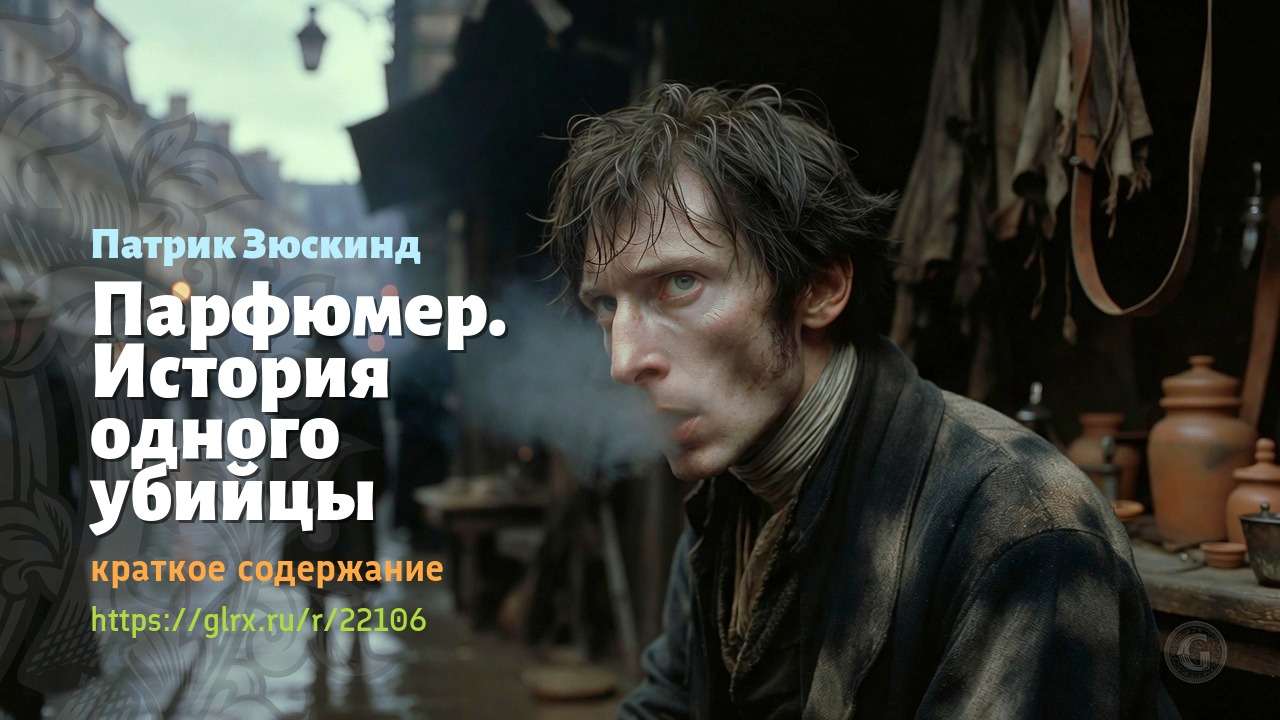
Birth and childhood in Paris
Jean-Baptiste Grenouille was born on July 17, 1738, in Paris, in the stinking Cimetière des Innocents, where his mother sold fish. The woman threw the newborn baby under a table among bloody entrails. However, the child screamed, attracted the attention of passersby, and was rescued. Grenouille’s mother was found guilty of infanticide and executed on the Place de Grève.
The infant passed through several wet nurses, each of whom abandoned him due to his excessive appetite. The wet nurse, Jeanne Bussy, brought the child to Father Terrier at the monastery of Saint-Merri, claiming the boy was possessed by the devil because he had no human scent at all. The monk attempted to disprove the superstition, but, frightened by the intent, searching gaze of the infant’s nostrils, he considered him a stranger and took him to Madame Gaillard’s asylum.
Madame Gaillard, deprived of her sense of smell and feelings due to childhood trauma, treated her pupils with dispassionate fairness. The other children immediately sensed Grenouille’s unusual nature, shunned him, and even tried to strangle him. The boy survived thanks to his incredible unpretentiousness, reminiscent of a tick lurking in anticipation of prey. He began to speak late, learning only the names of specific odorous objects. By the age of six, Grenouille remembered hundreds of thousands of specific scents and could combine them in his imagination.
At the age of eight, when the monastery stopped paying, Madame Gaillard gave Grenouille to the tanner Grimal for fifteen francs. In the tannery, the boy performed the hardest and most dangerous work, enduring contact with toxic solutions. After surviving anthrax, he retained a strong immunity, which increased his value to his master. Grimal began to allow him time to stroll around Paris.
Studying with Baldini
During the celebratory fireworks display on September 1, 1753, Grenouille caught the delicate aroma of a young red-haired girl peeling plums on the Rue de la Marais. Wanting to fully absorb her fragrance, he strangled her, tore off her clothes, and inhaled her scent until it evaporated. This event set the course for his life — to become the greatest perfumer of all time.
Soon, Grenouille found his way into the home of the renowned perfumer Giuseppe Baldini, delivering goatskins. The young man demonstrated his ability to reproduce and improve the fashionable "Amour and Psyche" perfume, created by Pélissier’s competitor, without formulas. Baldini bought Grenouille from Grimal for twenty livres. That same night, the drunken tanner fell off the embankment into the Seine and drowned.
Grenouille’s work brought Baldini’s firm immense fame and fortune. The young man developed hundreds of new recipes, and the old master recorded them in books, claiming them as his own discoveries. In return, Grenouille learned the professional language of perfumery, how to use scales, measuring cylinders, and distillation techniques. However, attempts to extract essential oils from inanimate objects in an alembic failed. A serious illness nearly killed the young man, but he recovered after learning from Baldini about other methods of extracting fragrances in the south of France.
Seven years of seclusion
In the spring of 1756, Grenouille received his apprentice’s charter and left Paris, swearing to Baldini never to return to the capital or divulge his recipes. That same night, Baldini’s house on the Pont du Change collapsed into the river, taking the old perfumer and his formula book with him.
Leaving Paris, Grenouille developed a profound aversion to human odor. He avoided cities, traveled at night, and sought out places of utter solitude. In August 1756, he reached the summit of the extinct volcano Plon du Cantal in Auvergne. At an altitude of two thousand meters, in a deep stone adit, he spent seven years. Grenouille ate lizards, drank seeping water, and indulged in inner fantasies, creating vast castles of scents in his imagination.
His seclusion was interrupted by a nightmare: in a dream, Grenouille realized he possessed no scent. After examining his belongings and body, he confirmed the absence of his own scent. The horror of this emptiness drove him to leave the mountain and return to the people.
Experiments in Montpellier
Descending from the mountains, the feral Grenouille found himself in the care of the Marquis de la Taillade-Espinasse in Montpellier. The Marquis used him to prove his theory about the pernicious effects of a "lethal earth fluid." After cleansing procedures, a diet, and a bath, Grenouille was dressed in a custom-made suit.
In the laboratory of perfumer Runel, Grenouille synthesized the first artificial human scent using cat litter, a rotten egg, cheese, and essential oils. After applying this mixture, he noticed that passersby no longer shyed away and began to perceive him as a fully-fledged person. He later created several different fragrances for different situations. Having received money from the Marquis, Grenouille secretly left Montpellier.
Enfleurage training in Grasse
In the spring of 1765, Grenouille arrived in Grasse, the center of perfume production. In a garden outside the city walls, he caught the delightful scent of fourteen-year-old Laura Richis, daughter of the Second Consul, Antoine Richis. This scent resembled the fragrance of his first victim in Paris, but was even more subtle. Grenouille decided to wait two years for the girl to mature, collect her scent, and use it to create a fragrance that would captivate the hearts of men.
He found work as a junior apprentice in the workshop of the widow Arnulfi, where her lover, Dominique Druot, was also a master craftsman. Here, Grenouille mastered the techniques of hot maceration and cold enfleurage using fat and alcohol. He soon learned to extract aromatic essences from inanimate objects, and then from animals.
A series of crimes in Provence
In May of the following year, mysterious murders of young beauties began in the vicinity of Grasse. The killer struck the victims on the back of the head with a bludgeon, carefully cut off their hair, and took their clothes, leaving the bodies untouched. In reality, Grenouille wrapped the murdered girls in fat-soaked cloth, capturing their individual scents to create his signature scent. A total of twenty-four girls fell victim to him.
Panic erupted in the city. The Bishop of Grasse excommunicated the criminal, after which the murders temporarily ceased. Antoine Richis, having deciphered the killer’s logic, realized that his daughter, Laura, was the perpetrator’s primary target. Wanting to save the girl, Richis secretly spirited her out of the city, heading for the coast to hide her in a monastery on the Lérins Islands and marry her to the son of Baron de Boyon.
Grenouille tracked the fugitives by scent and caught up with them in La Napoule. That night, he entered Laura’s room through a window, killed her with a blow to the back of the head, and collected her scent with a greasy cloth.
Arrest and execution
The next day, Richis discovered his daughter’s dead body. Using evidence and witness testimony, the captain of the guard tracked down Grenouille. A search of his hut yielded the hair and clothing of all twenty-five victims. The court sentenced the criminal to a brutal execution — his joints crushed with an iron rod on the scaffold.
On the day of the execution, April 15, 1766, ten thousand people gathered in the square near the Barrière du Cour. When Grenouille stepped out of his carriage, perfumed with a drop of the scent created from the girls’ odors, the crowd was instantly transformed. An overwhelming feeling of reverence and love overwhelmed the people. The executioner lowered his arms, the bishop prayed rapturously, and Antoine Richis tearfully embraced his daughter’s murderer, declaring, "Forgive me, my son, my dear son, forgive me!" and offered to become his son. The square erupted into a mass orgy.
Grenouille experienced a profound revulsion at the people who idolized him. Realizing that the fragrance he had created could not give him a sense of self or true human love, he lost consciousness. Awakening in Richis’s house, he left Grasse that night and set out for Paris.
On June 25, 1767, Grenouille arrived at the Cimetière des Innocents in Paris. A rabble had gathered there that night — thieves, beggars, and prostitutes. Grenouille poured the entire vial of his concoction over himself. Overcome with frenzied passion, the crowd pounced on him, tore his body apart, and devoured him.
You cannot comment Why?