A summary of Ivan Bunin’s "The Cup of Life"
 Automatic translate
This book is a collection of short stories written between 1892 and 1930. It explores the tragedy of human existence, the fleeting nature of happiness, and the merciless power of time over human destinies. The author addresses the deep, often dark, sides of the human psyche, avoiding direct didacticism.
Rural life and the disintegration of estates
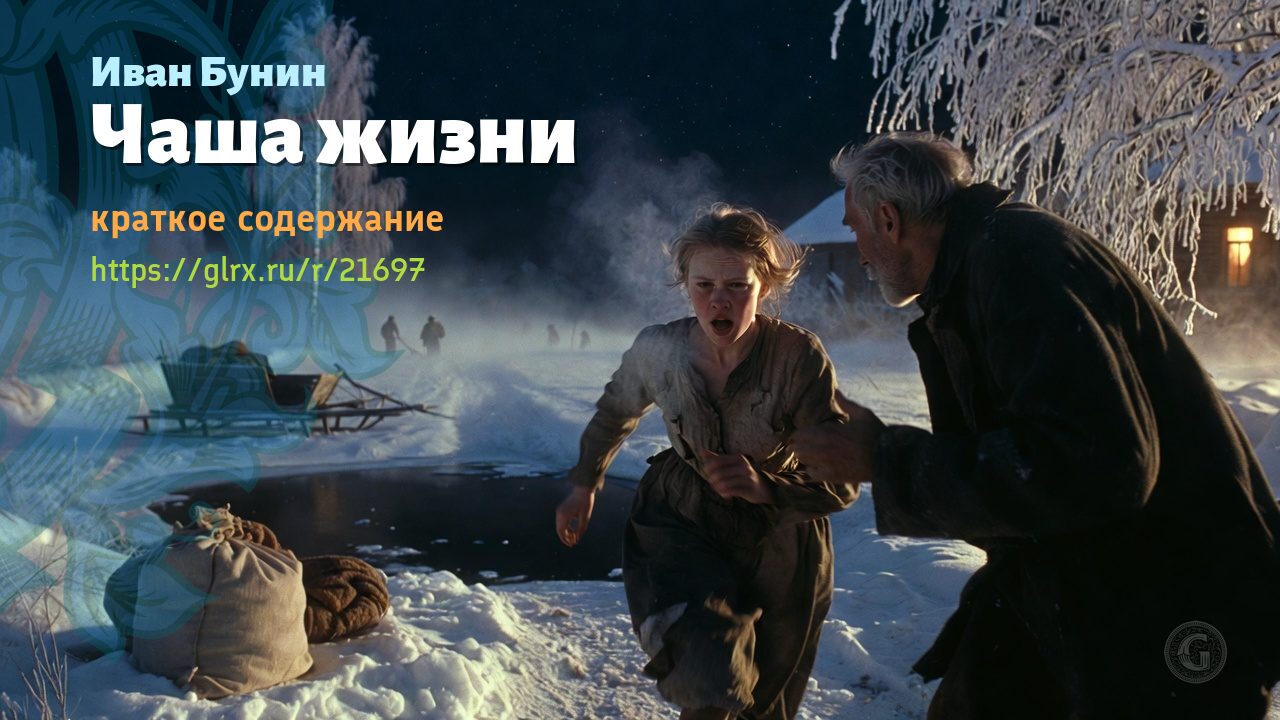
The story "Tanka" transports readers to a starving winter village. The destitute peasant Kornei sells his last horse to the dealer Taldykin. His hungry daughter, Tanya, secretly runs away to the pond. The girl is picked up on a sleigh by a lonely landowner, Pavel Antonovich. The old man brings the child to a warm house and feeds Tanya prunes and sugar, warming his hardened heart.
In the short story "Kastryuk," an old man remains home due to illness while the rest of his family toils in the fields. He acutely feels his own worthlessness. The hero recalls his former peasant strength, his bygone haymaking, and finds peace only late at night, gazing at the twinkling starry sky.
The changing morals are detailed in the story "The Good Life." The energetic bourgeois Nastasya Semyonovna coolly describes her long journey to wealth. For profit, she deceives the terminally ill young man Nikanor Matveyevich, taking his personal savings. Later, Nastasya Semyonovna cruelly expels her own son Ivan, finally establishing herself as the owner of a shop and tavern.
The evolution of a steppe village is depicted in the work "Epitaph." An old weeping birch tree and a decrepit roadside cross give way to new people. Workers mercilessly drill the earth, searching for minerals.
In his story "The Cricket," Ilya the saddler describes a terrible snowstorm. He and his young partner, Maxim, get lost in the night storm. The young man freezes, and the old man carries the dead body on his back for many kilometers to the railroad.
The peasant woman from the essay "The Old Woman" drinks boiling water with pickles. The seventy-seven-year-old woman recalls the harsh winters of her native northern region, the dense forests, and her God-fearing parents.
The search for the meaning of life
The wanderer from the story "Pass" makes his way through the mountains in thick fog. Initial despair gives way to sullen resignation. The hero recalls past misfortunes, illnesses, and sorrows, finding the inner strength to move relentlessly forward.
In the story "The Teacher," rural educator Turbin suffers from winter poverty. Unable to go home for the holidays, he goes to visit the landowner Lintvaryov. Turbin gets drunk, behaves awkwardly in front of his guests, and runs off to a wild peasant revel.
The hero of "On a Farm" wanders alone through the estate at night. Kapiton Ivanovich reflects on the meagerness of his past life, recalls his mad aunt, and his forgotten youthful poems.
The story "At the Dacha" brings young Grisha into contact with Kamensky, a follower of Tolstoy’s teachings. The ascetic calls for a complete renunciation of carnal pleasures. Grisha is torn between his ardent thirst for life and the harsh logic of the Tolstoyan.
The young man in the text "In August" escapes a sultry southern city. He meets a barefoot young woman, Olga Semyonovna, in a melon field. Their brief conversation conveys a profound longing for unrealistic human happiness.
The couple in the story "New Year" stop at an abandoned Tambov farmstead. A frosty moonlit night unexpectedly brings them together. The wife tearfully confesses her love to her husband, but both clearly understand the impossibility of a permanent life away from urban civilization.
In the story "The Saints," the old servant Arsenich is staying in the abandoned rooms of the estate. He drinks vodka and tearfully recounts ancient legends about Christian martyrs to the master’s children.
Secrets of love and dark passions
The title text, "The Cup of Life," recounts the long-running feud between the priest Cyrus Iordansky and the moneylender Selikhov. In their youth, they competed for the affections of Alexandra Vasilyevna. Selikhov married her, tormenting his wife with cold jealousy. Thirty years later, Selikhov dies, leaving his wife a vast fortune. Alexandra Vasilyevna perishes in a street crowd, never having found a true use for her belated wealth. Iordansky sinks into decline, suffering severely from dropsy. The giant Gorizontov, the third suitor, selfishly preserves his health for the sake of longevity.
The girl in the story "Dawn All Night Long" anxiously awaits the arrival of her fiancé, Sievers. That night, she takes a long walk through the wet garden, physically realizes the value of her maiden freedom, and firmly decides to reject the proposal.
The story "By the Road" depicts the brutal tragedy of growing up. A girl named Parashka lives in a remote village with her father, Ustin. A townsman named Nikanor takes possession of her by force. He forces the frightened girl to help him steal his father’s horses at night. As the crime unfolds, Parashka strikes Nikanor over the head with an iron lock and disappears into the high fields.
In his text "Loopy Ears," former sailor Sokolovich grimly preaches a philosophy of cruelty. In a tavern, he demonstrates to the sailors the absolute naturalness of murder. That night, Sokolovich takes the prostitute Korolkova to a cheap furnished room and cold-bloodedly strangles her.
Madame Marot from the story "The Son" lives happily in Algeria. Nineteen-year-old Parisian Emile falls passionately in love with a married woman. Tired of her emotional emptiness, the heroine surrenders to the young man and orders him to shoot her. Emile kills her, but survives.
In the story "Spring Evening," a blind beggar enters a bright village hut. A drunken peasant taunts the vagabond for a long time, taking his meager belongings and insistently demanding he hand over his hidden money. Receiving a firm refusal, the ferocious farmer kills the old man with a heavy stone.
In the story "Archival Case," the decrepit archivist Fisun has spent his entire life in awe of the provincial authorities. During a noisy zemstvo meeting, the old man accidentally encounters the gray-haired chairman in the restroom. Terrified, Fisun immediately takes to his bed and soon dies.
Reflections on Memory and Death
The stylized version of "Velga" conveys an ancient northern legend. The girl Velga is unrequitedly in love with the brave Irvald. Upon learning of her lover’s imminent death in the Icy Sea, she immediately swims to his aid. Velga transforms into a white seagull, saving Irvald at the cost of her own life.
"Chang’s Dreams" is written from the perspective of an old dog. Chang recalls long ocean voyages with his master, a captain. The captain’s life is destroyed by the sudden betrayal of his beautiful wife. The sailor quickly becomes an alcoholic and dies. Chang searches for the highest truth of the universe, feeling a strong connection with his departed master.
The alcoholic nobleman from the novel "Kazimir Stanislavovich" arrives in Moscow. He watches from afar the wedding of a beautiful stranger. Returning to his squalid hotel room, he leaves a suicide note, but lacks the strength to commit suicide and goes begging at the train station.
In the miniature "The Mad Artist," an eccentric painter arrives at an empty hotel on Christmas Eve. He longs to paint a radiant picture of the birth of a new person. His diseased imagination dictates entirely different images: instead of a serene scene, he depicts a bloody crucifixion against a backdrop of burning city ruins.
In the story "Numbers," the uncle has a heated argument with his little nephew, Zhenya. The boy begs him to show him the numbers. The adult displays cruel stubbornness. Zhenya cries for a long time until he finally gives in. The ending brings a warm reconciliation.
The work "At the Source of Days" describes a child’s very first childhood memory. A child sees himself for the first time in a large mirror. Soon, a sick girl, Nadya, dies. The mirror is tightly covered with a black cloth. The grown-up hero struggles to deeply understand the true nature of death.
In the story "Dreams," train passengers discuss their impending death. A gloomy townsman travels to see his dying wife. Another man recounts a mystical dream of a priest and three crowing roosters. The conversation devolves into a harsh verbal altercation.
The forest guard Meliton from the story of the same name lives quietly in the solitude of the forest. The author visits the old man’s dark dugout. Meliton seems like a true saint, but tearfully confesses his past grave sins.
In the village of Greshnoye, the proud nobleman and the holy fool Ivan Rydaletz are buried. This is described in detail in the story "Ivan Rydaletz." During his life, the holy fool frightened the aristocrat with mice and loud screams. The prince suddenly bequeathed that he be buried next to the slave.
The veteran artist from the story "Benevolent Participation" agrees to perform at a Moscow charity event. She torments herself with long rehearsals and valerian drops. At the concert, the singer gives it her all, earning a thunderous ovation from the audience.
The life of the party, Alexey Alexeich, from the text of the same name, visits a renowned doctor. The rude medic, Potekhin, makes a disappointing diagnosis. Alexey Alexeich’s ailing heart fails him, and he dies suddenly, right in the cab.
The collection concludes with the philosophical essay "Night." The hero sits alone on a balcony facing the sea at night. He reflects deeply on God, eternity, and time. Feeling a blood connection with his ancestors, he rejects the finitude of physical death. The Creator is doomed to suffer eternally from the thirst to express the multifaceted world in words.
You cannot comment Why?