A summary of Ivan Bunin’s "The Village"
 Automatic translate
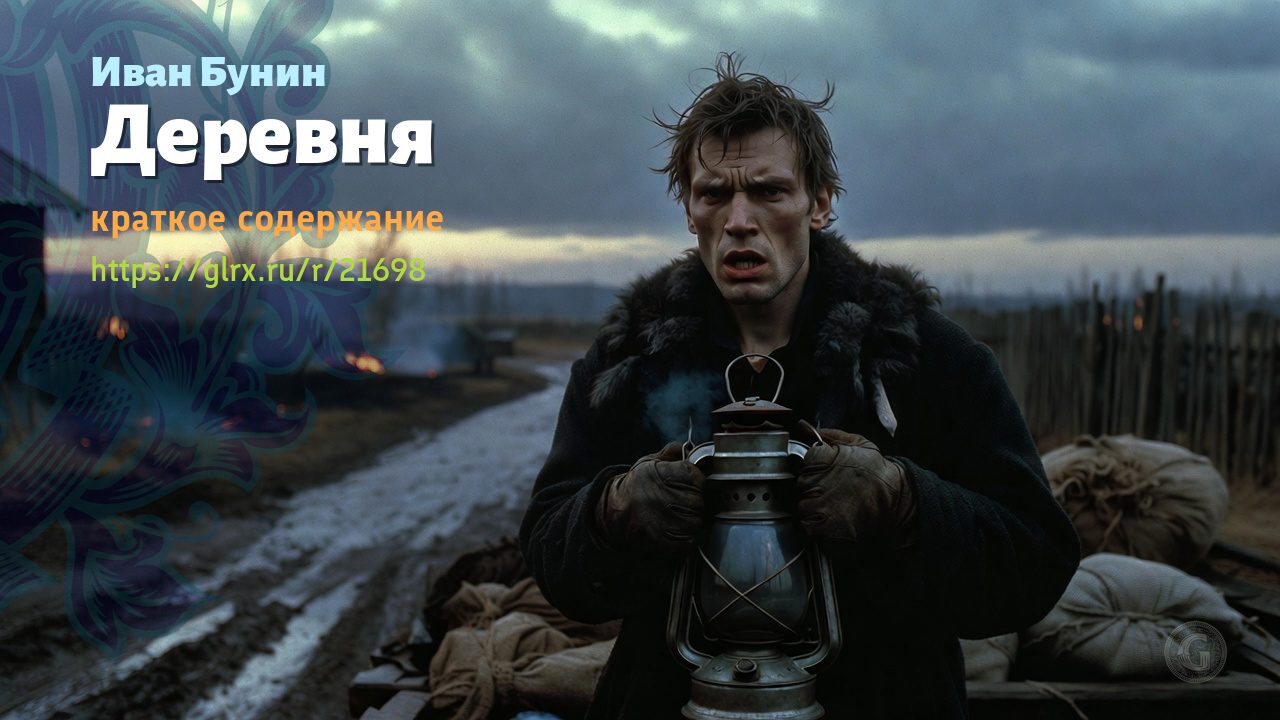
This book is a harsh, realistic portrait of the life of the Russian peasantry in the early twentieth century. Written in 1910, it mercilessly demolishes populist ideals, revealing the desolate, dark, and impoverished reality of the provinces against a backdrop of riots and social upheaval. The text is devoid of romanticism: instead of pastoral scenes, the reader is confronted with a brutal everyday life, full of ignorance and existential melancholy.
The story of the Krasov brothers
The story revolves around two brothers, Tikhon and Kuzma Krasov. Their great-grandfather, Tsygan, was hunted to death by greyhounds by the landowner Durnovo for stealing his mistress. Their grandfather managed to gain his freedom, moved to the city, and became known as a notorious thief. Tikhon and Kuzma’s father ran a small-time trade around the districts, but went bankrupt and died. At first, the brothers traveled together through the villages in a cart, trading haberdashery for rags and canvas. After a serious quarrel, they separated forever. Kuzma found work as a drover’s assistant, and Tikhon opened a tavern and grocery store on the highway near Vorgol station, just a few kilometers from Durnovka.
Tikhon’s path to wealth
By the age of forty, Tikhon had become a tall, stern, and imperious man. He tirelessly scurried through the villages, buying up standing grain and taking land for next to nothing. Having married the middle-aged maid, Nastasya Petrovna, he took a generous dowry and soon acquired the estate of the impoverished master, Durnovo. The peasants gasped at his acumen and recognized him as a true master. But Tikhon’s family life was dogged by misfortune. Nastasya Petrovna gave birth exclusively to stillborn girls. The only child, born from an affair with a mute cook, died — his mother accidentally crushed him in his sleep. Tikhon desperately wanted children, comparing himself to the biblical saints, but all was in vain.
Crisis and riots
With the closure of private taverns due to state monopolies, Tikhon lost part of his income and aged dramatically. In the sweltering heat, he went to a fair in town, where he fell ill from exhaustion and poor food. On his way back, he visited an old cemetery, indulging in heavy thoughts about death. Before winter sets in, a creepy wanderer named Makar visits Tikhon with an escaped blind convict. They sing dark psalms about the Last Judgment, and Makar gives Tikhon a picture of a man killed by lightning. This event intensifies Tikhon’s mystical fear of impending retribution for his sins.
Peasant revolt
Soon, news of the Russo-Japanese War and revolutionary unrest reached him. The peasants of Durnovka had indeed revolted. A crowd stormed the estate courtyard, demanding that the hired workers be driven out. Tikhon miraculously escaped the enraged crowd on runners, while the orchard burned behind him. Although the unrest had subsided, fear forever settled in his soul.
History of the Young
Despite his age, Tikhon never gave up hope of becoming a father. His eyes fell on a beautiful peasant woman, the wife of the one-eyed and cruel soldier Rodka. In the village, she was known as "Young." Tikhon took advantage of her husband’s absence and forced her into an affair. She complied, but the expected pregnancy did not occur. Upon learning the truth, Rodka began to systematically beat his wife daily with a leather whip. Tikhon decided to get rid of the soldier and dismissed him. Soon, Rodka died suddenly of stomach pain. Persistent rumors spread through the village that his wife had poisoned him. A terrified Tikhon decided to hand over the estate to his brother, Kuzma, with whom he had not spoken in a long time.
Kuzma’s Return
Kuzma turned out to be a man of a completely different nature. All his life, he strove for knowledge and dreamed of writing a book about his hard lot. In his youth, he read voraciously, interacting with intelligent but embittered people like the market accordionist Balashkin. While working as a broker in Voronezh, he became fascinated by the teachings of Leo Tolstoy and tried to live a righteous life, but harsh reality shattered his ideals. He witnessed the oppression of the peasants, their savagery and resignation to fate. One day at the station, he witnessed the torture of peasants bitten by a rabid wolf, and the sight plunged him into despair.
Fall and Reconciliation
Before moving to the village, Kuzma tried to rent a garden in the village of Kazakovo. There, he spent the night in a hut with ragged guards. One of them, Akim, suffered from night blindness and was incredibly vicious. He prayed at night, but during the day he was ready to kill anyone for a penny and furiously cursed the doctors. This acquaintance reinforced in Kuzma the idea of the people’s profound mental illness. He began drinking, sank into depravity, slept in communal rooms, and became the town jester. After receiving a letter from Tikhon, Kuzma agreed to become the manager and moved to Durnovka.
Durnovka Management
Kuzma settled into a cold, empty manor house. The loneliness and rural desolation weighed heavily on him. He spent his days wandering the countryside, observing the lives of the peasants. He met a teacher named Parmen, a former soldier who spoke incoherently and beat his students. Kuzma was particularly struck by a peasant named Seryi — an utterly penniless, apathetic man. Seryi rented out his land and spent his days in a cold hut, dreaming only of tobacco. He refused to work for hire, justifying his laziness with pride.
Winter hopelessness
Winter in Durnovka proved harsh and long. Snow-covered huts were drowned in blizzards. An old man named Ivanushka, an ancient man who had lost his entire family to cholera, took to visiting Kuzma. He told absurd legends about a golden tsar, ate boiled potatoes, and then wandered off into the blizzard. Soon, Ivanushka caught a cold and died in his son’s kennel, refusing communion. This death was a terrible blow to Kuzma.
Kuzma’s disease
On Tikhon’s orders, Gray slaughtered an old, sick horse to feed the shepherds. Kuzma watched in horror from the window as the dogs tore at the bloody carcass on the white snow, while blue crows hopped nearby. The spectacle of this primal cruelty mingled in his mind with thoughts of his own death. Kuzma fell seriously ill, delirious at night in the empty house. During his fever, he overheard the worker Koshel and "Molodaya" indifferently discussing how if the manager died, they would simply bury him.
Tragic ending
Tikhon Ilyich arrived in Durnovka with unexpected news: his wife, Nastasya Petrovna, had died on the way to the station. Widowed, he decided to sell the estate and leave forever. During this visit, Tikhon threw a tantrum at his brother. He screamed that the peasants hadn’t learned to plow the land or bake bread in a thousand years, that they hated each other and lied at every turn. Tikhon confessed that he drank out of hopeless melancholy and tearfully recited the funeral prayers from the service book, lamenting his ruined life.
Wedding
To somehow atone for his sin against "Molodaya," Tikhon forced her into marriage with Sery’s son, a boastful and cruel young man named Deniska, who had recently beaten his father. Tikhon provided the money for the wedding and dowry. Deniska openly despised his bride, calling her obscene names, but agreed for the sake of profit. Kuzma tried to dissuade her from this disastrous step. She meekly replied that she had nowhere else to go.
The wedding took place in the midst of a February blizzard. At the hen party, the girls sang orphan songs, causing the bride to sob, hiding her face in her knees. Before leaving for the church, the bride and groom fell at Kuzma’s feet. He looked in horror at the pale beauty kissing the icon and wept from helplessness. The wedding took place in a cold, fuming church. The priest recited prayers quickly, demanding abundance and happiness for the newlyweds, while a blizzard howled outside, concealing the impoverished, doomed village beneath snowdrifts.
You cannot comment Why?