"Verlioka" by Veniamin Kaverin, summary
 Automatic translate
This book is a philosophical fairy tale, completed by the author in 1981. Veniamin Kaverin combines folklore motifs with the realities of Soviet life. Magic exists openly here, naturally permeating the everyday lives of scientists, retirees, and schoolchildren.
Birth from illusion
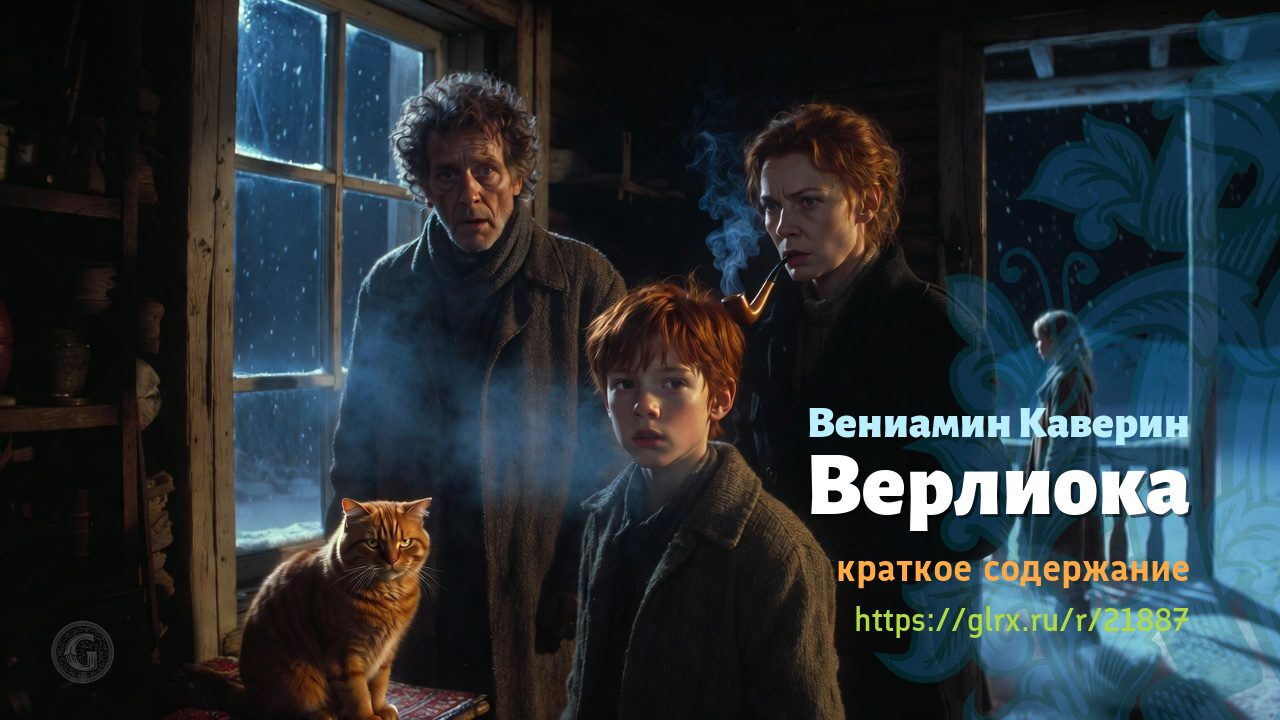
In the academic settlement of Sosnovaya Gora lives an elderly astronomer, Platon Platonovich, distinguished by his amusing, curly hair. He is surrounded by a rather unusual household. Scottish Rose and a luxurious pink-and-red cat, Philip Sergeyevich, whom the family calls simply Filya, can converse and understand each other perfectly. The cat is characterized by inordinate ambition and loves to philosophize. The household is run by the strict Olga Ipatyevna, who constantly smokes a pipe filled with Golden Fleece tobacco.
For many years, the old astronomer suffered from academic silence and oppressive loneliness. An absent-minded passport clerk mistakenly listed his son Vasily on his documents. The elderly scientist wholeheartedly believed this paper illusion. A powerful human desire took on a solid form, independent of the strict laws of nature. One winter night, to the sound of an invisible shepherd’s pipe, Vasya materialized from swirling motes of moonlight. The tall, red-haired boy immediately settled into the house, accepting everything as his due.
Vasya grows rapidly, devouring countless adventure books and trying to help around the house. Soon, he begins to display powerful magical abilities. Ordinary water from a room transforms into an inexhaustible, babbling forest spring in his hands. On a snowy hill, the young man accidentally meets Iva Ivanova. This peculiar girl asks to be called Zambezari Chinook. She enjoys composing eccentric poems, loves theatrical effects, and is constantly seeking incredible adventures. A strong attraction quickly develops between the young people. Vasya diligently practices his magical skills. At Iva’s cheerful request, he easily throws the thinnest straw bridges across streams, compels a withered dead branch to give a girl a green apple, and, through the power of poetry, transforms an ephemeral sunbeam into a real, living animal.
The enemy appears
The peaceful dacha life is disrupted by the sudden appearance of Leon Spartakovich Peshcherikov. This exquisitely dressed young man, remarkably reminiscent of a graceful butterfly, begins persistently courting Iva. He proudly calls himself the Chief Registrar of the town of Shabarsha and constantly speaks in a complex, dead bureaucratic language. Peshcherikov presumptuously announces to Iva’s parents his intention to marry their young daughter in the foreseeable future. He even cynically suggests using a computer to test their future marital compatibility.
Iva’s father, Alexei Lvovich, is immediately enraged by the guest’s unprecedented insolence. The former artillery battery commander explodes with emotion, literally sending scorching sparks flying from him. He loudly and shamefully expels Leon Spartakovich. The departure of the humiliated Chief Registrar is immediately followed by a sudden, devastating storm, aggressively snapping the centuries-old mast pines in the quiet village.
Iva fervently asks Vasya to give her a honeymoon long before their real wedding. She wants to rush off into the thrilling unknown. The young couple joyfully set off south in an old Moskvich, with a bunch of balloons tied to the trunk. The proud cat, Filya, categorically refuses to cowardly stay home and goes along with them, capriciously demanding a higher level of respect.
The Prophecy of the Old Raven
Having barely left the confines of Moscow, the carefree travelers encounter a huge talking Raven. The stern old bird perches heavily on a wooden telegraph pole and calls the surprised Vasya Lorenzo. The Raven sadly recounts a long story from four hundred years ago. In beautiful Venice, a noble youth named Lorenzo had a bitter conflict with a spy from the Council of Ten named Girolamo. The wily spy mercilessly filed a false denunciation, unfairly accusing Lorenzo of heresy and secretly supporting the bold ideas of Giordano Bruno.
Girolamo attempted to kill the peacefully sleeping Lorenzo in the dead of night, but the watchful Raven snuffed out the assassin’s wax candle with a saving wing. Lorenzo escaped unharmed, but years later he died heroically in a brutal battle with the aggressive Genoese. Girolamo, however, turned out to be a sinister, immortal creature. He was born from the sharp teeth of a defeated dragon, sown by the ancient hero Jason in distant, mythical Colchis. Changing his various guises, this cunning monster thrives for centuries, preying on the misfortunes of others.
The raven directly tells the shocked Vasya the true name of his immortal, cunning enemy. This name is Verlioka. The young man is inevitably faced with him in an uncompromising, mortal battle. At that fateful moment, a well-aimed silver arrow pierces the steel chest of the centuries-old bird. The raven dies painfully, barely managing to say goodbye in Latin. Vasya and the shocked cat bury him with due military honors, piling a traditional stone houri over his forest grave.
Miracles on the roads
Along the way, Vasya continues to actively perform kind, justice-restoring miracles. He permanently lifts a cruel magical curse from a gloomy, withered boatman. He was mercilessly punished for accidentally striking a noble stranger in a hat with a flexible river vine. The river’s fresh water turned into a thick, poisonous green syrup, forcing the frail boat to float forever between steep banks, with no chance of mooring. Vasya gently coaxes the green water to part, sincerely acknowledging his biological kinship with nature, and safely returns the exhausted boatman to safe shore.
In the cozy, clean town of Kotoma-Dyadka, young travelers are warmly welcomed as genuine, loving newlyweds. Vasya, for fun, makes a whole platoon of tin soldiers march in unison on the counter of a children’s toy store. The gray-haired director of the local hotel is overcome by terrible, inescapable grief. It turns out that last sultry summer, Chief Registrar Peshcherikov transformed his only son, Slava, into a motionless, cold statue of pink tuff. The young man was a very talented basketball player and bravely interrupted Leon Spartakovich during a violent, drunken brawl.
Vasya boldly uses his rapidly growing magical will. He is filled with profound human compassion for the petrified boy, sincerely appeals to higher justice, passionately recites Iva’s poetry, and successfully brings the pink statue to life. Slava safely returns to his weeping fiancée Katya. The provincial town rejoices wildly. The grateful locals throw a magnificent, riotous feast in honor of their red-haired savior, literally showering him with incredible, valuable gifts.
Taking advantage of the general, loud celebration, the treacherous Verlioka secretly and silently kidnaps Iva. Vasya and the cat Filya, discovering the empty hotel room, immediately set off for distant Shabarsha in an anxious search for the missing girl.
The bureaucratic kingdom of Shabarsha
Shabarsha looks like a stern, flat, geometric drawing, completely devoid of greenery. The bright rays of the sun barely penetrate here due to artificial dark spots on the sun. The local submissive residents live an unbearably boring and completely indifferent life. A lingering bureaucratic dreariness gradually transforms living people here into official cardboard documents. The streets are densely packed with rustling, dry papers, which sometimes aggressively fight among themselves and are mercilessly destroyed by the sharp hatchets of local police officers.
Vasya and Filya skillfully disguise themselves, wearing a curly black wig and a green jockey cap to avoid attracting unnecessary suspicious attention. The sly cat begins a brief flirtatious affair with the local cat, Rozalina, and boldly conducts a nocturnal reconnaissance mission in the Registrar’s richly mirrored house. During the day, Vasya confidently approaches his personal secretary, Luka Porfiryevich. This cowardly creature looks like a creepy, awkward hybrid of a bird of prey and a human being. The secretary secretly drinks strong vodka, dries piles of crumpled money on the floor, and shamelessly accepts large bribes for the physical, traceless elimination of undesirable people.
Vasya harshly threatens Luka Porfiryevich with a full, unconditional exposure of all his corrupt schemes. The intimidated secretary cowardly surrenders and reveals the shocking truth. It turns out that the cruel Verlioka punished Iva for her categorical refusal to marry him and planted her deep in damp earth. The captive instantly transformed into a young weeping tree in an old, abandoned park.
Battle with Verlioka
At night, Vasya easily finds the desired, sadly rustling young willow. He gently and quietly appeals to its deeply hidden human memory. Vasya recalls in detail their shared happy past, amusing road trips, and sincere, passionate feelings. The young man’s powerful, bright magic works flawlessly. The forest’s arboreal memory quickly gives way to human memory, and the obedient, supple plant transforms back into a sleepy, but perfectly healthy girl.
The next day, the gray office town is engulfed in a massive, spontaneous revolt of animated papers. Desperate, rustling documents aggressively dive toward Leon Spartakovich’s house. The registrar cowardly flees the righteous wrath of his own tortured victims, swiftly flying out of the chimney on a magical black cloak. Luka Porfiryevich immediately and obediently follows his deposed master.
Vasya relentlessly pursues the fleeing enemy through the scorching, waterless desert, flowing, boiling tar, and dense, impenetrable walls of fog. The disembodied, transparent ghosts of Verlioka’s tortured victims help the car safely navigate the insurmountable obstacles. Soon, the tireless travelers reach the dilapidated, abandoned palace of the bureaucratic demon.
The aging Leon Spartakovich tries to cunningly and gently negotiate with the enraged Vasya. He offers him Count Cagliostro’s magical golden globe, which infallibly predicts the future. The demon convinces the young man that his hypothetical disappearance will change absolutely nothing in the imperfect human world. The heavy antique furniture in the room suddenly comes to life and prepares to treacherously attack the unarmed guest from behind.
Vasya loudly and fearlessly shouts the enemy’s true historical name right into the face of his stunned opponent. Verlioka instantly disintegrates into hundreds of tiny, vicious, completely naked pink dwarfs, each holding sharp, deadly darts in their mouse-like hands. Vasya forcefully throws the heavy, glowing ball far into the open field. The dwarfs, like animals, rush after it, squealing ferociously. In a brutal, senseless struggle for the magical golden object, the tiny Verliokas completely and mercilessly destroy each other without shedding a drop of real, living blood.
The freed secretary-bird joyfully offers Vasya his polished office services, but is met with a firm, icy refusal. The secretary attempts to seize the balloon in high flight, but it quickly flies off into the frigid depths of outer space.
A Deal with Destiny
The travelers safely and joyfully return to their native land. Along the way, the grateful Slava the Basketball Player catches up with them on his fast bicycle and helps skillfully repair the car’s broken iron crankshaft. In snowy Sosnovaya Gora, they are greeted with incredible joy by Platon Platonovich, a tearful Olga Ipatyevna, and all the talkative, devoted family members, who have deeply missed their beloved children.
Several years later, late one evening, a stately elderly lady in a formal black dress adorned with a diamond snake comes to the now-mature Vasya in his student room. It is the inexorable Fate itself. She categorically declares that the young man’s lofty mission in life has been fully fulfilled. Ancient Verlioka has been destroyed forever, and therefore the original magical illusion must dissipate. Vasya is destined to vanish into thin air and forever leave the realm of the material world. Silence and Recklessness slowly and menacingly creep across the dark room.
Vasya categorically refuses to obediently die in the prime of his youth. He passionately and convincingly explains to Fate that he has already cultivated unbreakable life connections. He has a loving fiancée, a caring adoptive father, and devoted and loyal friends. His sudden physical disappearance would bring them unjustified, irreparable, and cruel grief.
A philosophy student resorts to a subtle intellectual ruse. Vasya confidently declares that he plans to write a lengthy academic paper on the historical systemic errors of Fate. The young man solemnly promises to convincingly prove that a supreme, unyielding force constantly yields to ordinary human courage and sincere, selfless love.
Fate becomes genuinely, sincerely curious. In the long centuries of human existence, no one has ever written such bold books about its direct, systemic flaws. The Mighty Lady agrees to patiently wait a few years and graciously leaves the student’s room.
The students’ lives continue happily and peacefully. An anxious Iva smashes a snowball through a window to ensure Vasya’s safety in the middle of the night. The young man gently reassures the frightened girl, promising to tell her everything in detail tomorrow. A heavy first snowfall quickly and densely covers the sleeping Sosnovaya Gora.
You cannot comment Why?