Arthur Hailey’s "Detective" Summary
 Automatic translate
The crime novel "Detective," published in 1997, was the author’s last major work. This book is a police procedural about Miami homicide Sergeant Malcolm Ainsley, a former Catholic priest whose theological training helps him decipher a serial killer’s motives and uncover a conspiracy at the city’s highest levels. The narrative reveals the routine work of investigators, forensic experts, and forensic scientists.
In 2005, the novel was adapted into a two-part television film starring Tom Berenger. The book is not part of a series and remains a standalone, complete work.
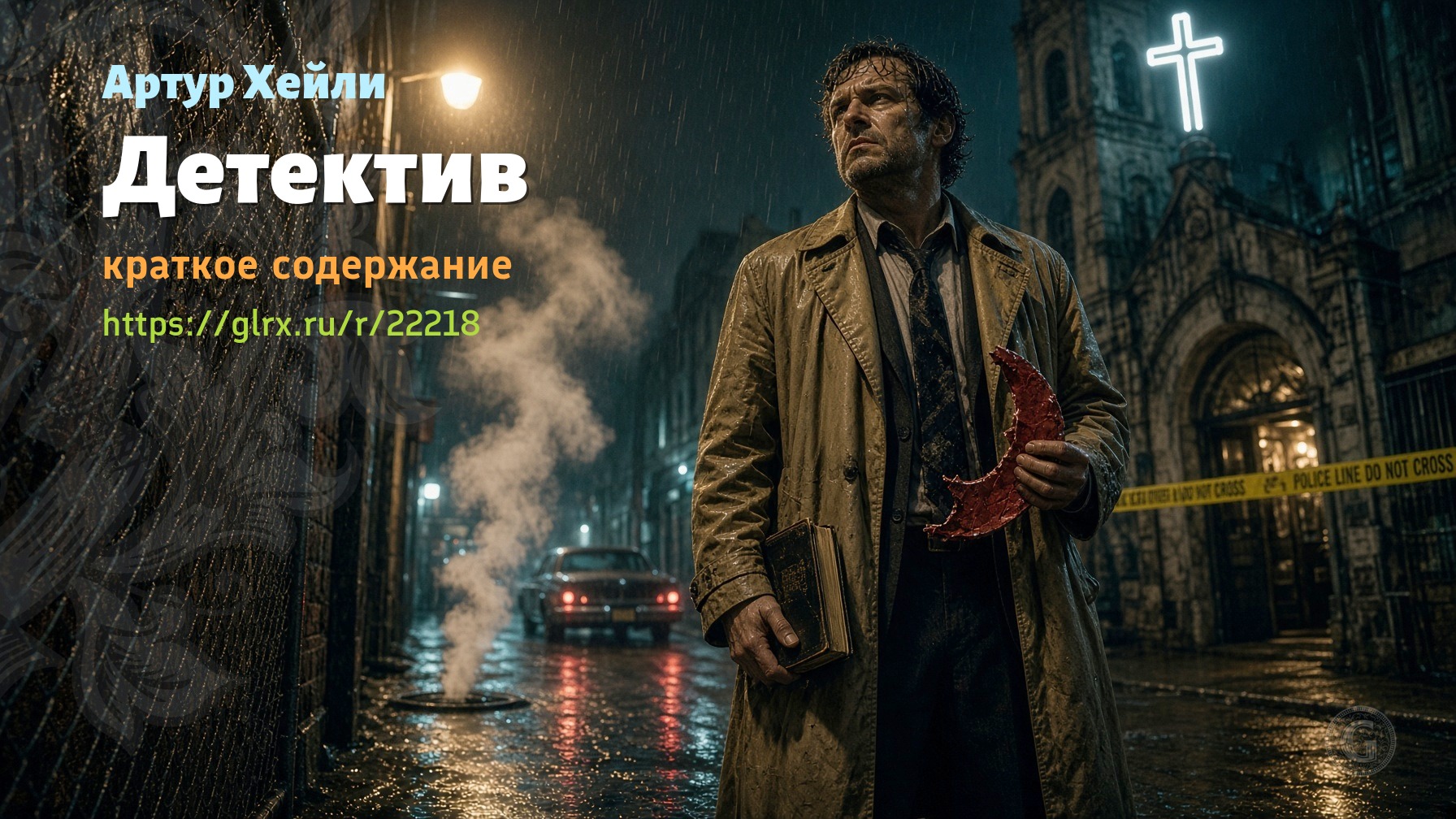
Night call and confession of a suicide bomber
Sergeant Malcolm Ainsley is getting ready for vacation with his wife, Karen, and son, Jason, when he receives a call from the Florida State Penitentiary in Starke. The chaplain reports that Elroy Doyle, nicknamed "The Beast," a prisoner sentenced to death by electric chair, wishes to make his deathbed confession exclusively to Ainsley, as he was once a priest. Ainsley, along with his young partner, Jorge Rodriguez, races the 400-mile north in their squad car, battling overnight rain and traffic jams.
In the jail cell just before his execution, Doyle kneels before Ainsley. The convict confesses to fourteen murders, naming not only the victims he was suspected of but also older cases unknown to investigators: the Esperanzas in Dade County and the Ikejas in Tampa. Doyle vehemently denies the murder of Miami City Commissioner Gustav Ernst and his wife, Eleanor. The sergeant reads a prayer of repentance over the condemned man, after which he is present in the execution chamber.
A series of massacres and an apocalyptic trail
The action shifts back in time to the beginning of the manhunt. At the Royal Colonial Hotel in the Coconut Oasis neighborhood, a security guard discovers the bodies of elderly couple Homer and Blanche Frost. The victims are bound, gagged, and seated facing each other, their bodies slashed with a Bovie knife, and the man’s eyes burned out. Four dead cats are found nearby, along with a radio playing a heavy metal station at full volume. The investigation reaches a dead end: the criminal wore two pairs of rubber gloves, leaving only a partial, unidentifiable palm print.
Months later, similar crimes occur in Clearwater (the Larsens), Fort Lauderdale (the Hennenfelds), and Miami (the Urbinos). At each location, strange objects are discovered: a dented forge and a red cardboard crescent moon, an electric heater with the victim’s charred feet, and a bronze vessel filled with sewage.
At a meeting of the investigative team, Detective Ruby Bowie compares dates, and Malcolm Ainsley guesses to open the Bible. His knowledge of the Holy Scriptures allows him to decipher the serial killer’s messages: the killer is obsessed with the Book of Revelation (the Apocalypse), believing himself to be a divine punisher of sinners. Based on surveillance reports, the police draw up a list of six suspects with religious delusions.
The death of Commissioner Ernst and the capture of the Beast
Suddenly, news arrives of the death of Commissioner Gustav Ernst and his wife in their Bay Point mansion. Their daughter is Police Major Cynthia Ernst, with whom Ainsley had a torrid office romance. A strangled rabbit is found at the scene of the murder, and the radio is tuned to a classical music station. Ainsley doubts the same serial killer committed the crime, but management combines the cases.
The task force maintains round-the-clock surveillance of the suspects on the list. Carlos Quiñones dies while attempting to attack an armed woman; Alec Polite and Earl Robinson are eliminated for innocence.
After retrieving seventeen-year-old medical records, forensic scientist Sandra Sanchez uncovers the unsolved murder of the Esperanza couple, in which the prime suspect was a minor named Elroy Doyle.
Ainsley secures the release of Doyle’s sealed juvenile file, uncovering his pathological passion for violence, lies, and knives. Doyle is placed under surveillance. During his shift, Detective Dan Zagacki leaves his post without permission, and Doyle escapes. The criminal breaks into the Tempones’ home and begins torturing the elderly couple. Their twelve-year-old grandson, Ivan, manages to call 911. The police surround the house and arrest a blood-soaked Doyle red-handed.
Prosecutor Adele Montesino indicts Doyle only in the Tempoun case, where there is direct evidence. The court sentences the killer to death.
Confession Verification and Side Investigation
After Doyle’s execution, Ainsley decides to verify his dying testimony. Ruby Bowie finds an old robbery file of a certain Harold Baird, from whom Doyle stole a gold money clip with the initials "HB," which he later dropped at the scene of the Esperanzas’ massacre. In Tampa, Ruby and local detectives find an old grave with the name Doyle and dig up a Bowie knife hidden there, which contains traces of fibers from the clothing of the deceased Ikejas. It becomes clear: Doyle was telling the truth and did not kill the Ernsts.
Meanwhile, Ainsley and Jorge Rodriguez investigate the death of Byron Maddox-Davanal, the son-in-law of the city’s wealthiest family. His wife, Felicia, attempts to make her husband’s suicide look like a robbery, faking evidence with the help of his butler, Holdsworth. Ainsley exposes the falsification, proving that he committed suicide due to gambling debts.
Cynthia Ernst’s Exposure
Ainsley returns to the Ernst case. Ruby Bowie opens boxes of evidence from their mansion and finds the encrypted diaries of the deceased Eleanor. The entries reveal that the seemingly pious Commissioner Gustav systematically sexually abused and beat Cynthia from early childhood, and at twelve, she gave birth to his child, who was given up for adoption. Her mother knew everything, but covered for her husband out of fear of shame. Cynthia had been harboring hatred for years.
In one of the boxes, Ruby discovers evidence hidden by Cynthia in an old double murder: a gun, bloody clothes, and an audio tape incriminating her lover, writer Patrick Jensen. Detectives arrest Jensen. Escaping the electric chair, the writer agrees to a plea bargain and hands over the tape hidden in a bank vault. The tape captures their conversation: Cynthia hired the Colombian hitman Virgilio to kill her parents, handed over a floor plan of the house, and instructed him to imitate the signature of the serial killer seen in the news, leaving a dead rabbit in its place.
The end of the drama
The grand jury indicts Cynthia Ernst. Ainsley and Ruby Bowie go to the city hall to arrest her. Ainsley enters the office alone. Cynthia realizes she’s been exposed. Pulling a pocket revolver from its hiding place, she aims at Malcolm, but Ruby Bowie arrives just in time to shoot first, killing her instantly.
Malcolm Ainsley retires from the police force. He accepts an offer to become the chair of comparative religion at the University of South Florida, with an annual salary of $100,000. At a gala reception, Ainsley learns that the large anonymous donor who funded the chair and selected him was Felicia Davanal. She offers to meet him again, leaving the outcome open.
You cannot comment Why?