A summary of Ivan Turgenev’s "A Nest of the Gentry"
 Automatic translate
Written in 1858, the novel is a profound exploration of the crisis of the nobility through the lens of shattered human destinies and the impossibility of personal happiness despite duty. The main plot unfolds in 1842 in the provincial town of O… and its surrounding estates. The narrative’s defining characteristic is its psychological precision in depicting the inner turmoil of a man struggling to find his footing after devastating life events.
In 1969, director Andrei Konchalovsky successfully adapted this work into a feature film of the same name. The book is a standalone, complete novel and is not part of any literary series.
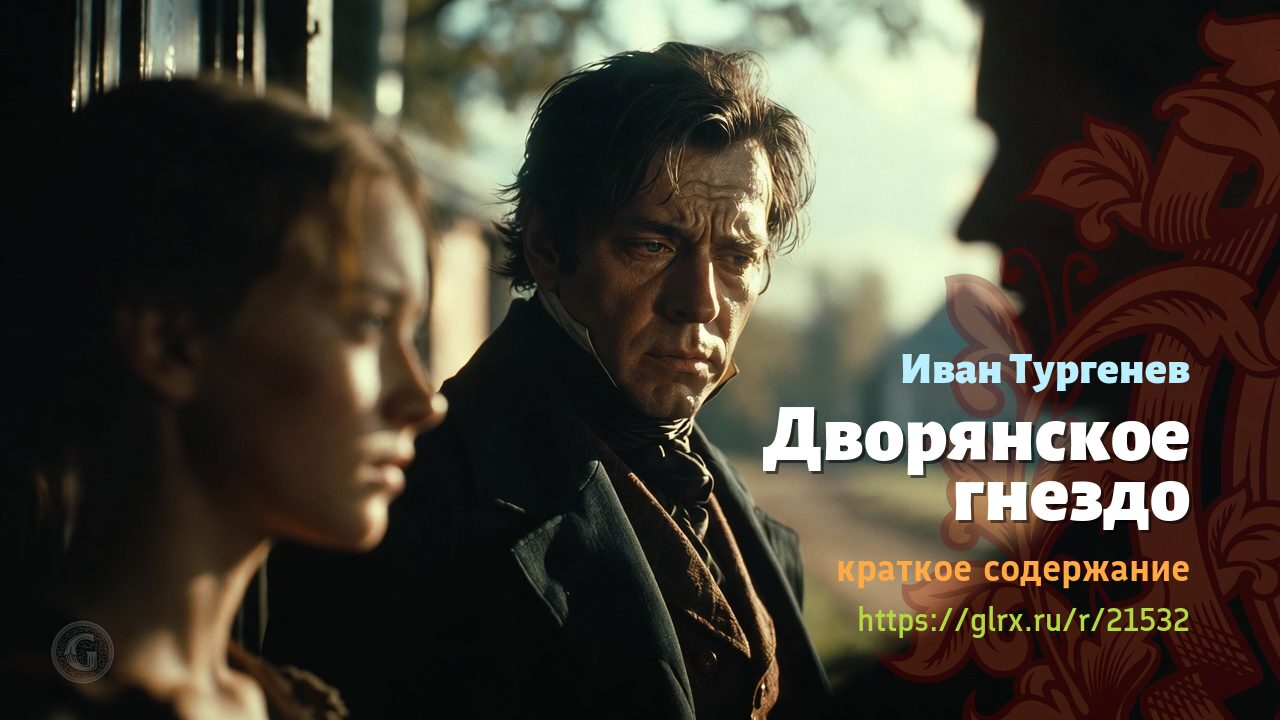
In the spring of 1842, the nobleman Fyodor Ivanovich Lavretsky arrives in the town of O…. Thirty-five years old, a large man with the healthy appearance of a steppe warrior, his eyes conceal a deep weariness. Lavretsky is visiting his cousin Marya Dmitrievna Kalitina, the widow of a former prosecutor. Local society is gathering at her home. Among the guests, Vladimir Nikolaevich Panshin, a brilliant young St. Petersburg official, stands out. He is courting the hostess’s eldest daughter, nineteen-year-old Liza.
Gedeonovsky, an old official and gossip lover, informs Marya Dmitrievna of Lavretsky’s arrival. Fyodor Ivanovich is considered an unhappy man in provincial society. Everyone knows of the enormous scandal plaguing his family. His wife, Varvara Pavlovna, has remained in Europe after her infidelity was discovered. Lavretsky decides to leave the city for his small, abandoned estate, Vasilyevskoye, located approximately twenty-seven kilometers from O…, to find solitude and tend to his household. Before leaving, he speaks with Liza Kalitina, whose stern and pure face makes a strong impression on him.
To understand the hero’s character, his origin story is crucial. His great-grandfather, Andrei, was a cruel and power-hungry nobleman; his grandfather, Pyotr, was a careless hound hunter who ruined the estate. Fyodor’s father, Ivan Petrovich, was raised by a wealthy aunt and imbued with the ideas of the French Enlightenment, but remained a domestic despot. Ivan Petrovich fell in love with the defenseless maid, Malanya, secretly married her in defiance of his father, and then went abroad, leaving his wife in the wilderness. Fyodor was born in 1807 and grew up under the strict supervision of his aunt, Glafira.
The boy’s mother quietly died under the harassment of his sister-in-law. Ivan Petrovich, returning from abroad, decided to make a Spartan of his son. Young Fyodor was awakened at four in the morning, doused with ice water, forced to do gymnastics, study mathematics, and carpentry, and completely banned from music. Relatives joked that Fyodor could lift nearly one hundred and sixty kilograms with one hand. This artificial upbringing confused the boy, depriving him of social skills. After the death of his blind father, twenty-three-year-old Fyodor went to Moscow and enrolled in university, feeling like an awkward eccentric.
In Moscow, Lavretsky fell passionately in love with Varvara Pavlovna Korobyina, the daughter of a retired general. The beautiful and intelligent woman quickly captivated the inexperienced young man. They married, and Varvara Pavlovna skillfully took control of her husband’s life. She ousted his aunt Glafira from the estate, moved her husband to St. Petersburg, and then to Paris. In the French capital, Lavretsky’s wife flourished, creating a brilliant salon where French cavaliers gathered. Fyodor Ivanovich sensed the emptiness of such a life, but obediently followed his wife.
Their firstborn died in infancy. Soon, Lavretsky accidentally found a note in his wife’s study from her young lover, Ernest. Fyodor Ivanovich’s world collapsed, and he nearly strangled his unfaithful wife in rage. After wandering all night in a frenzy, he awarded his wife a generous allowance, forbade her from seeking meetings, and left for Italy. Varvara Pavlovna gave birth to a daughter, Ada, and became a famous figure in the scandal sheets of European newspapers. After four years of wandering, Lavretsky found the strength to return to his homeland.
In Vasilievsky, Lavretsky immerses himself in the peaceful silence of the village. His old servant, Anton, tells him tales of his ancestors. Fyodor Ivanovich moves furniture, orders books, and tries to numb his pain with contemplation of nature. Soon, he begins visiting the Kalitins in town. There, he becomes close to his old music teacher, Christopher Lemm, a poor German composer who discerned a deep soul in Liza and dedicated a spiritual cantata to her. Lemm despises Panshin, considering him a superficial dilettante.
An invisible spiritual connection develops between Lavretsky and Liza. Liza grew up under the influence of her devout nanny, Agafya Vlasyevna, who instilled in her a deep religious feeling and humility. Liza views life as a service to duty. She questions Fyodor Ivanovich about his family drama and urges him to forgive his wife, declaring that he must submit to God’s will. Lavretsky argues with her, claiming that Varvara Pavlovna lacks a heart. Liza hesitates when Panshin proposes marriage and asks the official to wait with his answer.
Lavretsky’s former university friend, Mikhalevich, arrives in Vasilyevskoye. He behaves like a penniless idealist and argues heatedly with Fyodor Ivanovich until four in the morning. Mikhalevich accuses Lavretsky of laziness, calling him a "well-read loafer," and urges him to take up business in his native land. These words force Fyodor Ivanovich to consider his calling. Soon, the Kalitins pay a visit to Vasilyevskoye. While fishing by the pond, Lavretsky and Liza engage in a quiet conversation. Returning in the carriage that night, they realize they have become truly close.
One day, Lavretsky opens a recent French magazine and comes across a feuilleton by Monsieur Jules. The text reports the sudden death of Varvara Pavlovna in Paris. Fyodor Ivanovich is shocked. He cannot cry, as his past love is completely burned out of his heart, but he realizes he has become a free man. He shows the news to Liza, begging her to keep it a secret. The girl is terrified, seeing the incident as God’s punishment and urging Lavretsky to consider seeking forgiveness before the Almighty.
An ideological dispute between Panshin and Lavretsky erupts in the Kalitin house. Panshin argues that Russia has fallen behind Europe and needs to be remade through administrative methods. Lavretsky completely demolishes the official’s arguments, calling for recognition of the people’s truth and humble plowing of the soil. Liza listens attentively to the argument and takes Fyodor Ivanovich’s side. Panshin senses her coldness and leaves irritated. That night, Lavretsky secretly comes to the Kalitin garden. He sees Liza descending the alley. A heated argument ensues. Lavretsky confesses his love, and Liza, weeping, rests her head on his shoulder. A happy Fyodor Ivanovich runs to Lemm, who that same night composes a brilliant piece about the triumph of love.
The lovers’ happiness proves fleeting. The next day, Lavretsky returns to his city apartment and smells the overpowering scent of someone else’s perfume. Varvara Pavlovna rises from the living room to greet him. She falls at his feet, begging for mercy. She explains that she took advantage of the false rumor of her death to flee Paris in remorse. She shows him her little daughter, Ada. Lavretsky realizes his hopes are dashed. He leaves in a daze, cursing his hasty belief in newspaper gossip.
Varvara Pavlovna displays a cunning spirit. She goes to Marya Dmitrievna Kalitina and stages a scene of profound humility. Kalitina’s widow melts with admiration for her guest’s Parisian manners and promises to reconcile her with her husband. Meanwhile, Panshin, having been finally rejected by Liza, finds solace in Varvara Pavlovna’s company. They sing duets, engage in light conversation in French, and the official instantly forgets his recent love affair. Varvara Pavlovna subtly manipulates everyone in the house, deeply disgusting both the stern Marfa Timofeyevna and Liza herself.
Lavretsky meets with Liza in Marfa Timofeyevna’s room. The girl looks pale and exhausted. She displays unyielding firmness, refusing to shake Fyodor Ivanovich’s hand in farewell, declaring that their duty is to submit. Liza begs her husband to reconcile with Varvara Pavlovna for the sake of their little daughter. Marya Dmitrievna sets a trap for Lavretsky, bringing her wife out from behind a screen at the most inopportune moment. Fyodor Ivanovich, exhausted by the mental anguish, agrees to bring Varvara Pavlovna to Lavriki and support her, but frankly warns that their former feelings cannot be restored.
On Sunday morning, Lavretsky goes to church, hoping to see Liza. He finds her in a dark corner near the choir. She’s praying fervently, oblivious to those around her. After the service, Fyodor Ivanovich catches up with her on the street, begging her to say at least a word. Liza asks him never to come again, to leave as soon as possible, and to try to forget the past. She leaves almost at a run, leaving Lavretsky alone. Fyodor Ivanovich takes his wife to Lavriki, and he himself goes to Moscow. Varvara Pavlovna isn’t bored in the village for long — Panshin begins visiting her regularly, and the high rooms resound with French speeches.
Liza locks herself in her small room, which is known in the house as "the nursery." She tidies up, waters the flowers, and then kneels before the crucifix. Her aunt, Marfa Timofeyevna, finds her niece in tears and tries to console her, urging her to endure her grief. But Liza announces her firm decision to enter a convent. She confesses that happiness has eluded her, and she feels the need to atone for her own and others’ sins, as well as for the wealth accumulated by her father. Despite her aunt’s tears and protests, Liza agrees only to postpone her intention for six months. With the onset of cold weather, Varvara Pavlovna takes the money and moves to St. Petersburg. The following spring, Fyodor Ivanovich receives news that Liza has taken monastic vows at a remote monastery.
Eight years pass. A new spring arrives. Mikhalevich has found his calling, becoming a senior warden at a state institution, where he is adored by his students. Panshin has risen through the ranks, received the Vladimir Cross, turned yellow in the face, and abandoned music, secretly writing small comedies. Varvara Pavlovna lives comfortably in Paris, attends theaters, and finds her ideal in the plays of Dumas fils, while her daughter Ada has become a pale, sickly girl with frayed nerves. Her closest companion is the retired guardsman Zakurdalo-Skubyrnikov.
In the town of O…, the Kalitin family has grown younger. Marya Dmitrievna, Marfa Timofeevna, and Nastasya Karpovna have died and are buried in the local cemetery. The nest is bustling with new youth: the grown-up, beautiful Lenochka with her hussar fiancé, Marya Dmitrievna’s married son with his wife, and the now-mature Shurochka. They run through the rooms, playing and laughing loudly. A tarantass pulls up to the gate, and forty-five-year-old Lavretsky emerges. The young people greet their forgotten relative warmly, and Lenochka tells him the latest news, including the death of their teacher, Lemm, in Odessa.
Lavretsky goes out into the garden and sits on the bench where he once spent his happy life with Liza. He is overcome with a vivid sadness for his vanished youth, but his heart harbors no envy or bitterness toward the new generation. Over the years, he has changed, stopped thinking about his own selfish happiness, become a good farmer, learned to till the land, and improved the peasants’ lives. The lonely wanderer mentally blesses the bustling youth in the clearing, who are destined to do real work, and quietly departs, ready to face his old age.
Some time later, Lavretsky visits the remote monastery where Liza had hidden. He sees her as she passes by with the steady, hurried, and humble gait of a nun. Liza doesn’t look up at her former lover; only her eyelashes tremble slightly, and the fingers of her clasped hands, entwined with a rosary, press even tighter together. Their inner world remains a mystery, which the author passes by in reverent silence.
You cannot comment Why?