Vladimir Nabokov’s "The Gift," a summary
 Automatic translate
This Russian-language metanovel was written in 1938. The text’s true heroine is Russian literature itself. The plot describes three years in the life of a young émigré writer, whose creative development slowly merges with reality. The text is replete with wordplay, literary allusions, and stylistic shifts. The ending of the work seamlessly transitions to the beginning of the creation of the very book the reader is holding.
First steps in Berlin
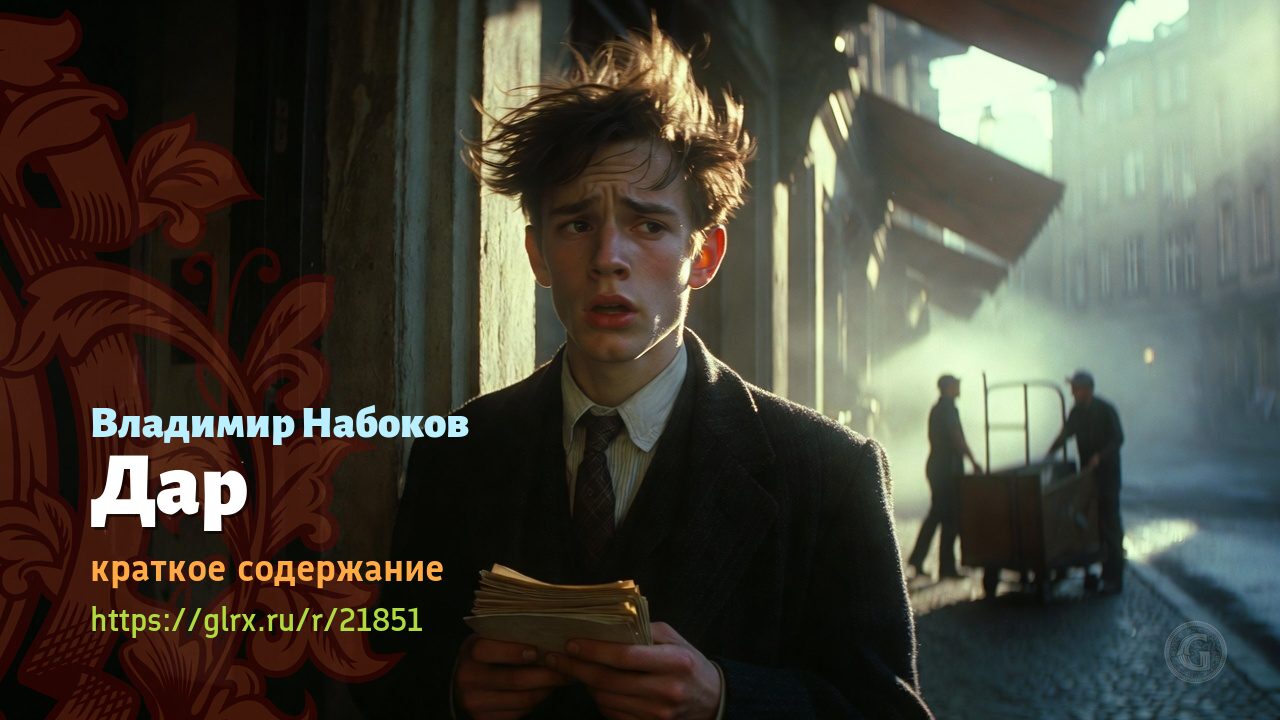
Aspiring poet Fyodor Godunov-Cherdyntsev moves into a new room on Tannenberg Street in Berlin, renting it from a predatory German woman, Klara Stoba. On a spring day in 1926, he watches someone else’s furniture being unloaded. His first collection of poems is published. These texts are dedicated to a carefree childhood in pre-revolutionary St. Petersburg and the family estate, Lyoshino. Fyodor excitedly rereads his own poems, bringing to life the images of wind-up toys, a lost ball, frightening shadows on the wall, and an enormous Faber pencil. The young man awaits enthusiastic press reviews. The creamy white cover of the collection evokes a feeling of absolute happiness.
That evening, the young man goes to visit the Chernyshevskys. Alexander Yakovlevich and Alexandra Yakovlevna are agonizing over the suicide of their son Yasha. The young man shot himself in the Grunewald forest because of a banal love triangle involving his friend Rudolf and the student Olya. Yasha’s father is slowly going mad, constantly haunted by the ghost of his son. Alexander Yakovlevich vainly conceals his madness behind loud laughter. At the Chernyshevskys’ home, Fyodor meets the writer Vasilyevich, the engineer Kern, the pale young lady Tamara, and the plain Lyubov Markovna. The guests listen to a reading of a philosophical tragedy by the Riga author Bush.
Late at night, Godunov-Cherdyntsev returns to his home. It turns out he’d mistakenly taken the keys to his old apartment. The poet waits a long time on the dark street. He finally manages to get inside. Until morning, he composes new rhymes.
Father’s image
Fyodor is on his way to a lesson with an elderly paper mill owner who wants to learn to speak fluent French. On the tram, the young man becomes acutely irritated by the German passengers. On a sudden impulse, the poet skips class. His mother, Elizaveta Pavlovna, arrives in Berlin. They share a common melancholy and a timid hope for the return of Konstantin Kirillovich Godunov-Cherdyntsev. The famous Russian entomologist and explorer disappeared in Asia in 1917. Rumor has it he died in Siberia on his return journey. His mother brings Fyodor an old photograph of Leshina, which awakens warm feelings.
Fyodor immerses himself in memories of his father’s expeditions. The Tien Shan ranges, the Lop Nor desert, and the Tibetan plateaus pass before the young man’s mind’s eye. He sees Cossacks, laden camels, and the shimmering colors of rare Asian butterflies. His father possessed an independent spirit, a stern disposition, and a mysterious charm. He despised all falsehood and boldly explored mountain gorges untouched by civilization. The writer decides to create a documentary biography of Konstantin Kirillovich. He collects materials, studies maps, and rereads the notes of his contemporaries.
Fyodor soon realizes the impossibility of a dry presentation of facts. His own poetic intonation distorts the strict scientific truth. The work stops. The landlady asks Fyodor to vacate the room. He moves into the Shchegolev family’s apartment on Agamemnonstrasse.
A new apartment and secret love
The Shchegolevs’ life is filled with the noises of everyday life. Boris Ivanovich Shchegolev often bores Fyodor with empty political musings, absurd predictions, and salacious jokes. Marianna Nikolaevna dutifully serves her husband. Shchegolev’s stepdaughter, Zina Mertz, hates the domestic environment and despises her job at the lawyer Traum’s office. She suffers under the despotism of the manager, Hamekke, sympathizes with the exhausted old secretary, Dora Wittgenstein, and patiently endures the narcissistic boss, Traum. Zina has a keen literary ear and remarkable grace. She reverently cherishes the memory of her late father, Oskar Mertz.
A whirlwind romance blossoms between Fyodor and Zina. They hide their relationship from their parents, agreeing never to communicate in their presence. The lovers secretly meet on the streets of Berlin at night, kissing in the shadows of fences and trees. Zina becomes the young writer’s ideal listener and muse. Imaginary conversations with the poet Koncheyev about the works of Pushkin, Gogol, Fet, and Nekrasov inspire Fyodor. In his free time, he enthusiastically composes elegant chess problems, finding a strict harmony in the movements of the pieces.
Immersion in history
A chance quote in a chess magazine draws Fyodor’s attention to Nikolai Gavrilovich Chernyshevsky. Godunov-Cherdyntsev borrows the works and diaries of this 1860s idol from the library. Studying the old texts reveals to him the absurdity and comicality of materialist aesthetics. Fyodor writes a bold, satirical biography of Chernyshevsky. Zina types the manuscript.
Biography of Chernyshevsky
The fourth chapter of the novel consists entirely of the text of a book written by Fyodor. The biography traces Nikolai Gavrilovich’s path from his youth in Saratov to his death. The young Chernyshevsky keeps meticulous seminar diaries, constantly weeps over his poems, and unsuccessfully invents a perpetual motion machine from basins and corks. He marries the temperamental and frivolous Olga Sokratovna, meekly enduring her numerous infidelities, whims, and hysterics.
In 1855, Chernyshevsky defended his dissertation in St. Petersburg on the aesthetic relationship of art to reality. He judged the beauty of women’s faces by the prints in shop windows. He despised pure poetry, hated Fet’s verse, and extolled social utility. His editorial work at the journal "Sovremennik" made him an idol for radical youth. The government feared the influence of this clumsy publicist.
Chernyshevsky is imprisoned in the Peter and Paul Fortress. In his cell, he composes the didactic novel "What Is to Be Done?" The manuscript accidentally falls out of Nekrasov’s sleigh, but the impoverished official finds and returns the pink package. The court sentences Nikolai Gavrilovich to hard labor, using crudely fabricated evidence by the police and forged letters from the half-mad traitor Kostomarov. After a public civil execution in the rain, Chernyshevsky is sent to Siberia.
Long years in the remote Yakut town of Vilyuysk are spent in illness, constant reading, and the writing of talentless utopian novels. His meeting with Olga Sokratovna, who has arrived, lasts only four days. Returning from exile to Astrakhan, the aging and ailing thinker translates Weber’s multi-volume world history. His son Sasha slowly goes mad. Chernyshevsky’s life ends in delirium and a quiet death in Saratov.
Literary scandal and the anticipation of freedom
The publication of Chernyshevsky’s biography provokes a storm of indignation in the press. Warsaw reviewer Linev writes a comically absurd review, distorting the entire plot. Parisian critic Christopher Mortus hypocritically accuses Godunov-Cherdyntsev of tactlessness and mockery. Professor Anuchin angrily accuses the author of desecrating a progressive social sacrosanctity. Only the poet Koncheyev praises the young author’s sparkling style and sharp wit. Journalist Vasilyev refuses to shake Fyodor’s hand.
Alexander Yakovlevich Chernyshevsky dies. Before his death, he is acutely aware of the absolute absence of an afterlife. Fyodor attends the crematorium ceremony, experiencing a strange numbness and detachment. After the funeral, he wanders aimlessly through the park with the writer Shirin, deaf and blind to the beauty of nature.
Then Fyodor attends a scandalous meeting of the Writers’ Union. The members, among whom the speculator Gurman and the timid treasurer stand out, quarrel furiously over the embezzlement of three thousand marks. The writers disrupt the election of a new board, shouting insults.
Summer heat
A very hot Berlin summer arrives. Boris Ivanovich receives a lucrative position in Copenhagen. The Shchegolevs pack their things and leave for Denmark. Zina and Fyodor are given the opportunity to live alone in the empty apartment for a month before a new German tenant moves in.
On the eve of his hosts’ departure, Fyodor spends the entire day naked in the Grunewald forest. He swims in a murky lake, savors the sunlight, and meticulously observes the golden butterflies, ants, and carved forest shadows. The writer sees evangelical sisters passing by, singing hymns. Someone steals all his clothes, leaving only one shoe and a set of keys. The poet, wearing only his swimming trunks, is forced to explain himself to an indignant policeman. The young man returns home by taxi.
That evening, Fyodor accompanies the Shchegolevs to the train station. He meets Zina, and they go to dinner at an outdoor restaurant. The writer shares with his beloved a grand new creative project. He plans to write a novel about how fate itself skillfully maneuvered them together, using the Lorentzes’ move and his cousin Raisa’s ball gown. The young people slowly make their way home through the fragrant darkness. Approaching the building, they suddenly realize they have lost the keys to their locked apartment. The book ends with rhythmic lines promising a continuation of life beyond the last page.
You cannot comment Why?