"People Among the Trees" by Hanya Yanagihara, summary
 Automatic translate
American author Hanya Yanagihara’s debut novel was published in 2013. It is based on the life story of real-life Nobel laureate Daniel Carlton Gajdusek. The narrative is presented as the memoirs of immunologist Norton Perina, written in his prison cell after being accused of pedophilia and edited by his devoted colleague Ronald Kubodera. The book was a finalist for the PEN/Hemingway Award and was shortlisted for the Dylan Thomas Award. It is not part of a book series.
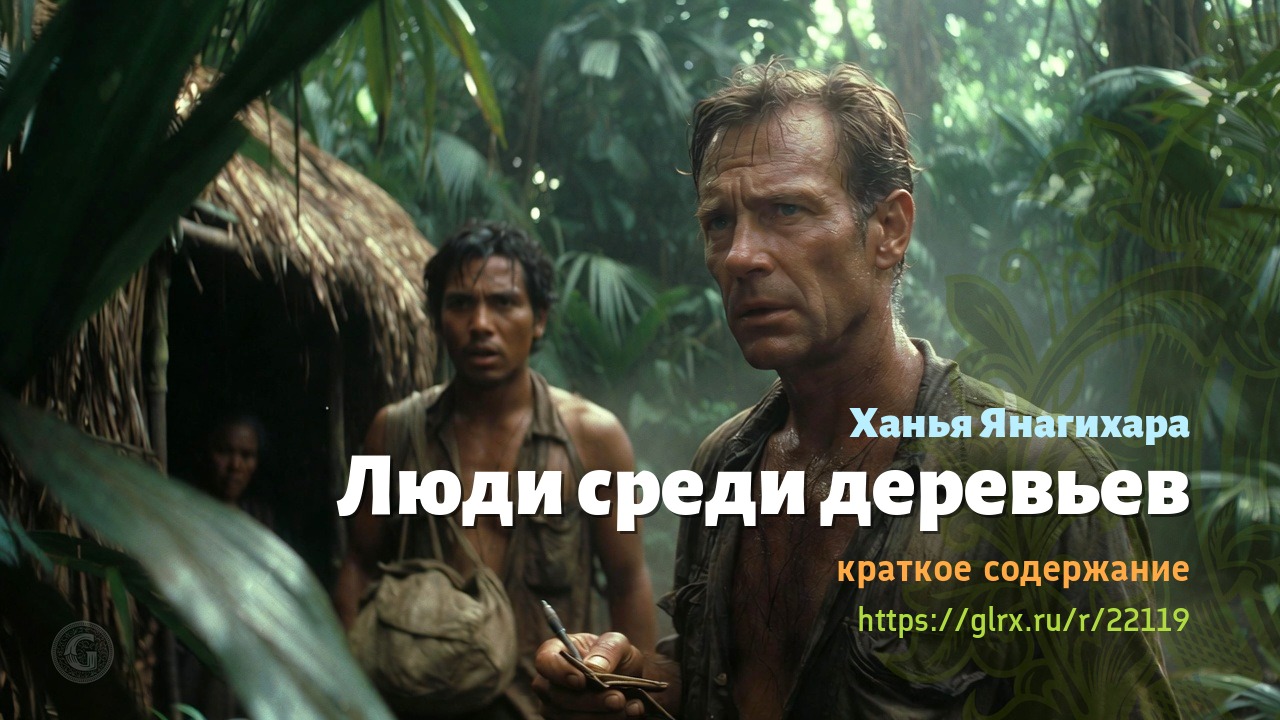
Norton Perina’s Early Life and Early Life
The narrative begins with newspaper articles from 1995 and 1997. They report the arrest and sentencing of 71-year-old scientist Norton Perina to two years in prison for sexually abusing his adopted children. This is followed by a foreword by Ronald Kubodera, who exonerates his teacher and undertakes to publish his manuscript.
Norton Perina was born in 1924 in Lyndon, Indiana. He grew up with his twin brother, Owen, a taciturn mother, and an indifferent father, Joseph. His mother died in 1933 of a brain aneurysm. Local physician John Naples mistakenly attributed the cause of death to Chinese flu from mosquito bites. This explanation inspired Norton’s interest in biology and medicine. His aunt, Sybil, a doctor in Rochester, gave him a children’s microscope and biographies of scientists, encouraging his interest in science. His father died in 1946 when a dilapidated spiral staircase collapsed under him. After the funeral, the brothers traveled to Italy.
Studies and first medical practice
In the fall of 1946, Norton entered Harvard Medical School. He found the school boring, often skipping classes to collect beetles in Connecticut. In 1948, renowned researcher Gregory Smythe invited Perina to work in his lab, which was studying the viral nature of cancer. The lab was hierarchically organized, led by residents Brassard and Fitch. Smythe confessed to Perina that he saw himself in him. After a bizarre dinner at which Smythe got drunk, served unripe persimmons, and burst into tears, Norton quit his job.
In March 1950, Professor Adolphus Sereny offered Perina a position as a physician on Paul Tallent’s anthropological expedition. The expedition was headed to the little-studied island of U’ivu in Micronesia. Norton immediately accepted the offer.
Discovery on Forbidden Island
In June 1950, Perina flew to Hawaii, where he met Paul Tallent and his assistant, Esmé Duff. From the Gilbert Islands, they crossed to U’ivu, and from there, with native guides Fa’a, Tu, and Uva, they traveled to the "forbidden island" of Ivu’ivu.
As they made their way through the jungle, Tallent recounted a local legend about the sea god Ivu’ivu, the sun god A’aka, and the rare turtle Opa’ivu’eke. According to legend, eating the turtle’s meat grants eternal life, but without a sacrifice, it brings a curse. The travelers ate manama fruit with hunono worms and encountered primitive wuaka monkeys. Soon, they encountered a group of feral humans. One of them turned out to be an elderly mute woman named Eva, with a turtle tattoo on her neck.
Another native, Mua, told the story of his father, Vanu, who fled from U’ivu to Ivu’ivu many decades ago. Explorers discovered a lost village of twenty-five palm huts. Its inhabitants had relatively short lifespans, and everyone who reached 60 o’ana — the local age — was subjected to the ritual of waka’ina, or the eating of Opa’ivu’eke meat. At this stage, people physically stopped aging, but gradually lost their minds and the power of speech. Such people were called "mo’o kua’au" and were exiled into the jungle.
Crime in the Jungle and Return
Norton realized that the substance from turtle tissue inactivated telomerase, halting the physical aging of cells at the expense of the inevitable brain degradation. Wanting to obtain tissue samples for further research, Perina secretly went to the sacred turtle lake at night and killed one.
The guide, Fa’a, caught Perina in the act. Accidentally touching the carcass, Fa’a decided he was cursed and hanged himself from a tree the next morning. The explorers took four natives with them — Eva, Vana, Mua, and Ika’ana. They returned to shore and, in late 1950, sailed for the United States.
Scientific triumph and environmental disaster
Returning to America, Perina found a position in a Stanford University lab. Together with his assistant, Ryu Cheol Yu, he began experiments on mice. The rodents given turtle tissue lived three times longer than normal, but eventually developed symptoms of insanity.
In 1953 and 1958, Perina published articles on this phenomenon. In 1956, Adolphus Sereny repeated his experiment and published the results in The Lancet. The publication caused a scientific sensation. Expeditions, pharmaceutical companies Pfizer and Lilly, and tourists flocked to Ivu’ivu. The island’s unique ecosystem was destroyed, and the Opa’ivu’eke tortoises were completely exterminated. The local culture collapsed. In 1961, Paul Tallent disappeared without a trace in the Ivu’ivu jungle. In 1974, Perina received the Nobel Prize in Medicine.
Adopted Children and the Fall of a Scientist
Beginning in 1968, Perina began adopting children from the impoverished U’ivu Islands. In total, he brought 43 children to his home in Maryland. In 1980, he adopted a seven-year-old boy named Victor.
Victor grew up rebellious. He rejected the name "Victor," demanded to be called "Vi," and accused Perina of trying to deprive him of his indigenous identity. One day, Victor locked Perina outside on a cold night. In response, Perina locked the boy in the basement, beat him, and then began systematically sexually assaulting him.
In 1995, Victor, a university student, contacted the police with the help of Perina’s brother, Owen. Norton was arrested. At the trial, Victor testified against his adoptive father. In 1997, Perina was sentenced to two years in prison.
The ending and disappearance
In prison, Perina wrote a memoir. In an appendix to the text, he frankly admitted to abusing Viktor, showing no remorse. In January 2000, Perina was released. He and Ronald Kubodera, who had taken all of the scientist’s savings, fled to an unknown location. In the epilogue, Kubodera confirms that they are living together in a tropical country, hiding from justice and society.
You cannot comment Why?