"The Role of the Victim" by Elena Topilskaya, summary
 Automatic translate
"The Role of the Victim" is a detective novel by Elena Topilskaya, published in the early 2000s. Written in the first person, the book’s protagonist is prosecutor Maria Sergeyevna Shvetsova, an investigator working in a district of St. Petersburg. The author, a serving prosecutor, explains the rare precision in her depiction of the daily routine of the investigative apparatus: humor coexists with professional routine, and the detective plot unfolds directly from the prosecutor’s office reception area.
"The Role of the Victim" is part of a series of novels about Maria Shvetsova, which was also published under the series "Secrets of the Investigation," "Riddles of the Investigation," and "The Investigation Led by Maria Shvetsova."
Working days and the first visit
Masha Shvetsova arrives to work in her uniform jacket — a rare occurrence for her, forced into this by the fact that her only decent skirt split at the seam after a competition with her colleague, Larisa Kochetova, to see who could lift their legs higher on the stairs. The prosecutor, seeing Masha in a uniform with major’s epaulettes, seizes the opportunity and persuades her to cover for Larisa at an evening reception for citizens.
Before leaving for court, Kochetova treats Masha to sandwiches and tells her about some curious visitors, including the renowned writer Andron Latkovsky, author of the popular thriller "Heart in a Fist," who has come to ask about housing. At the evening reception, a quiet woman in a polka-dot dress comes to see Masha. Her face seems familiar: it’s actress Tatyana Viktorovna Klimanova, who played the lead role in the film adaptation of that very same Latkovsky novel.
Actress’s complaint
Klimanova explains that she is Latkovsky’s ex-wife. After the divorce and filming, she was admitted to a neurosis clinic, and upon her release, she lives alone in her parents’ large top-floor apartment. Lately, something has been bothering her: someone tiptoes around the attic above her, and the phone rings at night, but the receiver remains silent. Masha frankly explains that the prosecutor’s office is powerless in this regard: current legislation does not provide for liability for such actions, and advises installing caller ID on the phone. Klimanova leaves upset.
The next visitor turns out to be a regular client of the prosecutor’s office, Toropovets, who has long been convinced that her neighbors are throwing sulfuric acid at her walls; this time, she discovered the acid in a carton of kefir. Masha listens patiently and escorts her out.
After the appointment, Masha involuntarily notices the similarities: the silent calls and stalking at night are almost a literal retelling of the plot of "Heart in a Fist," where the heroine is first tormented by calls, and then a voice utters the phrase "nobody loves you, you must die."
Evidence-based disaster
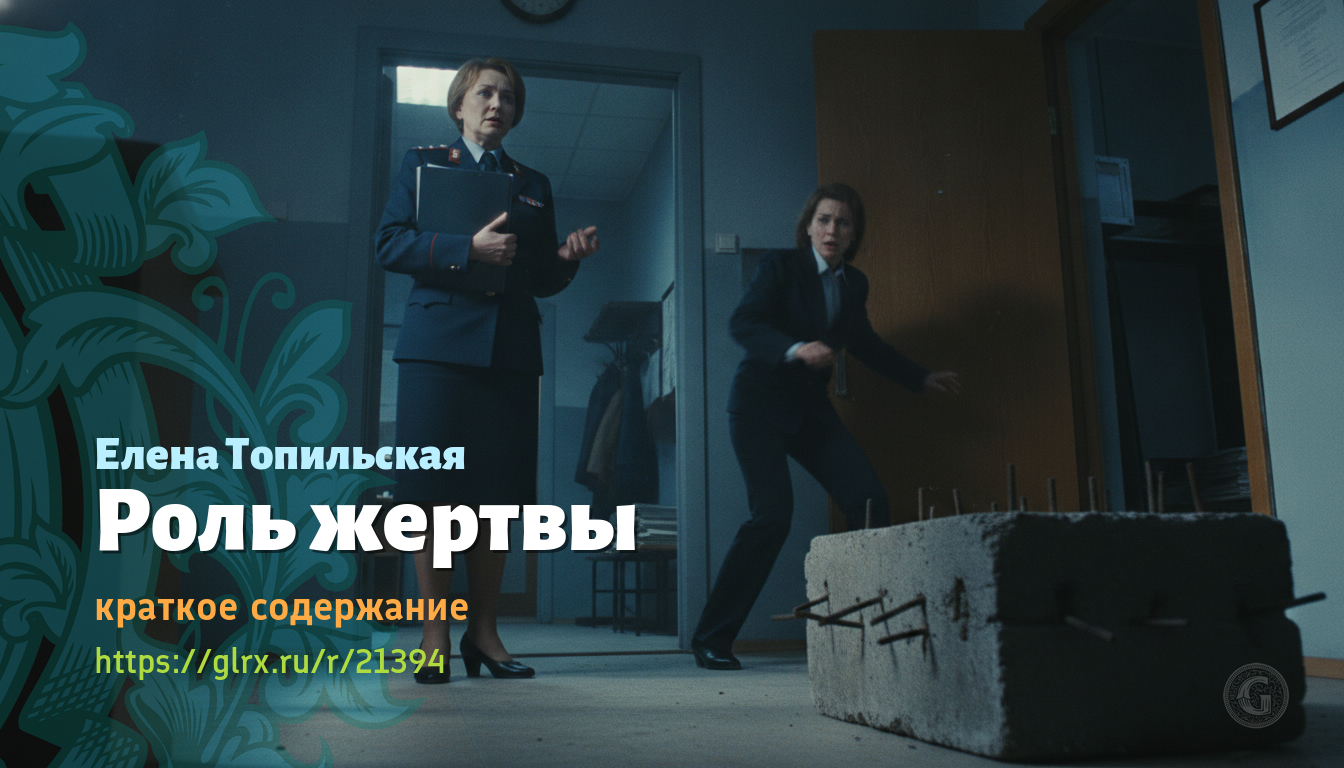
The next day, Masha investigates an accident at a construction site: a defective concrete block fell and crushed a worker. The block, with its protruding rebar, sits in the corner of her office as evidence. The prosecutor demands it be immediately stored in a storage locker before an inspection by the city prosecutor’s office. A colleague and close friend, Alexey Gorchakov, attempts to move the block, slips, and ends up hanging on a rebar — and the concrete monolith slowly collapses on top of him. Gorchakov is taken away by ambulance with a broken leg, and all his cases are automatically transferred to Masha.
A corpse in the apartment
While Masha visits Gorchakov in the hospital, sorting through his work, a homicide detective arrives at the prosecutor’s office: a cadaver is needed. In a large top-floor apartment, a dead woman in a short silk robe lies face down on the floor next to the bed. Empty bottles of diphenhydramine lie nearby. On the vanity, in front of the antique mirror, lies a piece of paper with two lines: "Nobody loves me, I must die."
Masha recognizes the face: it’s Klimanova — the very actress who came to see her. The abundance of stage makeup on the dead face, the red silk blanket carelessly thrown on the bed, the entire setting — everything seems artificially staged. Young detective Pyotr Valentinovich Kozlov notices that the handwriting on the note matches Klimanova’s on the phone bills. It looks like a classic suicide. However, the phrase in the note — word for word the same one used in Latkovsky’s novel — has been haunting Masha.
The murder of operative Burov
That same night, while Masha was working on an inspection, her colleague from the homicide department, Kostya Migulko, received an alarming call: patrol officers had detained a drunk man, covered head to toe in someone else’s blood, and found to be carrying Detective Burov’s identification. A dead man, with a crushed head, lay in the front door of the same building. The body was identified as Burov.
Masha notices a discrepancy: the ID is completely clean, without a single bloodstain, even though the detainee’s hands are covered in blood up to the elbows. The biological swabs show that the detainee has not a single wound of his own — all the blood is foreign. There is no murder weapon on him. Masha concludes that the detainee was framed. Someone killed Burov, drove his body and the detainee’s to this house in a car — the tire marks and blood trails along the wall confirm this — and planted the ID in the pocket of the framed person.
Meanwhile, it turns out that Burov may have tried to call Masha on his day off: her son says someone called. The phone card found in the dead man’s pocket may contain call records and become crucial evidence in the investigation. The story ends there.
- "New Painting" with the latest works of Peter Shvetsov presented ANNA NOVA
- A summary of "The Blonde Trap" by Elena Topilskaya
- "Sheep’s Skin" by Elena Topilskaya, summary
- "Investigative Mania" by Elena Topilskaya, summary
- "Remember Death" by Elena Topilskaya, summary
- A summary of Elena Topilskaya’s "Fatal Role"
You cannot comment Why?