A summary of "The Reprieve" by Jean-Paul Sartre
 Automatic translate
The novel recounts eight September days in 1938 during the Sudetenland Crisis, when Europe stood on the brink of global carnage before the signing of the Munich Agreement. The narrative weaves together dozens of shattered lives into a single, synchronous thread: a conversation in a Parisian café continues in a Berlin hotel, and the thoughts of a Czech teacher instantly shift to the experiences of vacationers on the Riviera. The manuscript was written between 1941 and 1943 in occupied Paris. The work was published in 1945.
This book is the second part of the "Roads of Freedom" novel series. It was preceded by "Age of Maturity" and continued by "Death in the Soul." Chapters from the unfinished fourth volume, "The Last Chance," also survive.
Anxious Friday
In the Sudetenland, schoolteacher Milan Hlinka awaits reprisals from the Nazis. His pregnant wife, Anna, collects windows shattered by cobblestones. Sudeten Germans rage in the streets, and Czechoslovakian gendarmes barricade themselves in a police station. On the Côte d’Azur, philosophy teacher Mathieu Delarue makes Easter cakes out of dry sea sand. He is forty years old. Odette, the wife of his wealthy older brother, Jacques, sits nearby and muses aloud about the possibility of mobilization. Communist Brunet strolls along the luxurious Rue Royale, amid bourgeois storefronts and flannel suits. He sees cracks in the stone of ancient Parisian buildings. In the Berka sanatorium, the paralyzed youth Charles rejoices in the misfortune of others. Healthy people will finally fall to the bottom of the trenches and become horizontal. In Marrakesh, the dapper Pierre buys shoes for his mistress and searches for a medical atlas with photographs of disfigured jaws. Meanwhile, in Godesberg, British Prime Minister Neville Chamberlain vainly tries to reason with Hitler behind the closed blinds of his hotel.
Saturday bustle
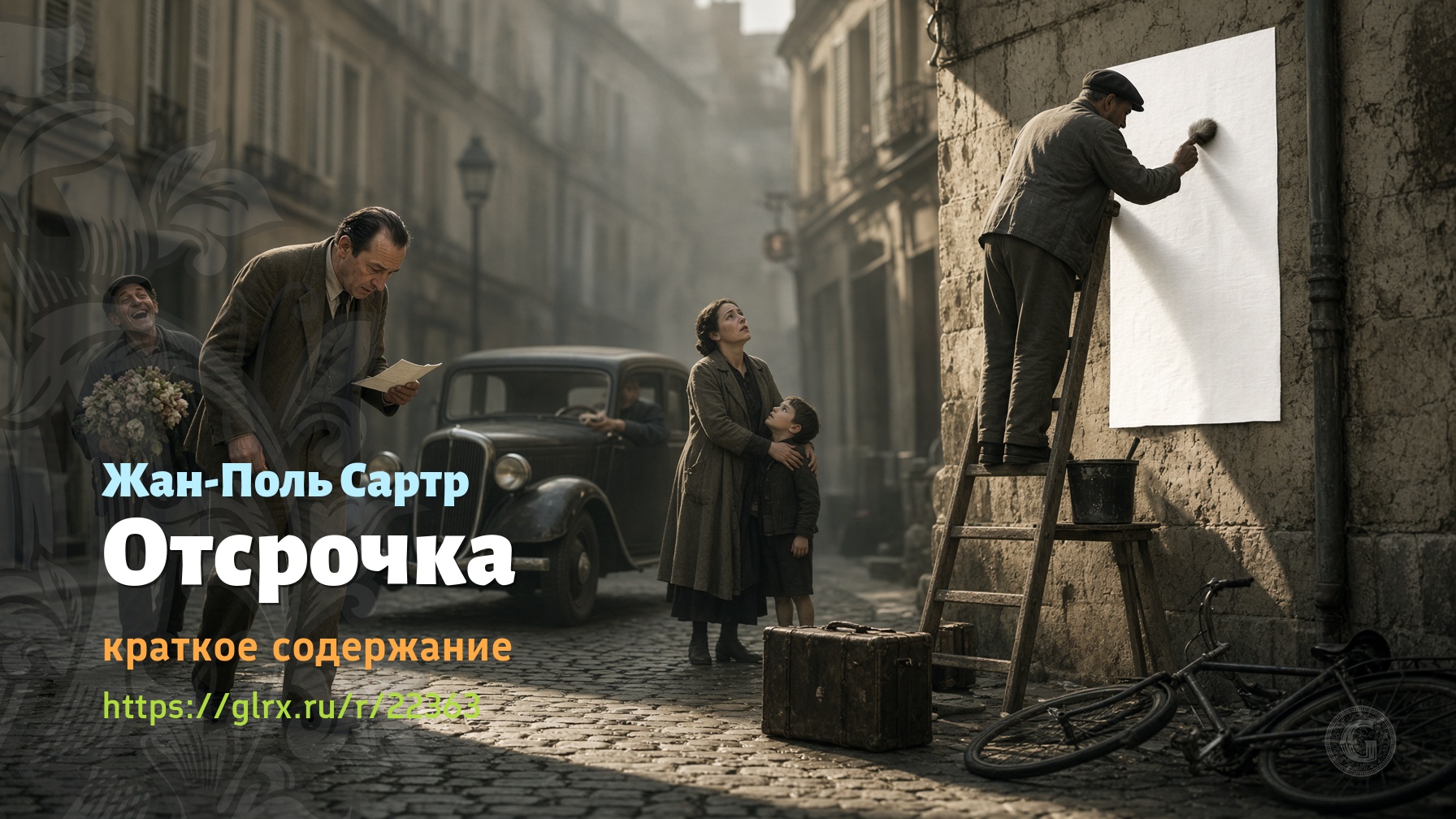
In the morning, the walls of French town halls are covered with white posters calling up second-priority reservists. The village idiot, Papa Kroulard, first posts a decree declaring general mobilization, then runs to tear the paper off with his fingernails on the orders of a cowardly lieutenant of the gendarmes. Peasants drive their purebred oxen to requisition. Panic forces wealthy Parisians to load pots, mattresses, and sewing machines onto the roofs of their cars.
The highway to Normandy is clogged with cars. The crooked flower seller Pascal Montastruc laughs in the middle of the pavement, dodging roaring radiators.
In Juan-les-Pins, Mathieu Delarue finds a military ID card with a fatal "F" in his pocket. His former, orderly life instantly seems like a sham. All twenty years of peace have become a blind sham. In Paris, the jeweler Birnenschatz throws out his impoverished fellow tribesman, Shalom, furiously disowning the worries of others. In Marseille, the vagabond Big Louis searches for a black friend and stumbles upon the port’s pimps. Meanwhile, the young poet Philippe runs away from the house of his stepfather, General Lacaze. The boy proclaims himself a holy martyr of peace, steals his mother’s savings, and orders a false Spanish passport. By nightfall, he hides in a cheap hotel room, listening through the partition to the amorous moans of the worker Maurice and the flower girl Zezette. Philip approaches the proletarian with an offer of desertion, but receives two crushing blows to the jaw.
Sunday dope
The bells call the townspeople to service. The homosexual Daniel Sereno sits in the estate’s garden, dreaming of a devastating bombing. He married the pregnant Marcelle solely for the sake of sophisticated self-flagellation, and now he gazes at the muscular back of the landlord’s son, Emile. The man suddenly freezes with the burning sensation of absolute witness. An invisible divine gaze reveals his nature, leaving him without the right to hide in the darkness.
The trains are overflowing with conscripts. On the platform in Niort, clerk Georges bids farewell to his indifferent wife, envious of someone else’s love. In Berque, nurses load the helpless residents of the asylum into dark freight cars, saving them from the border. Charles falls in love with the voice of his invisible companion, Catherine, as the stench of toilets and rotten straw permeates the floor. Big Louis is robbed blind in the siding near the station.
Mathieu Delarue dines on the embankment with the artist Gomez. He has arrived from Barcelona wearing Republican commander’s stripes. Gomez devours a tournedos with Rossini sauce, openly admiring the bloody delight of real war.
Monday of Ultimatums
A plane carrying French Prime Minister Édouard Daladier lands at Le Bourget Airport. Newspapermen crowd the steps, trying to read the verdict of European civilization on their faces. In the evening, radios crackle with the speech from the Berlin Sports Palace. Hitler sputters, demanding the handover of the Sudetenland by October 1st and threatening to crush the Czech nation into dust. In the middle of a Parisian bar, a young Boris Sergeyev translates the broken broadcast for the patrons. The young man secretly rejoices at the impending massacre. Now he won’t have to spend years in the dreary care of the aging singer Lola. Across town, Philippe gets drunk with a dark-skinned girl named Flossie, drinks away the remains of his stolen francs, and misses the Geneva Express.
The week’s treacherous finale
While the diplomats divide up the map, Philippe, wearing only a shirt, paces the stranger’s room, searching for the trousers hidden by a prostitute. He emerges onto the sidewalk of Saint-Denis, shrieking pacifist slogans at the top of his lungs. Random passersby trample him into rotten cabbage leaves right in front of a grocery store. Mathieu comes to the rescue. The teacher rescues the young man from the onlookers, hands him over to his typist friend Irène, and spends a casual night with her. At dawn, Mathieu hastily tosses the keys to his empty apartment to the returning Iviche, ignoring her tears. On a Parisian bridge, he is suddenly overcome by a cold understanding of his own fate. Freedom reveals itself to him as a void, devoid of attachments, excuses, and former hopes.
On September 29, four powers sign the capitulation of Czechoslovakia in Munich. The Czech delegation is held in the hotel corridor like guilty lackeys, after which Lord Halifax dryly reads them the death sentence for the entire state. A train carrying mobilized troops stalls on a siding amid rusty rails. The soldiers spill out onto the embankment to the joyful ringing of provincial bells. There will be no war. Passengers crack open cheap booze, kiss the station vendors, and uncontrollably praise their saviors.
Mathieu Delarue gloomily gazes at the dusty pavement of the garrison parade ground through the iron fence. He is unable to share this alien joy. At the Paris airport, Édouard Daladier descends the steps toward a roaring crowd with bouquets of flowers. The prime minister grimaces in disgust and whispers the bitter truth about his jubilant fellow citizens to diplomat Alexis Léger.
- "Crimea. Return" - a personal exhibition of Alexei Burtashenkov following the results of the autumn plein air in Crimea
- In the Nizhny Novgorod Theater. Gorky held a press conference on the new work of director Rodion Ovchinnikov
- Exhibition by Ekaterina Belyavskaya "Checkmate and You"
- A summary of "Maturity" by Jean-Paul Sartre
- Three new exhibitions at the Museum of Modern Art in Porto
- Жорж Матьё: абстрактный художник Арт-информель
You cannot comment Why?