A summary of Alexander Ostrovsky’s "The Forest"
 Automatic translate
The play "The Forest," written in 1870, depicts the provincial mores of post-reform Russia, where two worlds collide: the hypocritical environment of a noble estate and the free life of poor but honest itinerant actors. In 1999, director Kirill Serebrennikov created a celebrated television production of this play, and in 2004, he also staged "The Forest" at the Chekhov Moscow Art Theater, a film version of which was recently released. The play won the prestigious Crystal Turandot theater award for best set design.
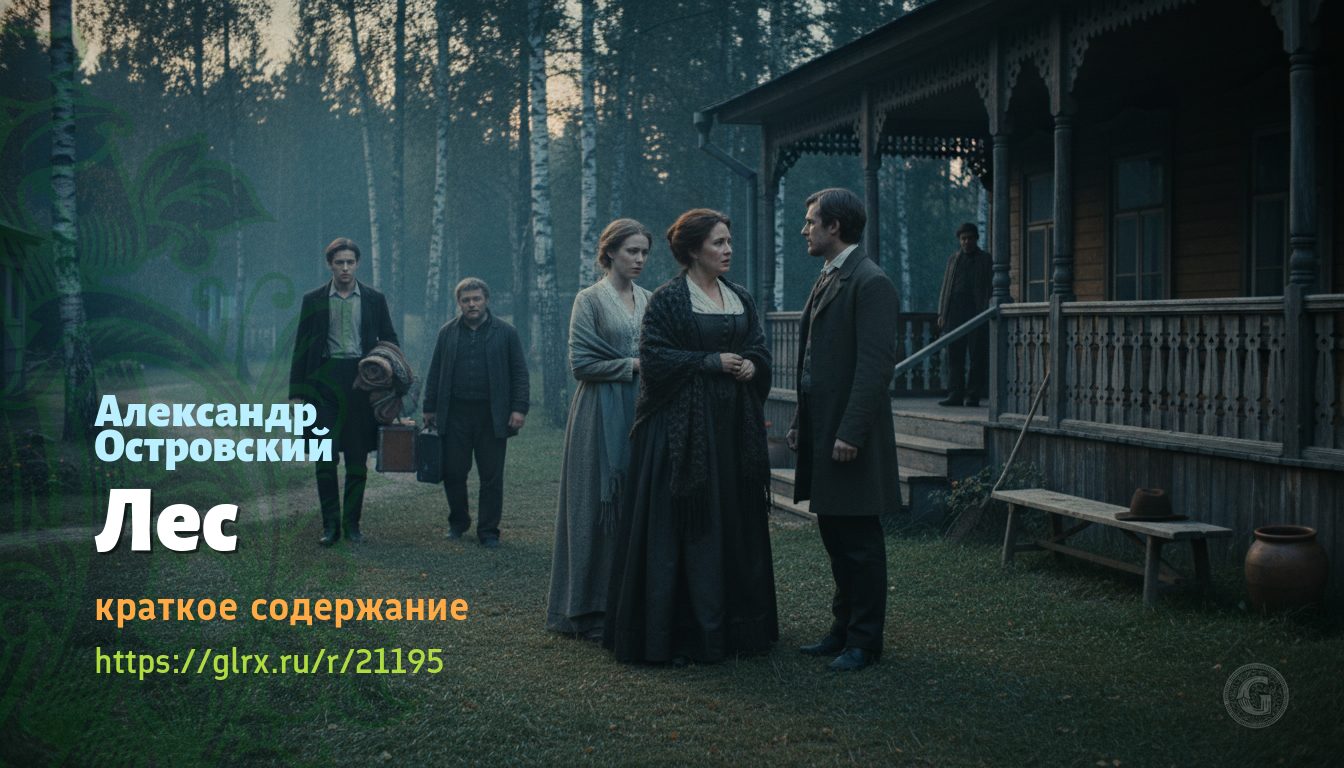
The comedy unfolds on the estate of a wealthy landowner, Raisa Pavlovna Gurmyzhskaya, a fifty-year-old widow. She carefully maintains the image of a pious and virtuous woman, wearing modest clothes and caring for orphans. Living in her house is twenty-year-old Aksinya Danilovna, or Aksyusha, a distant relative. Penniless, she tolerates a dependent position and dresses little better than a maid.
Gurmyzhskaya also has a young man, Alexei Sergeyevich Bulanov, staying with her. He dropped out of high school and was left penniless, so Raisa Pavlovna, a friend of his late mother, took him in. Bulanov tries to court Aksyusha, but she rebuffs his advances. The old servant, Karp, advises Alexei to pay attention to the mistress of the estate herself, hinting at Gurmyzhskaya’s attraction to the young guest.
Business negotiations and secret meetings
Gurmyzhskaya is visited by her wealthy neighbors, Yevgeny Apollonovich Milonov and Uar Kirilych Bodayev. Milonov enjoys discussing lofty matters, while Bodayev is deaf and blunt. Raisa Pavlovna complains to her guests about her relatives’ ingratitude. She tells them about her missing nephew, Gennady Neschastlivtsev. The landowner assures her that she is ready to hand over her inheritance to him if he returns and proves worthy, and also plans to marry Aksyusha to Bulanov.
The merchant Ivan Petrov Vosmibratov arrives at the estate with his son, Pyotr. Vosmibratov is buying the forest from Gurmyzhskaya. The bidding is difficult; the merchant is cunning and underpaying for plots already sold. He proposes marrying Pyotr and Aksyusha if Raisa Pavlovna offers a substantial dowry for her niece. Gurmyzhskaya refuses the merchant, claiming that Aksyusha already has a fiancé, Bulanov. Pyotr Vosmibratov and Aksyusha meet secretly in the garden. The young people are in love, but Pyotr’s father forbids his son to marry a woman without a dowry. Pyotr asks Aksyusha to raise three thousand rubles so that the elder Vosmibratov will consent to their marriage.
The appearance of the actors
In the forest near the estate, two travelers meet on foot. They are wandering provincial actors: the tragedian Gennady Demyanovich Neschastlivtsev and the comedian Arkady Schastlivtsev. Neschastlivtsev turns out to be Gurmyzhskaya’s missing nephew. The actors discuss their poverty, share theatrical tales, and decide to head to the "Penki" estate to rest and improve their financial situation.
Gennady Neschastlivtsev doesn’t want to admit to his aunt that he’s an actor. He pretends to be a retired military man and passes off Schastlivtsev as his footman. Gurmyzhskaya receives guests, although the arrival of her nephew ruins her plans to leave all her property to Bulanov. Neschastlivtsev behaves with dignity, recites poetry, and displays good manners. However, Schastlivtsev soon lets slip to Karp that they are actors, not an officer and a footman.
Intrigues at the Penki estate
Neschastlivtsev overhears a conversation between Gurmyzhskaya and Bulanov. It turns out that Raisa Pavlovna is indeed in love with the young man. She decides to forge documents and transfer her fortune to Bulanov in order to disinherit Neschastlivtsev. Arkady tells Gennady what he’s heard. The tragedian is outraged by his aunt’s hypocrisy, but decides to leave rather than cause a scene.
Aksyusha is desperate due to a lack of money for a dowry. She turns to Gurmyzhskaya for help, but the landowner refuses. Raisa Pavlovna openly states that she plans to marry Bulanov and therefore needs the money herself. Distraught, Aksyusha runs to the river. There, Neschastlivtsev spots her. The girl confesses her misfortune to him and tells him of her love for Pyotr Vosmibratov.
Neschastlivtsev’s noble deed
Gennady decides to help Aksyusha. He doesn’t have any money of his own, so he demands it from Vosmibratov. The merchant is bringing Gurmyzhskaya the unpaid sum for the timber he purchased. Neschastlivtsev forces the merchant to hand over three thousand rubles honestly, threatening him with violence. Vosmibratov is forced to hand over the money, but Gurmyzhskaya keeps it for herself.
Then Neschastlivtsev decides to play his best role for his aunt. He plays out a scene of despair, begging Gurmyzhskaya to lend him money so he can leave. Raisa Pavlovna, eager to be rid of her nephew as quickly as possible, gives him the three thousand rubles. Having received the bills, Neschastlivtsev immediately hands them over to Aksyusha. Now the girl has a dowry and can marry Pyotr.
The actors’ secret is revealed. Gurmyzhskaya and Bulanov attempt to humiliate Neschastlivtsev by pointing out his profession. But Gennady delivers a fiery speech. He declares that he and Neschastlivtsev are honest workers of art, while the real comedians and hypocrites are the estate’s inhabitants. The actors depart Penki with dignity, leaving Gurmyzhskaya with her young fiancé and their greedy neighbors. Aksyusha and Pyotr receive Vosmibratov’s blessing for their marriage.
You cannot comment Why?