A summary of "The Lucky-Unlucky" by Grigory Gorin
 Automatic translate
The play, written in 1997, is a whimsical interweaving of classic theatrical plots and the harsh realities of post-Soviet times. The author masterfully weaves together the fates of Alexander Ostrovsky’s characters with the pressing issues of the late twentieth century. The main characters sometimes appear as themselves, sometimes donning the masks of historical and fictional figures. Grigory Gorin wrote this work specifically for his friends, the actors Alexander Shirvindt and Mikhail Derzhavin.
In 2003, the Moscow Satire Theater produced a television film/performance of the same name. The lead roles were played by Alexander Shirvindt and Mikhail Derzhavin. The production won audiences’ hearts and brought the unique duo of outstanding actors to television.
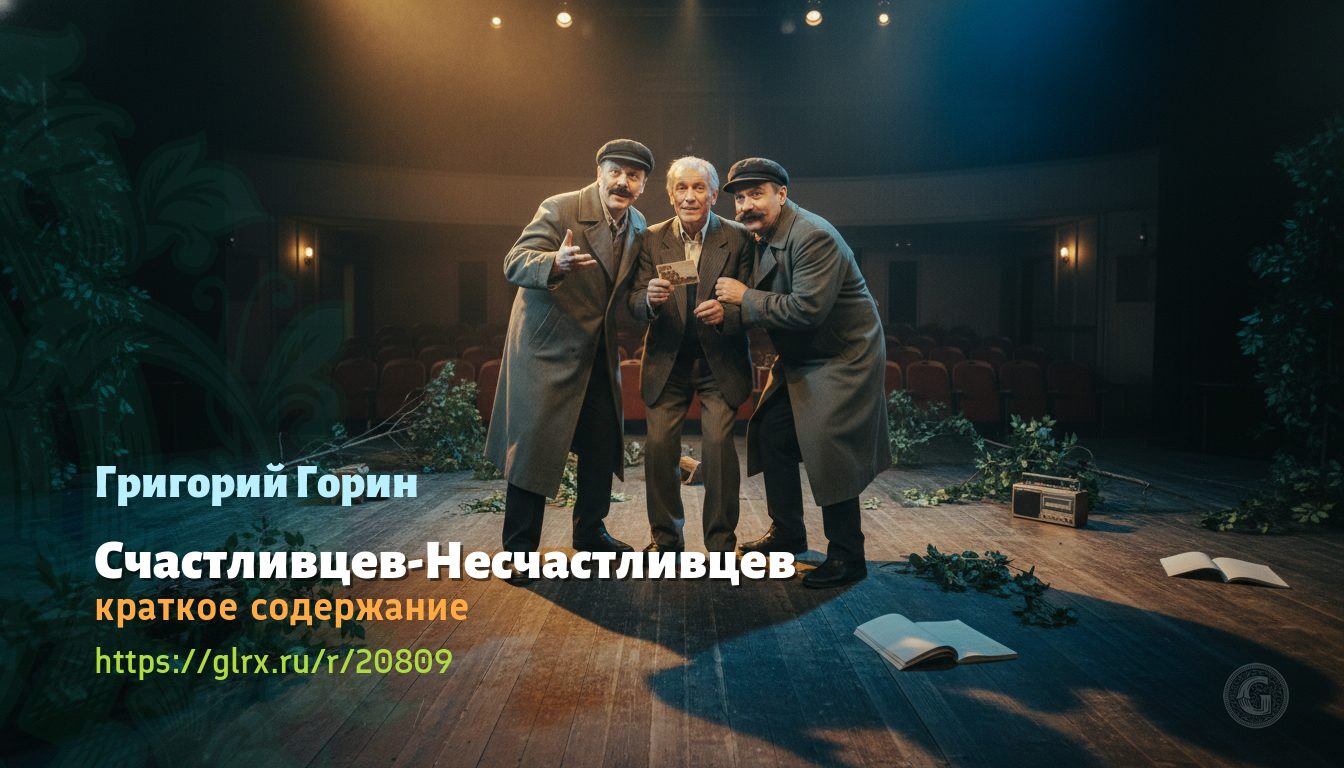
Rehearsal of the play
The action unfolds on the stage of a capital theater. A rehearsal is underway for Alexander Ostrovsky’s play "The Forest," in which the actors portray the tragic actor Neschastlivtsev and the comedian Schastlivtsev. Neschastlivtsev is diligently immersing himself in his role, but his cell phone suddenly rings. Schastlivtsev interrupts the conversation and answers. The tragic actor is furious at the spoiled atmosphere, while the comedian tells his partner a surprising story. He recently starred in a television film as Kliment Voroshilov. During filming, a strange old man named Bodayenko approached the actor and offered him an old postcard for an autograph.
Bodayenko had previously worked in the Central Committee of the Party. Relatives believe their grandfather knows the secret of the missing "party gold," and his greedy grandson-in-law, Milonov, forces the old man to reveal it. Bodayenko is cunning, promising to tell only the true leaders of the world revolution. Milonov finds Schastlivtsev and offers a substantial advance. Schastlivtsev persuades Neschastlivtsev to play along with the old man for the sake of a good salary. The tragedian is outraged by such a hack job, but agrees to help his colleague, after which the actors hastily disguise themselves as Stalin and Voroshilov.
The meeting takes place on stage, amidst a forest backdrop. Actors in makeup appear, and the old man quickly admits he recognizes the popular performers perfectly. Bodayenko explains his ruse: he’s simply stalling for time and escaping from his aggressive relative. The old man hasn’t hidden any party gold, declaring that true wealth lies in people’s hearts. Bodayenko turns on a portable tape recorder and asks the actors to take a souvenir photo. They sing a revolutionary song about the capture of Primorye with the old man until Milonov calls.
The tragedian tells Milonov a ridiculous story about hidden money. Neschastlivtsev claims the capital is in the hands of a black singer performing the role of Lenin in Alfred Schnittke’s opera. Milonov believes the false leader’s words and plans a trip to Amsterdam. Neschastlivtsev gives Bodayenko his personal hundred dollars, imitating Ostrovsky’s noble hero. Then the tragedian decides to stage an acting skit, shooting Schastlivtsev with an antique dueling pistol. The comedian falls in terror, Bodayenko panics and runs away, and Milya, the administrator, persuades the actors over the phone to go on a provincial tour.
Provincial tour
The second act shifts to a regional town. The actors perform on a local stage for the residents of Nizhnegorsk, performing a variety act about Don Juan and his faithful servant, Leporello. Leporello delivers monologues and seeks volunteers. The actors call a random woman from the audience to portray the beautiful Donna Anna, and a large man is asked to play the stern Commander. The skit is a resounding success, after which the exhausted actors hide behind separate screens in a cramped dressing room. Neschastlivtsev complains of a sharp pain in his lower back, and Schastlivtsev takes out a tonometer and measures his blood pressure.
A young, persistent fan enters the dressing room. She hands over programs and asks for autographs directly on her skin, but the actors resolutely shoo her away. Then, local photographer and theater director Alik Marinin appears. Alik begs the guests from the capital to invite his wife, Marina, who is suffering from severe depression after an unsuccessful facial plastic surgery, on stage at the next concert. Alik hopes that Don Juan’s public recognition of her beauty will help restore his wife’s lost peace.
The actors flatly refuse to participate in this dubious therapy. Soon, Marina herself arrives, bringing a jar of honey as a gift and asking them not to listen to her husband. A rather complicated situation emerges: the local theater building has been bought by the criminal businessman Kordyukov. The gangster has set up a roulette wheel in the lobby and is actively running for mayor, while Alik has written a symbolic play about this outrage. Marinin wants to turn the Muscovites’ variety act into a high-profile protest. Schastlivtsev, meanwhile, recalls their recent conversation: at the insistence of the manager, Mili, the comedian has already promised to bring Kordyukov’s wife on stage.
Unexpected visitors
Suddenly, the lights go out, and new, aggressive visitors appear in the dark dressing room. They are representatives of the local power workers’ union’s strike committee, Zvyagintseva and Sudakov. They have deliberately cut off the power to the building in protest against the prolonged non-payment of wages and are harshly demanding that chairwoman Zvyagintseva be brought on stage. The actors categorically reject this ultimatum. The lights suddenly come back on, and police officers with a sniffer dog burst into the room. The police captain chases the strikers away, informs them of a recent phone call threatening a terrorist attack, and begins a thorough search.
The captain methodically checks everyone’s belongings with a hand-held metal detector. He reaches Alik’s leather briefcase, from which the policeman produces a glass bottle of local vodka called "Nabokov." The officer opens the container, sniffs the liquid suspiciously, and ignites a drop in a metal ashtray. A bright chemical flash ensues, and the captain confidently declares it to be an incendiary mixture. Facing a potential prison sentence, Marinin despairs at the absurdity unfolding around him. The director snatches the bottle, pours the pungent liquid onto his clothes, and pulls out a pocket lighter, threatening to start a fire.
The magic of art
Neschastlivtsev reacts without hesitation. The tragedian uses the power of great theatrical illusion and addresses Alik in a loud voice, as if addressing a stone statue of the Commander. Neschastlivtsev delivers the classic lines of the fearless Don Juan. Alik succumbs to the magic of high art and automatically joins in the proposed game. The tragedian boldly takes the glass bottle and lighter from the broken director, then takes a long swig straight from the bottle. It turns out that the bottle contains ordinary, strong village moonshine. The officer decides to smooth things over and allows the manager to begin the second part of the concert.
Neschastlivtsev lies down behind a small screen to rest before going on stage. The audience noisily fills the theater hall. Neschastlivtsev quietly approaches the screen, checks his partner’s physical condition, and in a panic, tugs off his thick cloak. Instead of the resting tragedian, a smiling old man, Bodayenko, is revealed beneath the cloth. The former party worker calmly explains his sudden appearance. Neschastlivtsev secretly went to change for the final scene, tired of lying motionless and listening to the fake sobs of his frightened colleague. Neschastlivtsev returns in a smart black tuxedo, and Schastlivtsev is also hastily changed.
The vibrant final scene begins. Loud, upbeat music plays, and every participant in this strange performance takes to the stage. The actors sing a song about the powerful attraction of art. The lyrics of the musical number celebrate the daily madness of the theater, and the actors sincerely confess their undying love for their challenging profession. The desire to perform and appear before an audience overcomes any everyday difficulties. The packed auditorium enthusiastically takes up the familiar tune, the stage lights burn brightly, and the heavy curtain slowly descends.
You cannot comment Why?