"Don’t Live the Way You Want" by Alexander Ostrovsky, summary
 Automatic translate
This book is a folk drama in three acts, written in 1854. Based on popular oral traditions, it revolves around passion, jealousy, and family conflict in Moscow during Maslenitsa in the late eighteenth century. In 1871, Alexander Serov’s opera "Enemy Force" premiered, the libretto for which was based on this dramatic work.
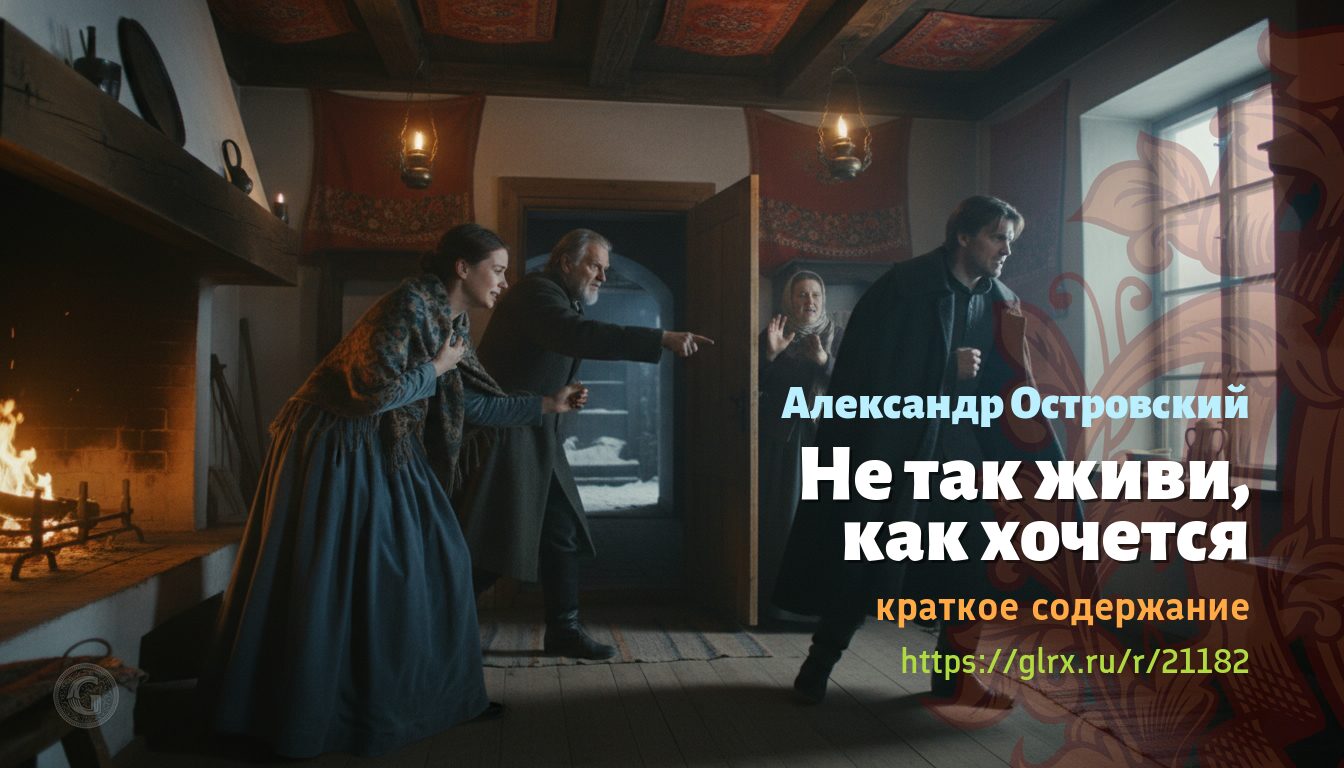
Family discord
The action begins in the spacious home of a wealthy merchant, Ilya Ivanovich. The room is furnished according to old Russian customs. His son Pyotr’s wife, Dasha, complains to her aunt Afimya about her bitter fate. The girl sadly recalls her carefree youth in her parents’ home. She tells her aunt bluntly, "A girl’s happiness is better than a woman’s," because after marriage, only worries and tears begin.
Her husband, Pyotr, has completely lost interest in her. He’s away from home for days at a time, doesn’t attend to his business, and is constantly disappearing to the inn. Afimya tries to calm her niece while doing her usual housework. Dasha sends her housekeeper, Ivan, on a long search for her missing husband, searching through every tavern.
Soon, Ilya Ivanovich himself enters the room. The old merchant sternly demands an answer from his daughter-in-law about the behavior of his negligent son. Dasha defends her husband with all her might, inventing ridiculous excuses. Her father-in-law sees the truth clearly; he doesn’t believe her timid words and promises to punish Pyotr.
Suddenly, Peter himself appears at the door. He demands a clean shirt immediately for another night of revelry. Ilya Ivanovich sternly reprimands him for his incessant drinking and public debauchery. His father utters stern words about living by God’s commandments and not giving in to one’s own momentary sinful desires.
Pyotr brazenly responds to his elder brother. He confidently claims that evil people have drugged him with a magic love potion. The man declares to his father his complete inability to control himself and his passion. Ilya Ivanovich flies into a rage and threatens to deprive his son of his entire legal inheritance and fortune. Pyotr is completely unafraid of these terrible threats. He brazenly laughs at his father and rushes off into the cold street to join his drunken comrades.
After the enraged old man leaves, Dasha tearfully begs her husband to stay home for at least one night. She cries loudly, vividly reminding him of the happy days of their recent marriage, when they lived in peace and harmony. Pyotr remains completely deaf to her sincere pleas and requests. He rudely pushes his wife away and quickly runs off to his mistress, Grusha.
Afimya advises the unfortunate Dasha to pack her things and return to her father’s house forever. Dasha flatly refuses to abandon her wedded husband in such dire straits. She remains alone in the empty, dark room, in utter despair, shedding bitter tears.
Events at the inn
The second act takes place in a spacious hut at a bustling inn. The innkeeper, Spiridonovna, and the young coachman, Yakov, are busily discussing small matters of life and the price of oats. The inn quickly fills with cheerful people. The town is in the midst of a boisterous Maslenitsa week, with pancakes and singing. Spiridonovna rejoices at the handsome profits from the numerous carousing guests.
The landlady’s daughter, Grusha, sits by the frozen window, looking out onto the road. She’s dressed elegantly in expensive silks. She eagerly awaits rich and generous guests, sincerely dreaming of unbridled joy. Her mother sternly advises her to be careful with drunken visiting men and to protect her maiden honor.
Soon, Agathon and his wife Stepanida arrive by sleigh. These tradesmen have traveled fifty kilometers from a distant provincial town to enjoy Moscow. The couple enters the hut and immediately begins to quarrel loudly. Agathon is terribly jealous of Stepanida’s relationship with every young man he meets, suspecting his wife of all sorts of sins.
Stepanida is completely unafraid of her husband and openly calls him a fool. She brazenly asserts her legal right to look at any young men during the celebration. Their noisy squabble provokes loud laughter from everyone in the hut. Agathon constantly waves his arms and threatens his wife with severe physical punishment. Stepanida deftly mocks his empty threats in front of the astonished audience.
Suddenly, the local blacksmith, Eremka, appears. He wears a dirty work apron and brazenly asks for a free vodka. Eremka acts as a kind of demon-tempter for all the weak-willed. He willingly and skillfully incites those around him to the most evil deeds.
Soon, a young merchant’s son, Vasya, arrives at the hut. The young man is clearly attracted to the beautiful Grusha. Vasya gives her sweet honey cakes and nuts and begins masterfully playing cheerful dance tunes on the guitar. At that very moment, a drunken Peter bursts into the room. He loudly demands music, sweet wine, and endless dancing for all the willing guests.
Peter thoughtlessly squanders large sums of money and gives the greedy Spiridonovna a whole handful of gold coins. He begins to persistently court Grusha right in front of the public. The girl eagerly accepts the merchant’s expensive gifts. However, she keeps a cool distance and doesn’t let Peter get too close.
Grusha boldly tells her suitor, "I need a free man," rejecting the married merchant’s advances. She has absolutely no need for a married merchant with a living wife for a serious relationship. Pyotr sits down at the oak table to drink strong vodka with Yeremka. The blacksmith loudly sings wild bandit songs about robberies and murders.
Pyotr tearfully complains to him of his unbearable heartache and love for Grusha. Yeremka ominously hints to his drunken drinking companion about the possibility of very easily getting rid of his loathsome legal wife forever. The blacksmith tells him terrifying, bloodcurdling stories of dark, moonless nights and accidental deaths.
These words sink deep into Pyotr’s inflamed mind, clouded by strong alcohol. He begins to seriously rave about the imminent physical elimination of the unfortunate Dasha. Agathon and Stepanida are also involuntarily drawn into the general commotion. Pyotr spitefully and cruelly mocks the jealous, clumsy Agathon. Then, in a complete frenzy, Pyotr rushes out into the frosty night street. He loudly shouts, "Dark night, deep snow!", frightening everyone around him.
Dark night
The third act unfolds on a snowy, frosty street in front of Peter’s large house. It’s late evening on the last day of Maslenitsa. People are joyfully and noisily celebrating, riding fast sleighs with bells, and singing ringing ritual songs in chorus. The exposition gradually gives way to the work’s climax.
Pyotr wanders aimlessly, completely alone, in pitch darkness. He’s completely lost his sanity from the torment of searing jealousy and the enormous amount of wine he’s consumed. He quietly mutters chilling, terrifying words under his breath about a sharp steel knife and hot human blood.
Dasha, in a state of deep, unbearable grief, also emerges from the empty, cold house. She slowly walks through snowdrifts toward the frozen Moscow River. She seriously considers committing suicide immediately in the icy, black water to end her mental anguish.
At the same time, old Ilya Ivanovich appears on the street, holding a dim lantern. The gray-haired merchant is desperately searching the city for his missing son. Passersby tell the worried old man alarming news about the drunken and violent Pyotr. Ilya Ivanovich is desperate to find him before some irreparable, terrible disaster befalls him.
Pyotr accidentally spots a smartly dressed Grusha on a dark street. He rushes toward her and rudely demands immediate reciprocity and love. Grusha pushes him away with disgust and force. She boldly calls the rich merchant a pathetic, worthless drunkard. The girl mercilessly tells him to his face that she only ever wanted his large sums of money and expensive, lavish gifts.
She turns abruptly and quickly walks away, arm in arm with another cheerful and sober suitor. Pyotr is instantly overcome with indescribable, wild rage at this incredible public humiliation. He takes off running towards the river as fast as he can.
In the darkness on the frozen, slippery shore, Pyotr suddenly encounters Dasha. Due to the darkness, he doesn’t immediately recognize his own lawful wife. When Pyotr finally understands the identity of the trembling woman standing before him, a blind, animalistic hatred flares within him like a bright flame. He quickly draws a long, sharp knife from his bosom and swings it high at his defenseless wife. Dasha screams loudly and piercingly, then falls limply to the snow, unconscious from a deathly, icy fear.
At this most tense moment, an incredibly loud ringing of a large church bell resounds over the sleeping city. The solemn evening peals before the strict fast begin. This pure, holy sound instantly sobers Peter, distraught from grief and vodka. In wild terror, he throws his knife onto the cold, white snow.
The weeping man suddenly comes to a clear and complete understanding of the gravity and sinfulness of the bloody crime he had planned. The dramatic denouement begins. Pyotr falls to his knees in tears before Dasha’s motionless body. He sobs loudly and panics as he contemplates his wife’s sudden death from a broken heart. Dasha slowly comes to, groaning. Pyotr fervently begs her for swift forgiveness for all the unbearable suffering she has caused him.
A breathless Ilya Ivanovich runs through the deep snow to the scene of these dramatic events. Pyotr, sobbing loudly, throws himself at the feet of his dear elderly father. He loudly and sincerely repents of his grave, mortal sins before heaven and man.
The son openly admits all his past grave mistakes and tearfully vows to forever forget his drunken, reckless revelry. Dasha, with genuine tears in her eyes, completely forgives her sincerely repentant husband. Ilya Ivanovich, with great joy in his heart, blesses the reunited young family. Pyotr, through his own harrowing life experience, is finally convinced of the truth of his father’s wise words about the need to live righteously according to the laws of goodness.
- A summary of Alexander Ostrovsky’s "Family Picture"
- St. Nicholas Solbinsky Monastery invites to the feast of the Holy Apostles Peter and Paul
- Opening of the bust of the pilot, Hero of the Russian Federation A.S. Maslov by Z.K. Tsereteli
- Exhibition "Russian Impressionist Konstantin Korovin" from the collection of the Russian Museum
- A summary of "At-Davan" by Vladimir Korolenko
- Plato’s "Feast", summary
You cannot comment Why?