A summary of "The Heart is Not Stone" by Alexander Ostrovsky
 Automatic translate
Alexander Ostrovsky’s play, written in 1879, is set in merchant Moscow and hinges on the clash of money, the fear of death, domestic despotism, and quiet moral strength. At the center is Vera Filippovna, the young wife of the wealthy old merchant Potap Potapych Karkunov, who has lived for many years virtually in seclusion yet retains a keen compassion for others.
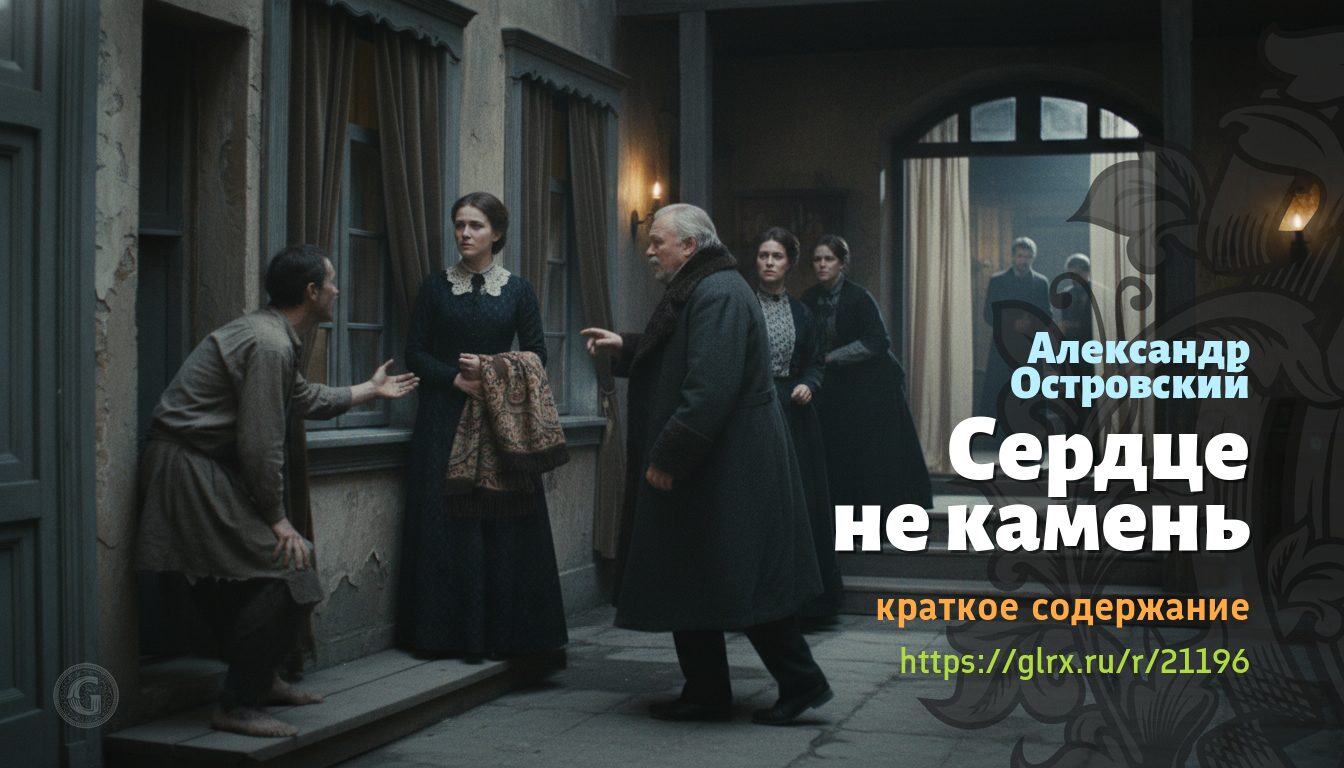
At the beginning of the play, Isai Danilych Khalymov, the owner’s godfather, is expected at the Karkunov house because Potap Potapych has decided to write a will. The merchant’s nephew, Konstantin Karkunov, is immediately alarmed: he’s accustomed to considering himself the natural heir and has already squandered his own money in hopes of his uncle’s capital. His wife, Olga, has little understanding of business but quickly discovers the same greed, and conversations in the house reveal that the will is becoming the main event of the day for everyone.
While the men confer, Vera Filippovna converses with Olga and Apollinaria Panfilovna, Khalymov’s wife. This conversation reveals her entire life: for fifteen years, she barely saw the light of day, rarely left home, ignorant of city life, and lived under her husband’s jealous watch. She recalls how, after their wedding, she once went to the theater, but Karkunov, noticing a stranger’s glance in her direction, immediately took her home and from then on almost deprived her of any outings. Wealth did not bring her freedom; she found solace in helping the poor and visiting monasteries.
This conversation immediately reveals the differences between the heroines. Apollinaria Panfilovna and Olga reason cynically, talking about male infidelity, women’s wiles, and the way in which everyone seeks profit or pleasure in love and marriage. Vera Filippovna responds quite differently: she doesn’t portray herself as a saint, admitting that she married for the family’s convenience, but she hasn’t lost her compassion for people or the habit of judging herself more harshly than others.
Meanwhile, Potap Potapych dictates one will in Konstantin’s presence, but after his departure, he reveals a completely different plan to Khalymov. Initially, he ostensibly intends to leave a huge share to Vera Filippovna, his trade and factory to Konstantin, and money for his service to Erast. However, in reality, the old man fears for his soul and intends to donate almost his entire fortune to memorial services, alms, and church needs. He agonizingly vacillates between greed, jealousy of his wife, and fear of judgment after death. He admits to having wronged both his wife and his clerk, but still, above all, he thinks of the salvation of his own soul.
After this, Konstantin and the clerk, Erast, begin their reckoning. They realize that under the new order, they could both be left with nothing, and Konstantin proposes a dastardly scheme: compromise Vera Filippovna so that Karkunov will disinherit her. Erast has already tried to appeal to pity, feigning an orphan and eliciting sympathy from his mistress; now Konstantin pushes him further, promising money if the scheme succeeds. Along the same line, Innokenty appears, a powerful and degraded wanderer with a criminal past, whom Konstantin wants to use for drunken dalliances and, essentially, for dirty deeds.
In the second act, Vera Filippovna encounters Innokenty at the monastery wall, who first begs for alms and then almost resorts to outright robbery. She is undeterred, does not voluntarily hand over the money she has prepared for the poor, and speaks to him as a lost soul, not a monster; the chance approach of help saves her from violence. Almost immediately afterward, Konstantin meets Innokenty, quickly recognizes him as a man of brute force and criminal skill, and draws him into his orbit.
Meanwhile, Erast grows closer to Vera Filippovna. He thanks her for the secret gifts, talks about being an orphan, asks not for money but for affection and compassion, makes her cry, and finally manages to kiss her hand. To Vera Filippovna, this seems like the innocent consolation of a man who lacks warmth, but Apollinaria Panfilovna almost immediately throws her a different look: she hints that Erast is involved with Olga and, in general, knows how to adapt to any woman. After these words, Vera Filippovna distances herself, and Erast, seeing the change, begins to appeal to fear and pity, almost talking about suicide.
The night scene on the ground floor of the house becomes the central hub of the entire play. Vera Filippovna arrives to save Erast from death, but hides and accidentally overhears his conversation with Olga. It turns out that Olga has a long-standing affair with him, is jealous of his aunt, and fears losing her lover. Even more terrifying is the other meaning of the conversation: the meeting with Vera Filippovna was intended as a trap, after which Karkunov and Konstantin were to catch her at Erast’s and deprive her of her good name and inheritance.
When Vera Filippovna emerges from hiding, the entire game falls apart. Erast realizes she’s heard everything, and for the first time feels genuine shame. Vera Filippovna doesn’t make a scene or seek revenge; she says she made a mistake in taking on the task of delving into other people’s souls, because people are easily deceived if they want to delve deeper into their affairs than they can handle. Her moral conclusion is simple and strict: one must help those in need, but not pretend to be a judge if one can’t distinguish truth from lies. She forgives Erast, but severing all ties with him, he remains conscious of his own baseness and says it’s better to be poor than to live by such things.
Karkunov, Khalymov, and Konstantin soon return. The old man, who has already realized much, first showers his nephew and clerk with drunken good-natured praise, but then abruptly changes his tone: he dismisses Erast and fires Konstantin without any hope of further patronage. He bluntly shows that his nephew is guilty simply for daring to oppose Vera Filippovna, whose moral high ground is now beyond doubt.
In the final act, the remnants of intrigue can no longer change the outcome. People still hang around the house, attracted by Karkunov’s money, the old will, and rumors of wealth, but the owner himself has changed internally. His former fear of his wife’s possible freedom recedes: he no longer talks about binding her with conditions after his death, and he ceases to measure everything by suspicion alone. He sees that Vera Filippovna is by nature kind and will not deviate from mercy under any circumstances.
The finale builds on Karkunov’s late softening. He acknowledges that Vera Filippovna is the one who knows how to manage the wealth fairly and conscientiously, and he hands over control of the house and fortune to her. For him, this is no longer a whim or a concession, but a bitterly earned confession: the person he held captive for so many years has proven purer, wiser, and morally stronger than anyone else who swung around his money. The old man’s final words are addressed to her with trust and gratitude, and the play’s title takes on a clear meaning: even a harsh and suspicious merchant’s heart is not made of stone.
- "Mafia Sets Up a Meeting" by Elena Nesterina, summary
- Bear in Rus’: a symbol in art and crafts
- "Late Love" by Alexander Ostrovsky, summary
- Tolerate, endure, endure. The witness diary of a tragic era
- Children’s play "Play a book" from 3 years
- A summary of "The Adept of the Heather Moors" by Maria Danilova
You cannot comment Why?