A summary of "The Morning of a Young Man" by Alexander Ostrovsky
 Automatic translate
This dramatic sketch was created in 1850. This book is a satirical reflection of Moscow life in the mid-nineteenth century. The merchant class clumsily adopts social manners. The protagonist strives to appear aristocratic, recklessly spending enormous sums to maintain an artificial image. The text exposes the stark conflict between traditional ways and empty tributes to fashion. The author meticulously documents social metamorphoses. The plot revolves around one morning in the life of a bored young man.
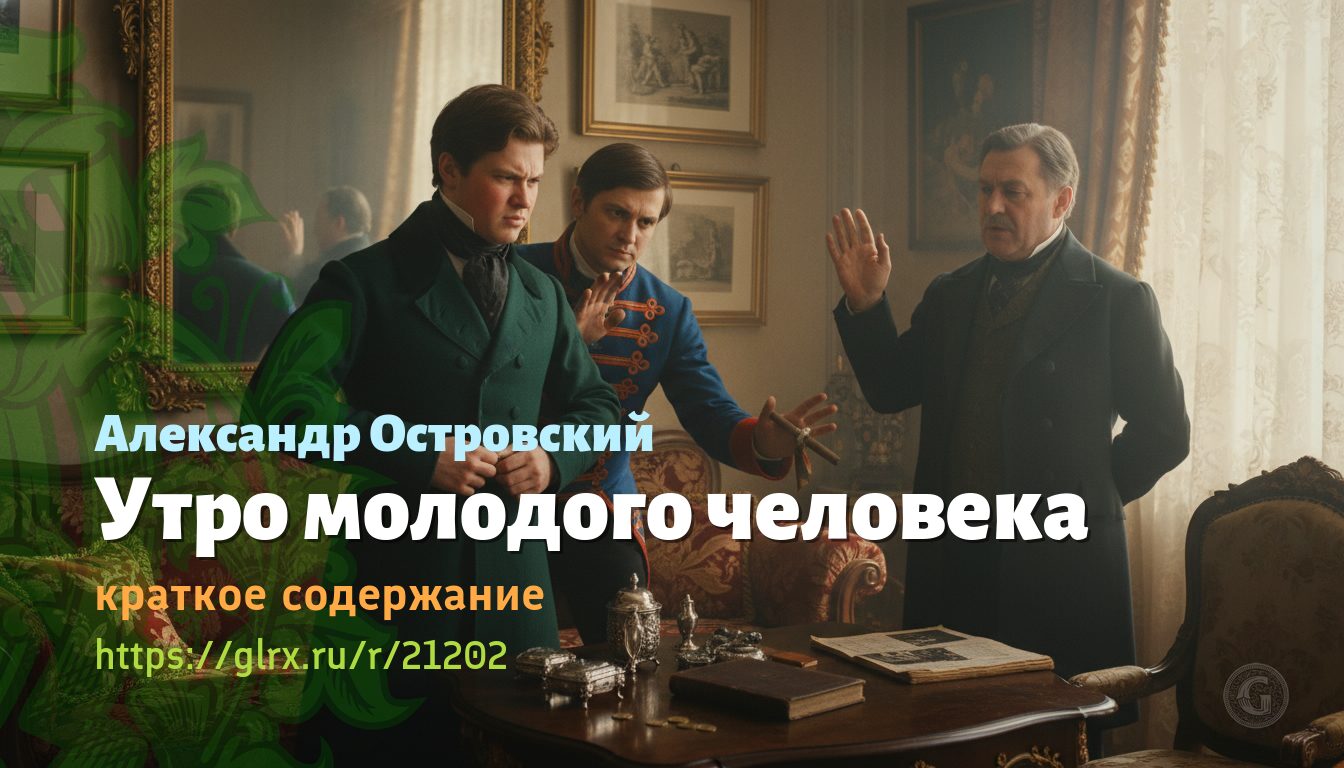
Lackey hierarchy and new orders
The action unfolds in the richly furnished room of Semyon Paramonych Nedopekin. The furnishings betray an extreme pretension to refinement. The viewer sees a Turkish sofa, a desk with expensive fittings, a massive dressing table, prints on the walls, and luxuriously draped windows. Mornings begin late for the inhabitants of the house. Ivan, the servant, and Sidorych, the clerk, are chatting lazily in the room. Sidorych has come on an errand for Nedopekin’s aunt. He invites his nephew to visit for the evening. Ivan haughtily replies that his master will not be coming. The servant sincerely disdains merchant customs. He openly mocks the fact that the relatives eat from the same bowl and go to bed at eight o’clock in the evening.
Ivan boasts about his master’s new life. The footman claims that Nedopekin deliberately wakes up at one o’clock solely for the sake of maintaining good manners. The master diligently copies the manners of those around him. He watches how other people walk at the theater or at parties, and then spends a long time rehearsing his poses in front of the mirror. Ivan behaves like the rightful manager of his property. The servant prides himself on having previously worked for General Simevich and is well versed in all the social customs. He brazenly offers Sidorych expensive cigars worth fifty rubles per hundred. Sidorych modestly asks for a couple, but the footman forces him to take a whole ten.
The clerk fears the owners’ wrath for such extravagance, but Ivan confidently declares that there’s plenty of it in the house. Sidorych hurries away. Left alone, Ivan scolds the boy Grishka for his constant idleness. Grishka snaps back and rightly points out that Ivan himself spent the entire morning simply reading the "Pchela" newspaper. The argument is interrupted by the doorbell.
The search for profit and wounded pride
Sidor Dmitrich Lisavsky appears in the room. He behaves completely unceremoniously, freely accepting cigars and trying to find the latest issue of the magazine "Library for Reading." Ivan reluctantly tolerates the guest, demanding the return of previously borrowed books. The footman asks Lisavsky to stop stealing the master’s things. Lisavsky waves him off and complains about the servant’s insolence. Left alone, Sidor Dmitrich finds an article about the theater in the magazine. He reads a scathing review of his own vaudeville. The text reads: "A joke in one act, and if it weren’t for the door to the street, it wouldn’t be a joke, but a serious matter." The critic delivers a harsh verdict: "Not the slightest talent!" Lisavsky flies into a rage.
The writer suspects an acquaintance, to whom he long owed fifteen rubles, of authoring the article. Lisavsky’s mood darkens even further when he notices the frayed sleeve of his tailcoat. The writer decides to procure new clothes from a wealthy friend. He calls Ivan over and asks him to tie Nedopekin’s green tailcoat into a scarf. Ivan flatly refuses to do so without a direct order from his master. The servant reminds the guest of his past sins. It turns out Lisavsky had already borrowed a bekesha (coat) once and worn it until it was threadbare. Sidor Dmitrich tries to appeal to his pity, calling Ivan an honest man. The footman coldly rejects such empty words.
False society
Two young men appear at the door. The second guest flatly refuses to enter. He’s ashamed to impose his company on a stranger merchant for the sake of free meals. He arrogantly declares, "After all, we’re honoring him with our acquaintance, not he us." The first friend cynically explains the obvious advantage of associating with a rich man. Nedopekin has delicious food and can always borrow money. The second guest goes off to Chevalier’s restaurant. The first guest stays and strikes up a flattering conversation with Lisavsky. They recall a caustic passage from Lisavsky’s poem: "Though he sells poorly in the rows, / Yet he climbs into the front row seats."
Finally, Semyon Paramonych himself emerges from his office. He apologizes for waking up late, proudly declaring that he always gets up at half past twelve. The merchant clumsily justifies this by citing long evening reading. When the guest asks about literature, Nedopekin confidently replies that he subscribes to scholarly works and French novels. Semyon Paramonych confesses his desire to hire the best singing teacher and write his own poetry. The first young man promises to introduce his host to a most intelligent literary figure during dinner at Chevalier’s. Nedopekin accepts this tempting offer with undisguised joy. The guest bids farewell and hurries away.
Breakfast of the False Aristocrat
Nedopekin asks Lisavsky to teach him French as soon as possible. The young merchant considers reading Russian books a great disgrace. Lisavsky begins to openly flatter his host. He calls Semyon Paramonych a true Apollo and the ideal man. Nedopekin twirls happily in front of the mirror. Lisavsky smoothly steers the conversation to his friend’s wardrobe. He harshly criticizes his friend’s green tailcoat, calling it utterly tasteless. Nedopekin easily succumbs to this crude manipulation and orders Ivan to immediately return the tailcoat to his guest.
The friends are getting ready for breakfast. Lisavsky demands elegant dishes. He wants asparagus and a good Lafite. The host produces a vintage bottle of wine but suddenly refuses to pour his guest’s drink. An absurd argument ensues. Lisavsky is deeply offended, declaring that Nedopekin has no understanding of taste and only cares for the expensive label. The writer threatens to leave. Nedopekin sternly rebukes him, demanding repayment of old debts. Lisavsky instantly calms down and recites his new poems. The romantic lines mention airy peris and fairies. Nedopekin doesn’t even know the meaning of these foreign words. Before leaving, the host gives Lisavsky money for front-row seats.
Bankruptcy and family shame
Nedopekin leaves, ordering the servants to resew the buttons on Grishka’s suit. The master dressed the little boy in a ridiculous jockey’s suit, to match English fashion as closely as possible. Soon, Uncle Semyon, the merchant Smurov, and his nephew Vasya arrive at the empty apartment. The relatives quietly discuss the catastrophic state of affairs. The terrible truth is revealed: the young dandy has racked up enormous debts amounting to five thousand silver rubles. He mindlessly signs promissory notes under his mother’s power of attorney.
The situation has reached its breaking point. Vasya reveals that one of the payments was transferred from the Belorybitsyns to Semyon Arefyich. Now this tough creditor is openly threatening to drag Nedopekin’s mother into debt. Smurov looks around the room and is astonished by his nephew’s utter stupidity. Vasya picks up a book from the table and assumes it’s French. Smurov laughs outright, since Semyon doesn’t speak any languages. Expensive items and books are there solely to show off to the naive guests.
The merchant notices Grishka in his ridiculous attire. Smurov feels genuine pity for the boy. His uncle realizes that Semyon is simply tormenting the servants for the sake of false pomp. Grishka admits that he doesn’t do anything worthwhile except run errands and dust. Smurov strongly advises the boy to apply for a job in a real merchant’s shop, so as not to waste his life and become an independent man.
Ivan hands Smurov paper and a pen, offering to write a note for his absent master. His uncle rudely cuts off the arrogant footman. He orders him to verbally convey a stern ultimatum to his nephew. Smurov will personally force his mother to revoke the power of attorney for managing his money. His uncle plans to publish an official announcement in the newspapers about the family’s refusal to pay Nedopekin’s bills. Smurov declares he will not say another word to his nephew. The relatives resolutely leave, leaving a stunned Ivan in the empty apartment.
- Александр Невский
- Александр Македонский
- Александр Бенуа: художник и сценограф
- “Молодой заяц” — Альбрехт Дюрер
- Александра Вейхерт, современный скульптор
- “Туманное утро”, Альфред Сислей
- Человек-лев из Холенштайн Штадель
- Александр Архипенко: русский скульптор-кубист
- Александр Колдер: американский скульптор, художник-кинетист
You cannot comment Why?