A summary of "A Hangover at Someone Else’s Feast" by Alexander Ostrovsky
 Automatic translate
"A Hangover at Someone Else’s Feast" is a comedy by Alexander Ostrovsky, written in 1856 and first performed that same year at the Maly Theater. The play’s action is set in Moscow, where the impoverished home of a retired teacher and the wealthy merchant class, with their brutal power of money, are juxtaposed. Already in the opening, Ostrovsky juxtaposes education without means and wealth without culture, and the entire subsequent course of events is built on this stark juxtaposition.
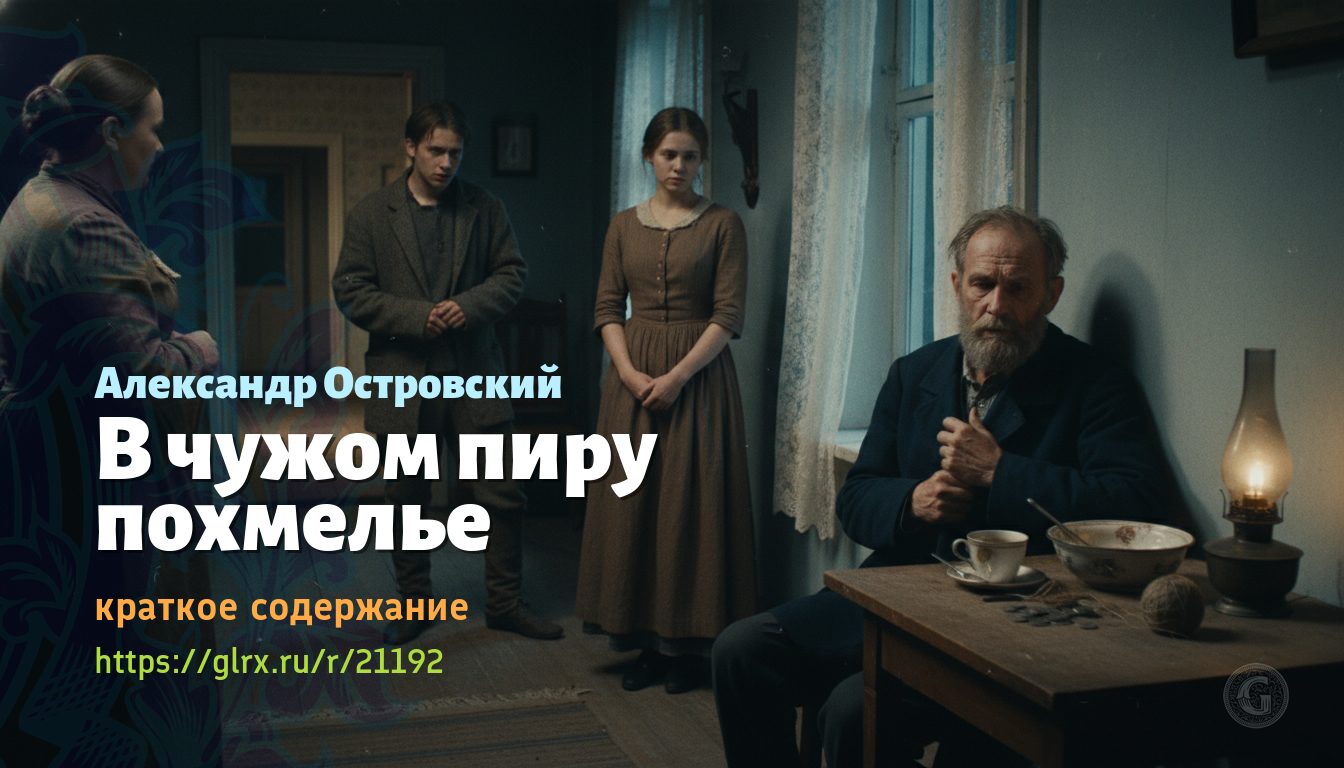
Act One
At the beginning of the play, Ivan Ksenofontych Ivanov, a retired teacher, lives with his daughter, Lizaveta Ivanovna, in a poor rented room belonging to the widow Agrafena Platonovna. His landlady urges him to consider his daughter’s marriage, bluntly naming a young merchant’s son, Andrei Titych Bruskov, who is wealthy and has been visiting them for a long time, as a suitable suitor. Ivanov is indignant: for him, Andrei is an ignorant, almost illiterate man, and the very idea of Liza marrying a merchant seems insulting. Agrafena Platonovna, on the other hand, argues simply and harshly: without a dowry, a girl is difficult to marry, poverty is dangerous, and honesty without money does not protect one from poverty.
After the landlady leaves, Ivanov speaks to Liza and cautiously asks if she harbors any feelings for Andrei Titych. Liza answers calmly and firmly: there is no love, and the young merchant strikes her as uneducated and awkward, though this response conveys not mockery but a measured assessment. Ivanov, embarrassed by his suspicions, hurries to his lessons, and in the brief scene between them, it’s clear that father and daughter live very poorly, yet are bound by mutual tenderness and respect.
Left alone, Liza reflects on her life and her father’s fate. It’s not the poverty itself that torments her, but the fact that honest work brings neither wealth nor honor, and that her old teacher is ridiculed for his shabby clothes and poor appearance. These complaints betray a weariness from constant humiliation: she understands that in their circle, a person is judged not by intelligence or usefulness, but by his wallet and outward appearance.
Then Andrei Titych arrives, and this scene dramatically changes the tone of the play. Behind the crude words and merchant-like turns of phrase, a man is revealed to be unhappy and depressed: his father is forcing him to marry a rich but unloved girl, and he is denied his own freedom in choosing a bride, his studies, and his habits. Andrei explains that he would like to study, loves the violin, secretly practices music, dreams of a freer life, and feels crippled by his upbringing. Liza initially reacts to his confessions with caution, but then takes genuine pity and advises him to speak frankly with his father, hoping that a rational conversation can change things.
The conversation between them becomes increasingly intimate. Andrei confesses his love awkwardly, haltingly, almost childishly, and it is precisely this awkwardness that makes his words ring true. He asks permission to kiss Lisa’s hand, crying from emotion and despair, and Lisa, although she doesn’t reciprocate, doesn’t push him away rudely and sees him not as an empty braggart, but as a man who has been broken and shamed at home.
After Andrei leaves, the landlady becomes even more determined to discuss marriage. She’s convinced that the Bruskovs’ wealth could save Liza from poverty, and advises her to endure humiliation for the sake of a future life of comfort. Liza rejects this plan without hesitation: she abhors the idea of living in a family where the son is ignorant and the father is rude and domineering, and she prefers poverty to dependence on other people’s money.
Immediately after this, Tit Titych Bruskov bursts into the house, searching for his son. He speaks unceremoniously to Liza, hinting at her desire to marry Andrei, and behaves like a man accustomed to breaking others’ wills wherever he goes. After Liza leaves, Agrafena Platonovna unexpectedly changes the scene and shows Bruskov a receipt signed by Andrei: in it, he supposedly pledges to marry Lizaveta Ivanovna. It turns out that she herself, having taken advantage of his infatuation and gotten him drunk, drew up the document, and is now bargaining with Tit Titych, selling him the receipt for a thousand rubles.
Returning home, Ivanov discovers the consequences of this deal and at first can’t understand it. Agrafena Platonovna, almost proud of her cleverness, explains that she acted as if she were acting for him and Liza’s sake and swindled the merchant out of money, relying on a document signed by Andrei. This is a heavy blow for Liza: she views the incident as a disgrace, while Ivanov sees the story as further proof that a poor and honest man can be dragged into someone else’s filth at any moment. He takes the money, resolves to return it immediately to Bruskov, and redeem the receipt at all costs to erase the traces of this dishonor.
Act II
In the second act, the action shifts to the Bruskov household, and here Ostrovsky depicts the same conflict from within the merchant world. First appears the youngest son, Kapiton, a dimwitted boy kept in the kitchen and entertained with absurd theatrical antics. Then, in a conversation between Nastasya Pankratyevna, Tit Titych’s wife, and Nenila Sidorovna, the Bruskov household is revealed: the mother complains about her sons, fears their erudition, believes in love spells, and dreams of marrying Andrei to a rich bride, disregarding his feelings. Thus, the comical everyday chatter suggests that ignorance has become the rule of life in this family.
Andrei, appearing before his mother and guest, again tries to explain that Lisa is above their usual circle in upbringing and mentality. He can’t find the right words, but he clearly senses the difference between this educated girl and the environment in which he grew up. His speech again trails off in frustration: he knows he must submit, and therefore asks to at least be spared the painful wait.
When Tit Titych returns home, the mood of the scene darkens. The merchant is seething with anger over the incident with the receipt and calls the solicitor Zakhar Zakharych to fabricate a denunciation of Ivanov, Liza, and Agrafena Platonovna, even helping to exile them to Siberia. This episode particularly clearly shows how easily a tyrant combines money, personal grievances, and the certainty of impunity. For him, the law is not a measure of justice, but a cudgel with which to strike any weak person.
Then Tit Titych summons his son and tells him his version of events. He assures Andrei that everyone in the Ivanov household deliberately deceived him, took a receipt, and extorted money from his father, and that the beautiful Liza is no better than the rest. Andrei is shocked: he easily believes this crude lie, because he knows too little about life and is accustomed to thinking of himself as the prey of someone else’s cunning. At that very moment, his feelings for Liza do not disappear, but a bitter humiliation and self-distrust appear alongside him.
The decisive scene begins with Ivanov’s arrival. The old teacher brings the money back, humbly explains that neither he nor his daughter knew about the mistress’s trick, and asks only one thing: the return of the receipt. Tit Titych and Zakhar Zakharych initially mock him, suspecting a new scheme, deliberately delaying, and even laugh when he desperately begs them to spare his daughter. Ivanov falls to his knees, ready to give up everything he earns just to destroy the receipt, because for him, it’s not a question of money, but of Lisa’s honor.
His mother’s pleas and Andrei’s silent compassion gradually soften the situation, but the final decision still comes from a despot. Tit Titych unexpectedly orders the return of the receipt, not out of generosity, but because he doesn’t want the extra hassle and expense of litigation. Upon receiving the paper, Ivanov immediately tears it up and stamps on it in a frenzy, then curses the Bruskov house and runs away. For him, this isn’t a victory, but a brief release after a severe humiliation.
The play’s finale hinges on Tit Titych’s new whim. Left alone, he suddenly changes his mind: he separates Andrei, promises him one hundred and fifty thousand silver rubles, and orders him to go to the tutor to ask for Liza’s hand, as she now seems a worthy wife for his son. There’s no spiritual change in this twist: the merchant still thinks in terms of commands, considers his will lawful, and tries to impose even good as crudely as he once imposed evil. Andrei understands that after everything that has happened, there will be no agreement, but he still goes with his mother to Ivanov, and the play ends with his bitter words about a life in which nothing but torment awaits him.
You cannot comment Why?