"People Who Are Always with Me" by Narine Abgaryan, summary
 Automatic translate
Narine Abgaryan’s novel, written in 2014, unfolds a family saga spanning several generations of residents of the Armenian town of Berd. This book is a poignant chronicle of a family, in which the individual fate of each person is inextricably intertwined with the tragic history of a people who have endured genocide, war, pogroms, and displacement.
Origins of the family and way of life in Berd
The history of the Berd families dates back to the distant past, when four Tavush clans — the Melkumyans, Melikyans, Atoyans, and Melikbekyans — hid from the Persian Shah Abbas I in the inaccessible cliffs of Karabakh. Two centuries later, their descendants returned to their historical homeland and rebuilt the devastated town of Berd. On the ruins of the ancient fortress, the men revived the blacksmith’s craft, and the women continued to weave the famous "tekhnahunj" carpets.
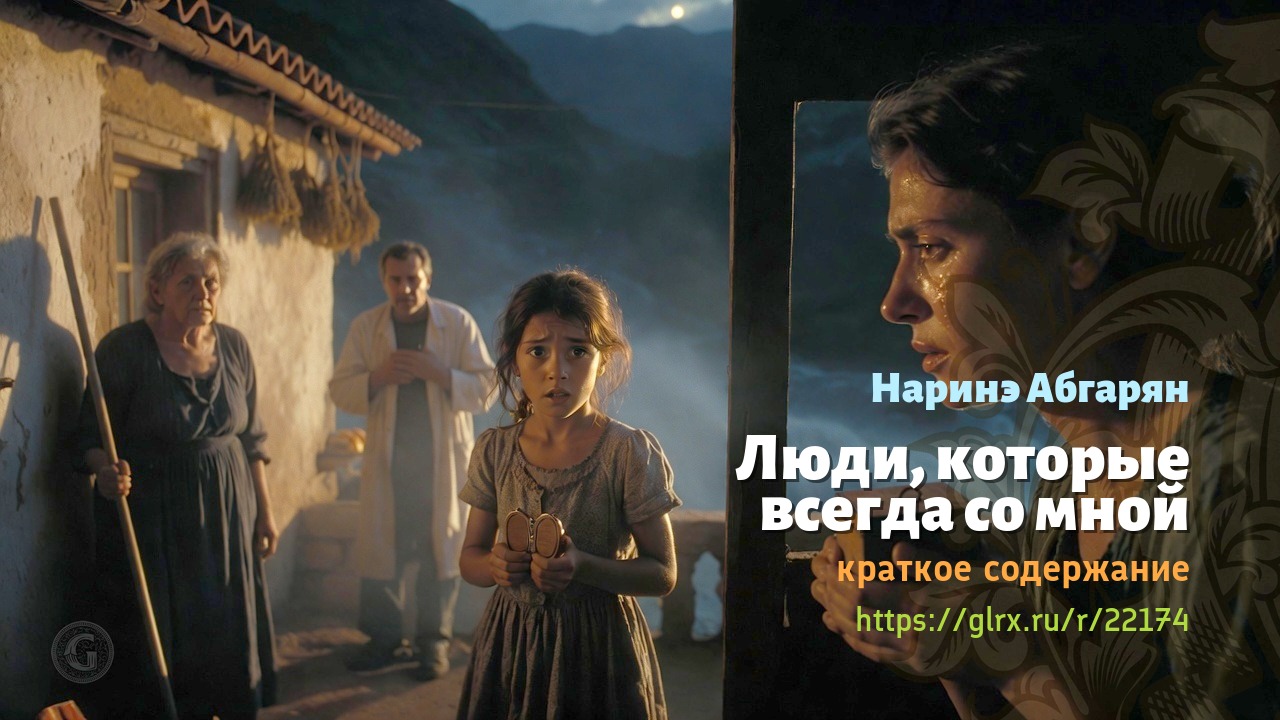
The story centers on a little girl living in a house on the slope of Halikar Hill with her parents — surgeon Petros and Russian teacher Vera — grandmother Tata, grandfather Ovakim, and great-grandmother Tamar. The girl grows up in an atmosphere of patriarchal warmth, where everyday life is filled with the aromas of freshly baked bread, herbs, and homemade jam. However, behind the peaceful façade of childhood games lies the unhealed emotional trauma of her elders.
The girl’s mother, Vera, often cries at night and keeps a wooden box containing her own light-brown braid on her dresser. In a fit of despair, her mother had once cut it off. Realizing this relic’s connection to her older sister’s secret death, the girl secretly takes the braid out of the house and throws it off a stone bridge into a raging mountain river.
Shadows of the Past and Vera’s Childhood
Vera spent her childhood in Kirovabad in the 1940s and 1950s. Her family huddled in a cramped rented room in a private house. Her father, veteran Andro Ogandzhanov, returned from the front with a broken leg and a severe concussion. Physically and emotionally scarred, he drowned out his memories with heavy drinking, leading to arguments with his meek wife, Marya, who worked as a nurse in a military hospital.
Six-year-old Vera cared for her younger brother, Vasya, and polished the dirt floor with a poor man’s mastic made from manure, clay, and kerosene. The girl was friends with her neighbor, Lilia Melkumova, whose disabled father, Igor Movsesovich, suffered from phantom pain in his severed arm.
A miserly old woman, Zoya, lived comfortably in the city. She had made a fortune looting the abandoned homes of deported Transcaucasian Germans and speculating on food products. Zoya’s cruel gossip about her husband’s infidelity caused Marya to suffer a severe attack of angina. Six-year-old Vera saved her mother by inserting a needle containing life-saving cordiamine right through her coat and into her shoulder.
Amulets, fears and trials of ancestors
The town’s older generation bears the weight of the tragedies they have endured. Watchmaker Usta Saro lost his family in Mush during the massacre and fled to Lebanon, from where he returned to his homeland during the wave of repatriation. The girl’s grandfather, Hovakim, lost his parents at the age of five: Turkish yataghans took the lives of his parents, and his grandmother, Sharakan, sheltered her grandson under the hem of her dress after losing her mind from a blow from a rifle butt. Since then, Hovakim has distanced himself from religious faith.
When a girl is frightened by the maddened donkey Seto, great-grandmother Tamar takes her great-granddaughter to the hunchbacked healer Zabel. The old woman whispers ancient prayers, pricks the girl’s hand with a pin, and enchants a piece of veal. Tamar buries the enchanted meat at the crossroads near the police station, with the assistance of traffic cop Karapet.
Tamar’s late husband, Amayak Melikyan, lost his brother Garegin during the Baku pogroms of 1918 when he was young. During the hungry post-war years, Amayak worked as a salesman and kept a debt book for his fellow villagers. The book was stolen, and Amayak, unwilling to demand money from starving people, sold his beloved orchard on the riverbank to cover the shortfall to the state.
The tragedy of loss and the memory of the family
The family of Petros and Vera suffered a terrible blow: their first daughter, Ninochka, was born with a severe diaphragmatic injury and died at eight months old. According to ancient custom, the infant, who has never tasted bread, is buried by the elders of the family in an unmarked grave among their ancestors, and the parents are forbidden to attend the funeral.
For years, Vera couldn’t come to terms with the ritual and every Sunday she came to the old cemetery, tending to the tombstones of Salome, Sharakan, Vasily, and Amayak. During a fierce thunderstorm, Petros finds his wife in the ruins of an ancient tenth-century chapel, where the shepherd Ambo had sheltered his flock. Her husband convinces Vera to stop torturing herself and let go of the past for the sake of the living.
Petros and Vera’s second daughter, named after her deceased sister, learns the truth from her father. The girl decides to renounce her own name and asks her family to call her simply "Girl" until her mother can finally heal her wounded heart.
The girl’s friend, eight-year-old neighbor Vitka, lives with his grandmother Lusine after his father’s death in Afghanistan. Suddenly, his mother, Marina, who abandoned him as a baby, arrives to pick him up and takes him to Simferopol. The girl is deeply distressed by the separation from her close friend. Soon, the family marries off her cousin Zheno to a resident of the city of Ararat, seeing off the wedding procession in the pouring November rain.
Trial by fire in Kirovabad
In the winter of 1988, peaceful life collapses with the outbreak of interethnic clashes. Vera’s brother, Misha, struggles to evacuate his wounded wife and children from pogroms in Kirovabad, but seventy-year-old Marya remains trapped in her apartment.
Vera decides to save her mother and takes a bus to Azerbaijan via Tovuz. Her Azerbaijani neighbors, the Alimovs, demonstrate their generosity: the pregnant Gulnaz shelters Marya from a gang of pogromists, passing off her apartment as her own. Vera picks up her mother and hands over the deeds to the Alimov family.
On the way back, the taxi driver recognizes his passengers as Armenians, takes them to a vacant lot, and pulls out a gun. Vera lunges at the attacker, wounds him in the neck with a family silver spoon engraved with a 1913 inscription, and ties him up with a coat belt. The women walk through the ravines at night past the village of Alyabayli and safely cross the border.
The power of love and forgiveness
In Berd, Vardik, an envious neighbor, spitefully reveals a family secret to the girl: Tamar is the stepmother of Tata, Shushik, Knarik, Sergey, and Zhora. Confused, the girl runs away to Knarik’s grandmother.
Petros finds his daughter studying an antique carpet woven with lines from the poet Grigor Narekatsi. Her father explains that motherhood is measured not by birth, but by selfless care and love. Tamar recalls how, after the death of her young man Vano in Tiflis, she married the widower Amayak and dedicated her life to his orphans, overcoming the agonizing fear of being left alone.
The book ends with the first December snowfall over Berd. The protagonist recognizes the invisible power of her ancestors, whose love and memory protect the living throughout all their journeys.
- Автомобили и люди на картинах Алана Фернли
- Дом, который рос вместе с коллекцией искусства
- Музеи, которых нет: галерея Ивана Евменьевича Цветкова
- 5 автопортретов женщин-художниц, которые вы, вероятно, не видели (а стоило бы)
- Резьба по дереву: древнее искусство, которое живёт до сих пор
- Экспозиция картин и гравюр
- Развитие европейской портретной живописи
- Развитие портретной живописи в эпоху Возрождения
- Хранение картин
You cannot comment Why?