"Lost Illusions" by Honoré de Balzac, summary
 Automatic translate
The novel "Lost Illusions," written between 1836 and 1843, occupies a central place in the epic cycle "The Human Comedy." The book realistically depicts the social mechanisms of Restoration-era France, revealing the underbelly of the book trade, the press, the theater world, and class prejudices. The narrative centers on the fates of two friends: the poet Lucien Chardon and the honest printer David Séchard.
The work is part of the "Scenes of Provincial Life" series and forms a trilogy with the novels "Père Goriot" and "The Splendor and Misery of Courtesans." The book has inspired theatrical productions, as well as a ballet by Boris Asafyev.
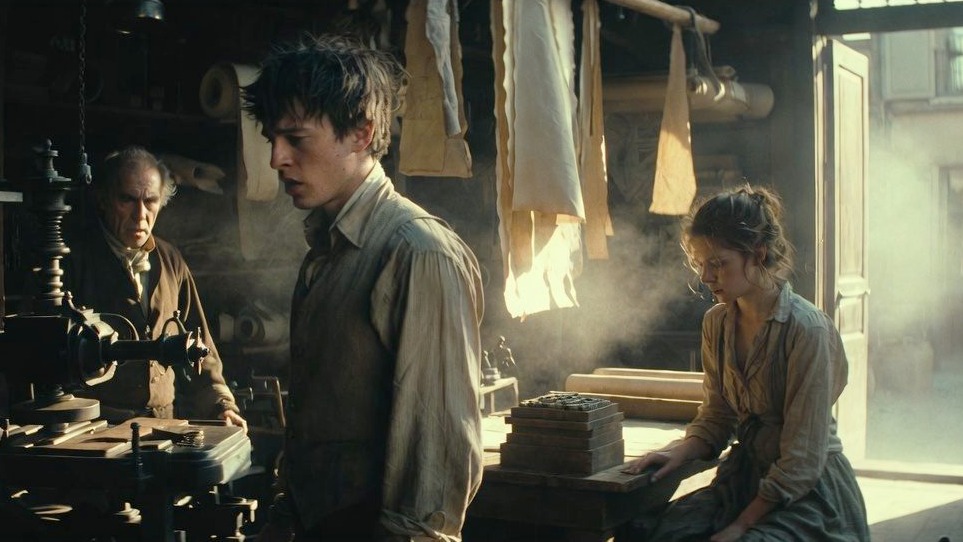
Two poets in Angoulême
The action begins in Angoulême in 1819. The aged printer Jérôme-Nicolas Séchard, a rude and stingy man, decides to retire. He sells his neglected printing press to his son David for the exorbitant sum of thirty thousand francs. David, who studied printing in Paris, dedicates his life to scientific research. He strives to create a cheap way to produce paper from plant materials.
David’s close friend, the young poet Lucien Chardon, dreams of fame and fortune. Lucien’s mother comes from the impoverished noble family of Rubempré, but his father was a simple apothecary. The Chardon family lives in poverty in the suburb of Houmeau. David falls in love with Lucien’s sister, Eva Chardon. The young couple marry, despite the old man Séchard’s complete refusal to provide financial support for his son.
Local aristocrat Louise de Bargeton is captivated by Lucien’s poetic talent and attractive appearance. She opens the doors of her salon in upper Angoulême to the young man. This provokes deep envy and outrage among the local nobility, who despise the poet’s humble origins. Visits to the salon become the cause of a conflict, fueled by Baron Sixte du Châtelet. After a duel between Louise’s husband and one of the gossips, Madame de Bargeton decides to leave for the capital, taking Lucien with her.
A provincial celebrity in Paris
Arriving in Paris in 1821, Lucien encounters a harsh reality. Socialite ladies, including the influential Marquise d’Espard, ridicule the young man’s provincial manners, cheap shoes, and ridiculous tailcoat. Fearing for her reputation, Louise de Bargeton rejects her lover. Left without funds or patronage, Lucien settles into a modest hotel in the Latin Quarter.
In the library of Sainte-Geneviève, the poet met Daniel d’Arthez. The writer led the Confrère, a circle of honest, selfless, and artistically dedicated young people, including the physician Bianchon, the philosopher Léon Giraud, and the artist Joseph Bridau. The circle’s members helped Lucien revise his historical novel, "The Archer of Charles IX."
However, Lucien’s thirst for quick success leads him astray from the path of work. He meets the cynical journalist Étienne Lousteau, who reveals to him the corrupt underbelly of the Parisian press, theater, and bookselling. Lucien learns of the existence of commissioned articles and blackmail.
Lucien joins a liberal newspaper and gains a reputation as a caustic critic. He forces the publisher Doria to buy his collection of sonnets, "Daisies," for three thousand francs and begins an affair with the young actress Coralie. Drawn into an atmosphere of revelry, cards, and luxury, the poet squanders his talent on short-lived articles.
In order to obtain a royal decree granting him the noble name of de Rubempré, Lucien defects from a liberal newspaper to the royalist camp. This move makes him an enemy of his former colleagues and earns him the contempt of the members of the Commonwealth. By writing a scathing review of d’Arthez’s book under pressure from his editorial bosses, Lucien commits a grave moral transgression. Meanwhile, d’Arthez himself, displaying generosity, personally edits the review, ensuring its objectivity.
The political intrigue ends in disaster: the royalists deceive the young man, and the liberals destroy his reputation. After a duel with Michel Chrétien, a member of the Commonwealth, Lucien is seriously wounded. Coralie loses her job at the theater, falls ill, and dies in poverty. The poet is forced to compose drinking songs at the body of his deceased lover to pay for her funeral. Lacking funds, he forges three promissory notes in the name of his brother-in-law, David Séchard, for a total of three thousand francs and sets out on foot for his native land.
The Inventor’s Sorrows
In Angoulême, Lucien’s counterfeit bills lead to disaster. David’s rivals, the Cointe brothers, team up with the Parisian paper merchant Métivier and the wily lawyer Petit-Claud. Taking advantage of the law of reverse accounting, they artificially inflate legal costs, inflating the debt to enormous proportions. Their goal is to bankrupt Séchard and seize his papermaking secret.
David is forced to hide with his friend Bazine Clerget. Eva Séchard and her mother try to save the printing house, but Cerizet, bribed by the agent, treacherously forges a letter in Lucien’s name. David escapes from hiding and is apprehended by the gendarmes.
Lucien returns to Angoulême in despair. The local youth throw a banquet in his honor, but the ruin of his family lies on his conscience. Realizing that his recklessness and mistakes have ruined his sister and brother-in-law, Lucien decides to drown himself in a creek near Marsac.
On the road, the poet meets a mysterious Spanish priest, Abbot Carlos Herrera. The Spaniard stops the young man from committing suicide and offers him a deal. The priest guarantees Lucien financial security, a return to high society, and the opportunity to take revenge on his enemies in exchange for his unquestioning obedience. The poet agrees and sets off with him to the capital, having first sent fifteen thousand francs to his sister to pay off his debts.
David Séchard is released from prison, but tired of the struggle and legal persecution, he hands over the rights to his invention to the Cointe brothers for a modest sum. He and Eva move to the countryside, where they live in peace and prosperity. Lucien, meanwhile, sets out once again to conquer Paris under the guidance of his new patron.
You cannot comment Why?