"On/Off" by Colleen McCullough, summary
 Automatic translate
An Australian author has created a retro detective story set in 1960s Connecticut, where the university elite encounters serial violence and racial tensions. Drawing on her personal experience as a neurophysiologist at Yale Medical School, the author meticulously recreates the realities of neurological labs, the intricacies of vivisection, the workings of closed EEG labs, and the bureaucracy of closed funds. Written in 2006 and published in 2006, the book represents the author’s return to the classic police thriller after her extensive historical sagas.
The novel opens the series about Lieutenant Carmine Delmonico. This detective series also includes the detective’s subsequent investigations: "Too Much Gossip" (the second issue), "Indecent Passion" (not part of the series), and the third and fourth books were "The Sin of Sorrow" and "The Prodigal Son."
Find in the freezer
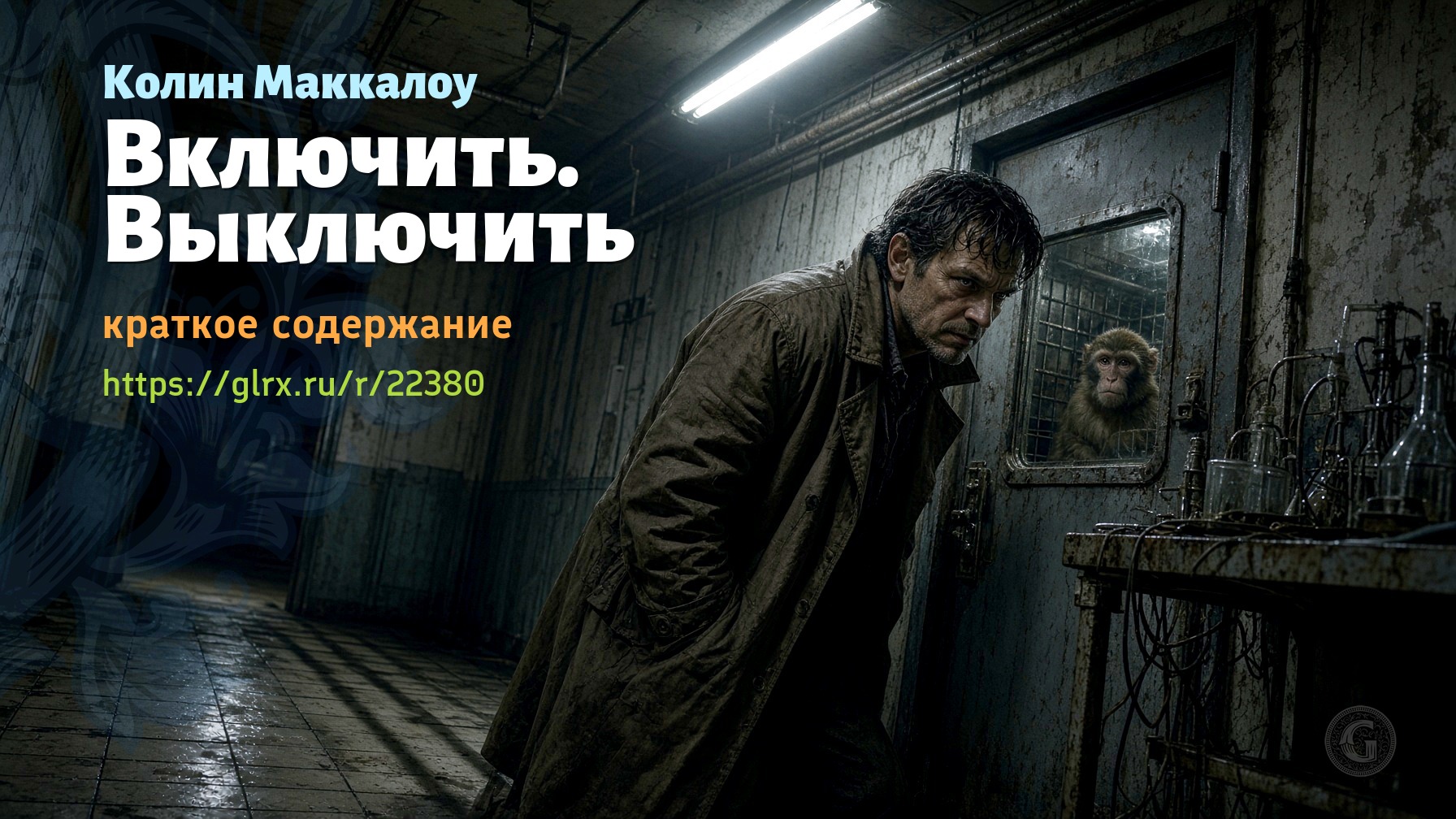
On the morning of October 6, 1965, vivarium staff at the Hughlings Jackson Center for Neurological Research discovered a commotion. A macaque named Jimmy, a test subject, had awakened in a biohazard disposal chamber, ripped open some bags, and startled a cleaner named Otis Green. While sifting through the dismembered corpses of laboratory rats, Otis pulled out a bag from which spilled the lower half of a woman’s torso, her skin the color of café au lait. The cleaner suffered a heart attack. His colleague, Cecil Potter, didn’t call the local station but dialed the number of the facility’s director, Professor Robert Mordent Smith.
Detective Carmine Delmonico and his subordinates, Abe Goldberg and Corey Marshall, arrived at the Hague building on Oak Street in Holloman. A search of the labs gave the police some troubling clues. Forensic pathologist Patrick O’Donnell, the detective’s cousin, noted the surgical precision with which the legs and spine were removed, the absence of blood, and the professionally applied ligatures. The pubic hair had not been shaved, but methodically plucked with tweezers. A neat, dark mark from cauterizing a vascular birthmark with diathermy forceps remained on the right buttock. The perpetrator had treated the wound with coagulating gel and covered it with foundation. The identity of the deceased was established through Norwalk police. Based on the characteristics of the hemangioma, Jose Alvarez identified Mercedes’ sixteen-year-old daughter, who had disappeared ten days earlier.
The circle of suspect scientists
The staff interview dragged on into the night. Carmine met the manager, Desdemona Dupre, whose cool tone betrayed her English training. Professor Smith met the cops in a luxurious office with an original Watteau and his secretary, Tamara Vilich. The facility’s neurophysiologists looked strange. Addison Forbes suffered from a manic obsession with diets after a heart attack. Maurice Finch kept cats to study ion channels and raised chickens. Dr. Noor Chandra sported cashmere and a princely Indian lineage. Sonia Libman, a lab technician in the operating room, admitted that she regularly decerebrates cats and has access to a supply of ether, strychnine, and pentothal.
The chemists lived on the top floor. Charles Ponsonby wore mismatched socks, collected the shrunken heads of savages, and hung reproductions of Munch and Bosch. Polonovsky complained about patients with malabsorption and hid his eyes. The Japanese Satsuma boasted of his bachelor habits, and the pathologist Kurt Schiller aroused Delmonico’s strong suspicions of latent homosexuality.
Searches in Connecticut yielded disturbing coincidences. Over the past two years, nine more 16-year-old Catholic girls of Caribbean descent had vanished without a trace. Each disappearance occurred within two months of each other. The killer apparently used a Haga furnace to cremate the remains. The press dubbed the serial killer the Connecticut Monster. The Parsons Foundation’s board of trustees, led by Roger Parson Jr., demanded that the institute’s good name be preserved. Anti-vivisectionists picketed the entrance. Meanwhile, Mohammed el-Nesr’s radical "Black Brigade" became active on the streets, joined by Celeste’s aunt’s nephew, Wesley LeClerk. The radicals sought to use the deaths of the young women of color as a pretext for a city riot.
Blood by the Stream
In November, tensions flared. Schiller attempted to poison himself due to bullying from colleagues, but Finch managed to pump his stomach. Carmine became close to Desdemona, inviting her out for Chinese noodles. In the manager’s apartment, someone cut up an embroidered silk priest’s vestment into ribbons and sprinkled a tuft of curly hair onto it. A guard was posted, and Delmonico moved Dupre herself into his mother’s sedan.
On December 1st, Francine Murray, a student at Travis High School, disappeared. The girl was the daughter of a Black engineer and a white woman, with no Caribbean relatives. The killer had altered the usual victim profile. A thick mat was found behind some drawers in the school gymnasium, with Francine’s pink school jacket sticking out. The killer had stalked his target near the restroom, drugged her, and hidden her in his inventory until evening.
Ten days later, Ruth Kynton, the mother-in-law of librarian Hug Hilda Silverman, went to chase away stray dogs from a clothesline in the backyard of a slum on Griswold Lane. The dogs were tearing at a human foot. In the shallow mud by the creek, investigators dug up eight pieces of Francine’s body. The head was missing. Patrick discovered a large, number 18 needle wound on the victim’s abdomen; she had been immobilized with Demerol. A gaping incision to the jugular vein, made while she was alive to drain blood, was visible on her neck.
A search of the laboratories with witnesses yielded no results. However, on the night of December 24th, Charlie, the guard on duty, was strangled with a piano wire on the stairs of Desdemona’s house. A mocking poem, printed in Letraset font, was stuck to the window with plasticine, threatening the "Othello" detective and "viper" Dupré. The garrote handle turned out to be a human femur, ground down. Carmine hid Desdemona in a safe house belonging to the Muscat insurance company.
Snow Trap
The new year of 1966 began with a burglary. Margaretta Bewley, a tall black woman, disappeared from her bedroom in Groton. The thief entered through a window, drugged the sleeping schoolgirl with ether, and carried her away while her younger sister slept peacefully in the next bed. Only thirty days had passed instead of the usual sixty. Delmonico suspected a coordinated operation by two criminals.
The detective visited Smith’s home. The professor showed him the basement, which was entirely occupied by a giant model railroad with eleven trains. The scientist flogged his sons for the slightest offense and kept them away from the tracks. At Tamara Vilich’s, the detective found sadomasochistic paraphernalia, erotic canvases, and a nude photo of neurosurgeon Keith Kynton, the husband of librarian Hilda. It turned out the couple indulged in role-playing, but had nothing to do with the corpses. Desdemona, offended by the tactless accusation of stinginess, threw Carmine out.
On January 4th, the institute’s façade was desecrated with swastikas. Director Smith’s nerves gave out: suffering from psychosis and hallucinations, he was taken to Marsh Manor, a private clinic. On January 16th, Maurice Finch went out into the apple orchard and stumbled upon Margaretta’s headless body on the crest of a frozen snowdrift. The victim had been dressed in a tiny, pink, sequined lace dress. The rapist had torn her insides with a dildo, left her to freeze in a refrigerator, and then planted her on a farmer.
The search for the outfit led detectives to the Tinker Bell boutique in White Plains. Manager Giselle Dobczyk recalled how, in late 1963, a woman in sable fur, accompanied by a silent chauffeur, purchased twelve different size-ten party dresses with cash in new 1933 hundred-dollar bills. The serial killers had planned their scheme years in advance.
On January 31st, a fair-skinned Lebanese woman, Faith Khoury, was kidnapped through a bedroom window in Norwich. All suspects were under surveillance, but the killer slipped through the cracks again. Desdemona heard the sound of the bolt of the safe house door being sawed through that night, climbed out onto the freezing balcony, and climbed two stories up the eaves to Carmine. After their rescue, they confessed their feelings for each other. On February 14th, a lilac dress containing Faith’s body washed up on the embankment near Dr. Forbes’s mansion.
Hiding place on the hill
The solution came from an old archive on Caterby Street. Delmonico found a box of evidence from the 1930 murder case of Charles Ponsonby’s father, Leonard, who was bludgeoned to death with a baseball bat at Holloman Station during a snowstorm. A woman and a six-year-old girl were killed along with the tycoon. An old suitcase contained a photograph of Leonard’s mistress, Louise Caton, with her daughter, Emma, and a child’s embroidered lace dress. The dead girl’s facial features, Louise Caton, exactly matched those of all fourteen victims of the Connecticut Monster.
Carmine realized the motive for the bloody massacre: the obsessive destruction of the descendants of someone else’s hateful blood. The detective went into the forest reserve on Deer Lane behind Ponsonby’s property. Slipping on rotting leaves, the policeman broke through the planking and found the wooden door of an underground passage.
On the night of March 2nd, the ambush worked. Around five in the morning, Ponsonby dragged the unconscious Delice Martin, abducted from a nearby school, through the hole. Then, blind Claire Ponsonby and her guide dog camouflaged the entrance with a rake and leaves from a bucket. Police entered the house through the kitchen, using a lever to dislodge the heavy wood stove.
In an underground bunker lined with stainless steel, Carmine photographed a naked Charles Ponsonby in front of an operating table. The victim lay strapped down. On the walls of the altar, beneath a satin curtain, stood fourteen severed female heads on four shelves, permanently encased in transparent plastic cubes.
Shots fired near the court
On the morning of March 3, the detainees were taken to appear before Judge Thwaites. Wesley Leclerc, wearing a hockey helmet with a "We Suffered" sign emblazoned on his forehead, burst onto the court steps and fired a pistol into Ponsonby’s chest. Carmine shielded the gunman from the guards’ bullets. The killer died at the scene. There was no evidence against Claire: a bucket of leaves was deemed insufficient for an accessory charge. She was released. The jury sentenced Wesley to twenty years for manslaughter, making him a media icon.
The Jackson Center was closed and handed over to the university, and Watson filled the empty chair. Delmonico married Desdemona, and the couple bought Forbes’s house and took in their daughter, Sophia.
In the finale, blind Claire Ponsonby received Carmine on the veranda before leaving for the West. Over tea, she recounted a tearful tale of a tyrant mother who, out of jealousy, split her husband’s skull, and of her feeble-minded brother, Morton, who supposedly died of heart disease. However, when left alone, her hostess revealed her true colors. No Claire existed: the girl had died of suffocation in a Cleveland boarding school many years earlier. Her mother had dressed her youngest son, Morton, as a girl for fun, and the brothers had taken advantage of her. Taking revenge for the humiliation of his mother and father, Morton dug a three-hundred-meter tunnel, murdered hired construction workers, and for years feigned his sister’s blindness, hunting with his dog for young versions of the hated Emma Caton. The monster safely escaped with millions in his pocket, leaving the detective in the dark.
You cannot comment Why?