A summary of "The Days of the Turbins" by Mikhail Bulgakov
 Automatic translate
Mikhail Bulgakov’s play, based on his novel "The White Guard," was written in 1926 at the direct request of the Moscow Art Theater. The text sparked heated debate due to its sympathetic portrayal of White Army officers, but the production was defended by Joseph Stalin, who attended the performance more than fifteen times. The events unfold in Kiev against the backdrop of the change of power during the Civil War.
The work gained immense popularity in Soviet culture after the release of a television adaptation directed by Vladimir Basov in 1976. The three-part film accurately captured the spirit of the original, and its musical themes became nationally known.
Act One
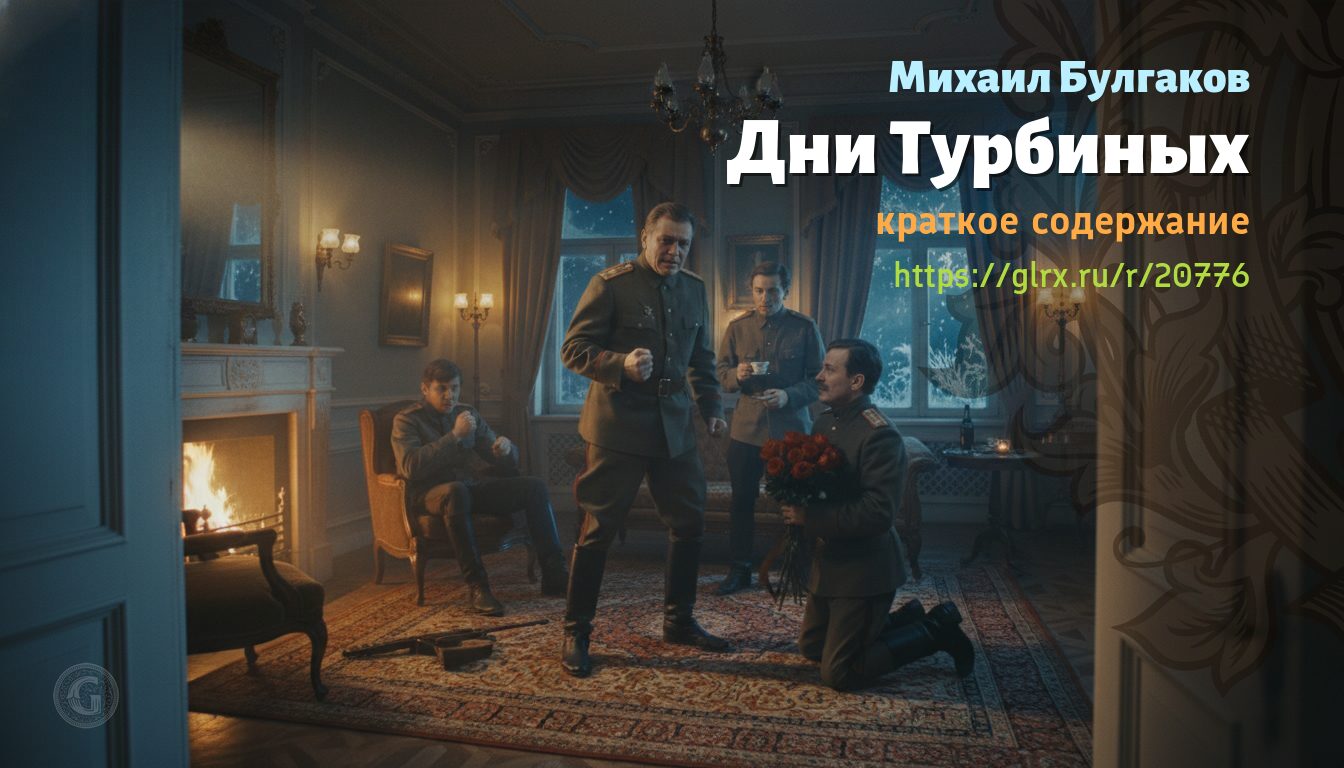
It’s the winter of 1918. The action begins in the Turbins’ Kyiv apartment. An old clock gently plays a minuet. Artillery Colonel Alexei Turbin and his eighteen-year-old brother Nikolka anxiously discuss the approach of Symon Petliura’s troops. His sister, Elena, awaits her husband, Colonel Vladimir Talberg of the General Staff. Staff Captain Viktor Myshlayevsky suddenly appears. The officer is frostbitten and angry at the incompetent command on the outskirts of the city. Next comes a cousin from Zhitomir — the awkward student Illarion Surzhansky, known to everyone simply as Lariosik. The young man traveled eleven days, lost his suitcase of linens, and naively hopes to find peace behind the cream-colored curtains of the Turbins’ apartment.
Talberg finally returns. He shares secret information with his wife from German headquarters: the Germans are abandoning the Hetman of All Ukraine to his fate. Talberg cowardly flees to Berlin on a German staff train. He leaves Elena in Kyiv, entrusting her with the care of the apartment. Immediately after her husband’s escape, Elena’s longtime admirer, Lieutenant Leonid Shervinsky, the Hetman’s personal adjutant, appears at the house. He brings a luxurious bouquet of roses and openly flirts with the married woman.
The family and guests sit down to dinner. During the feast, the officers drink vodka, sing songs to the guitar, and engage in heated debate. Alexei Turbin delivers a somber speech about the collapse of the empire. According to him, the hetman made a fatal mistake by failing to form a strong army in time. The division commander bluntly declares that the White movement is doomed, and the main threat comes from the advancing Bolsheviks. Shervinsky tries to reassure the assembled group with a fantastical tale of a living Emperor Nicholas II, who allegedly secretly visited Emperor Wilhelm. A heavily intoxicated Myshlaevsky nearly opens fire with a Mauser right at the table. Left alone with Elena, Shervinsky confesses his passionate love and persistently persuades her to leave Talberg.
Act II
That night, disaster looms in the hetman’s office at the palace. Shervinsky takes over and learns of the disappearance of his other adjutants. The hetman himself appears, and soon representatives of the German command — General von Schratt and Major von Dost — come to him. The Germans report the bare facts: Petliura’s forces have broken through the front and are only eight and a half kilometers from the capital. The German government refuses to provide troops to defend the city.
German officers offer the hetman immediate, covert evacuation. They tightly bandage his head, dress him in the uniform of a wounded German general, and secretly carry him out of the palace on a stretcher. Shervinsky clearly understands the scale of the betrayal. He takes the hetman’s massive gold cigarette case, forgotten on the table, calls Colonel Turbin to hide immediately, and changes into civilian clothes.
Meanwhile, work is in full swing at the headquarters of Petliura’s First Cavalry Division. Colonel Bolbotun and Captain Galanba interrogate a captured Sich deserter with frostbitten feet. Then a terrified shoemaker carrying a basket is brought to them. The Haidamakas mercilessly confiscate the master’s entire stock. The long-awaited message arrives over the field telephone. It becomes known that several of the Hetman’s Serdyutsky regiments have voluntarily defected to the attacking side. Petliura’s cavalry receives the order to advance and, with a deafening march, rushes toward Kyiv.
Act Three
Early in the morning, an artillery battalion under the command of Alexei Turbin assembles in the lobby of the Aleksandrovskaya Gymnasium. The cadets are freezing. They break government-issued desks and use them to light the stoves, terrifying the local guard, Maxim. Alexei arrives and issues a paradoxical order: everyone is to immediately remove their shoulder straps, throw down their rifles, and go home. The junior officers attempt to mutiny and threaten their commander with a revolver.
Turbin harshly suppresses panic. He reveals the shocking truth to his subordinates. The hetman and the army commander, Prince Belorukov, have secretly fled to Germany. There is no one left to defend the regime. The colonel refuses to lead the inexperienced students to certain death against Petliura’s massive cavalry. The officers and cadets realize the futility of resistance, throw down their weapons, and flee. Myshlaevsky sets fire to the armory to prevent the enemy from obtaining their warm overcoats.
Alexei remains alone in the building, hoping to wait for the outpost to retreat. The loyal Nikolka flatly refuses to abandon his older brother. A brief firefight breaks out with the invading Haidamaks. Alexei is mortally wounded. In despair, Nikolka leaps from the railing of the high staircase. The Haidamaks fire after him, and the young man is seriously wounded, but escapes into the courtyards.
In the Turbins’ apartment, Elena and Lariosik listen in horror to the sounds of nearby cannon fire. Gradually, the miraculously saved officers — Shervinsky, Myshlaevsky, and Studzinsky — come into the house. Soon, a bloodied Nikolka is carried in. Elena immediately notices her older brother’s absence and demands a direct answer from the officers. Nikolka confesses that the commander has been killed. Studzinsky experiences an unbearable sense of guilt for leaving the colonel alone. He snatches a Mauser and attempts to shoot himself. Myshlaevsky barely manages to wrest the weapon from his comrade’s hands. Hearing the terrible news, Elena faints.
Act Four
Two months pass. It’s Epiphany Eve, 1919. Elena and Lariosik are peacefully decorating the New Year’s tree with electric bulbs. The student timidly asks Elena to marry him, but is tactfully rejected. She confesses that she’s already having a secret affair. Shervinsky, wearing blue glasses and a tattered, non-party coat, sneaks into the apartment. He joyfully announces that the Red Army has taken the city and Petliura has been completely defeated.
Shervinsky makes a formal proposal to Elena. He promises to stop lying forever and admits that he simply stole a cigarette case from the hetman’s desk. Elena takes the jewel from him, agrees to a quick divorce from her husband, and promises to marry Shervinsky. Meanwhile, Nikolka awakens. The young man moves with difficulty around the room on crutches. He clearly understands that he will remain crippled.
Myshlaevsky and Studzinsky appear, dressed in civilian clothes. The officers argue heatedly about the future. Studzinsky intends to make his way to the Don to General Anton Denikin. Myshlaevsky categorically refuses to serve the White military commanders again. The former captain decides to join the Bolsheviks, as the entire Russian people are following them.
The front door suddenly opens. Talberg, who has returned, stands on the threshold. He cynically announces that he’s been sent on a business trip to the Don and orders Elena to pack quickly. She coldly informs him of the divorce. Enraged by Talberg’s insolence, Myshlaevsky strikes him hard and throws him out of the apartment in disgrace.
The heroes gather around a brightly lit Christmas tree. They drink wine and silently listen to Nikolka’s sad guitar song. Lariosik delivers a solemn speech about the small, frail ship that has finally found a safe harbor. Heavy cannon salutes can be heard in the distance. Then the powerful sounds of a military band ring out — the Bolsheviks enter Kyiv to the march of the "Internationale." Studzinsky bitterly calls this moment the final epilogue of their lives. Nikolka confidently corrects the officer, calling what is happening a grand prologue to a new historical play.
- A summary of "Necromancer" by Victor Pelevin
- "Svetoslavich, the Enemy’s Pet" by Alexander Veltman, summary
- Wind Energy in Cities: Benefits and Challenges
- The scale of the premiere performance "Quiet Flows the Don" corresponds to the novel by Sholokhov
- A summary of Mikhail Bulgakov’s "The White Guard"
- "Can I tell you about my soul?…"
You cannot comment Why?