"Enough Stupidity in Every Wise Man" by Alexander Ostrovsky, summary
 Automatic translate
Alexander Ostrovsky’s play, written in 1868, vividly captures the mores of post-reform Moscow, dominated by the nobility and bureaucracy. For the first time, the author portrays a cynical careerist, willing to do anything to achieve high status, as the protagonist. The text is replete with sharp dialogue and aptly captured social types of the era.
The play has been adapted for the screen several times, with considerable success. In 1923, the young director Sergei Eisenstein made a short film, "Glumov’s Diary," specifically for theatrical production. The work was later adapted for television. The most popular versions were those of 1952 and 1971, starring famous Soviet actors.
The beginning of the journey
The action unfolds in the clean, well-furnished apartment of Yegor Dmitrich Glumov. The young man is discussing a plan to get rich with his mother, Glafira Klimovna. Glumov is tired of writing epigrams and fuming at society. He plans to flatter influential people, exploit their weaknesses, and find a wealthy bride.
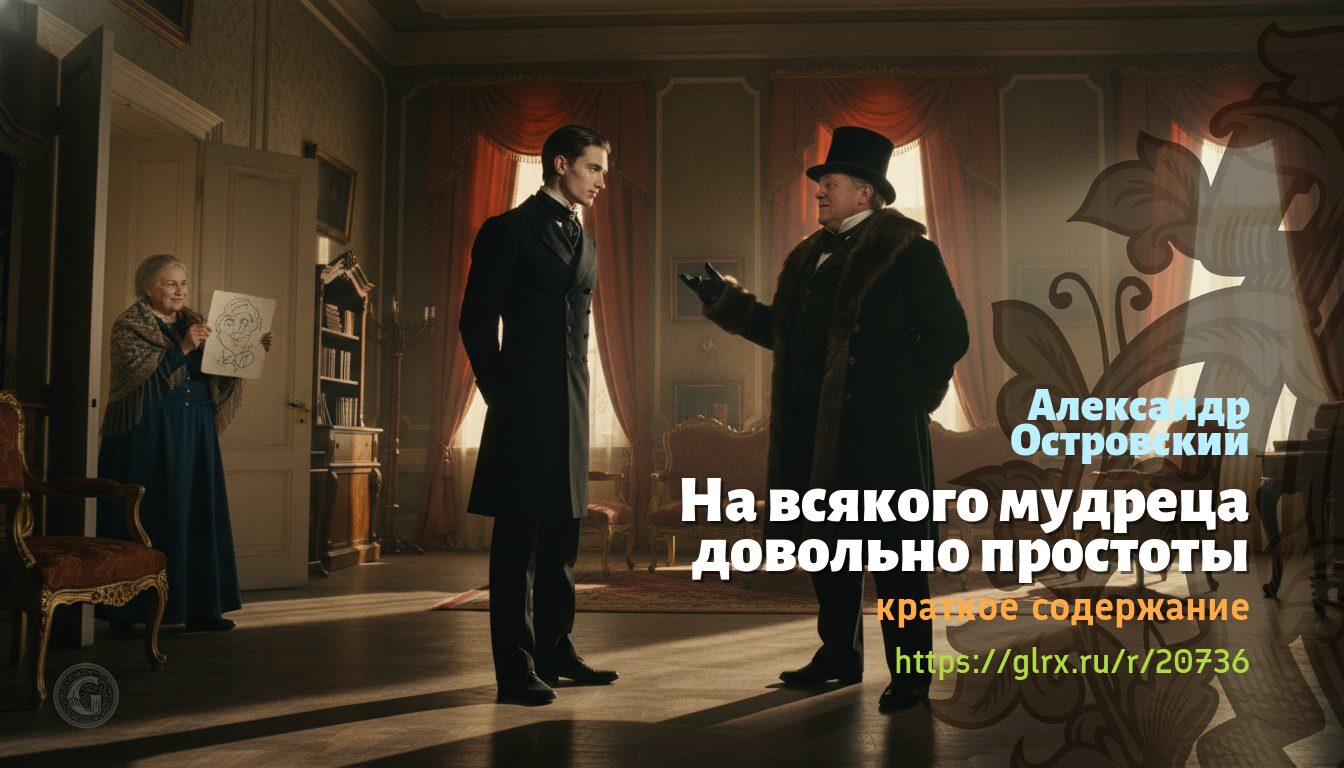
Glumov plans to record his true thoughts in a secret notebook. He says, "I will release all the bile that boils up in my soul into this diary." Soon, the hussar Kurchayev and Golutvin, a man without a fixed occupation, come to him. They ask for Glumov’s old, caustic poems for publication. Kurchayev draws a caricature of his uncle, Nil Fedoseyevich Mamayev, on paper. Glumov takes the drawing and hides it.
Mamaev’s visit
Mamayev enjoys looking at apartments for rent out of boredom. Glumov lured him in on purpose. Nil Fedoseich begins to berate the landlord for renting beyond his means. Glumov readily agrees. He calls himself stupid and asks for guidance. Mamayev loves to lecture people and is delighted by the submissive listener.
Glafira Klimovna comes into the room. She shows Mamayev a caricature drawn by Kurchayev. The enraged uncle bans Kurchayev from his home. He invites Glumov to be his frequent guest. Later, Manetha, a fortune teller, visits the apartment. Glumov gives her fifteen rubles for the necessary predictions in wealthy homes. Hussar Kurchayev returns with a complaint. His uncle has driven him away, and the wealthy widow Turusina has refused him the house. Glumov coldly sends his former friend away.
Intrigues in high society
Mamayev is talking with Krutitsky, a very important elderly gentleman. Krutitsky complains about the new order and tells about his new treatise. He needs a competent scribe to edit the text. Mamayev confidently recommends his nephew, Glumov.
Meanwhile, Mamayev’s wife, Kleopatra Lvovna, listens to Glafira Klimovna. Glumov’s mother subtly flatters the socialite, hinting at her son’s secret, ardent passion for his uncle’s lovely wife. Mamayev is intrigued. Soon, Glumov himself appears. He behaves timidly and respectfully, piquing her interest.
Useful connections
A young official, Ivan Ivanovich Gorodulin, comes to see Mamaeva. Mamaeva asks him to find a good place for Glumov. Gorodulin chats with the young man. Glumov deftly adapts to his interlocutor, delivering smooth phrases about the good of the people and the evils of bureaucracy. Delighted, Gorodulin asks Glumov to write him a speech for a dinner party.
Mamayev teaches his nephew about life. He advises Glumov to make a light courtship with Cleopatra Lvovna to distract her from dangerous dandies. Mamayev also suggests that his nephew marry Mashenka, the niece of the wealthy widow Turusina. Glumov readily agrees. Left alone with Mamayeva, he falls to his knees and passionately declares his love. She reciprocates.
Preparing for matchmaking
At the dacha in Sokolniki, Sofia Ignatyevna Turusina is talking with her niece Mashenka. The widow is superstitious, surrounded by hangers-on, and looks for omens in everything. She refuses to marry Mashenka to Kurchaev because of two anonymous letters. The letters have denigrated the hussar in Turusina’s eyes. The girl agrees to submit to her aunt’s will. Mashenka asks him to find her a wealthy groom with whom she can shine in society.
Krutitsky and Gorodulin arrive at the house one after the other. Both strongly urge Turusina to pay attention to Yegor Glumov. The widow is astonished by this coincidence. She calls for Manetha, her chief fortune teller. Manetha prophesies the imminent arrival of a blond groom named Yegor. At that very moment, a servant announces the arrival of Mamayev and Glumov. Turusina greets the guests with great joy.
Double play
Glumov brings Krutitsky a rewritten treatise on the harm of reform. The young man takes flattery to the extreme, delighting in the old man’s every word. Flattered, Krutitsky promises to be the groomsman at Glumov and Mashenka’s wedding.
Cleopatra Lvovna comes to Krutitsky. She accidentally learns from him of Glumov’s upcoming wedding. The news of a bride with a dowry of two hundred thousand rubles infuriates her. She hastily leaves the old man.
Glumov instructs his mother before her visit to Turusina. Glafira Klimovna is to generously shower her dependents with snuffboxes and money. Cleopatra Lvovna pays Glumov a surprise visit. He lies to her desperately. The young man claims the marriage was solely his uncle’s idea. He vows to give up his fiancée for the sake of his love for Mamayeva. The woman pretends to believe him.
Fatal oversight
Golutvin barges in on Glumov. He demands money, threatening to publish a scandalous article about the careerist. Glumov gives him a small sum and sends him away. Meanwhile, Cleopatra Lvovna finds Glumov’s diary on the table. She reads the entries, is horrified by the insulting words addressed to her, and secretly takes the notebook.
Returning to his room, Glumov discovers the diary is missing. He panics. The scale of the impending disaster dawns on him. All his plans could collapse at any second. Mustering his courage, he goes to see Turusina.
Exposure
On the terrace of Turusina’s dacha, Mashenka explains to Kurchaev her reasons for agreeing to the marriage. Glumov had been recommended by respected people, and fortune tellers had vouched for him. Kurchaev was forced to retreat. Glumov enthusiastically tells Turusina a fictitious story about a prophetic dream and a miraculous omen. It was this omen that supposedly brought him to this house.
Gorodulin joyfully greets Glumov. They discuss their future collaboration. Mamayeva appears. Glumov whispers to her of his fidelity. He promises to use his wife’s money to create a beautiful life with Cleopatra Lvovna. Mamayeva sends him out with his bride, reveling in her impending triumph.
Kurchayev complains to Mamayeva about the unfairness of fate. Turusina praises Manetha in front of the assembled guests, saying, "I’ve done a lot for Moscow with this." Suddenly, a servant brings an envelope delivered by the postman. Mamayev opens the letter and pulls out a newspaper clipping with Glumov’s portrait. The article is titled "How People Come Out in the World."
Reading the diary
The envelope also contains the stolen diary. Mamayev begins reading the entries aloud. The pages detail all of Glumov’s expenses: bribes to Manetha, money for hangers-on, and the lackey’s wages. The guests hear caustic, derogatory descriptions of each person present. Mamayev is called a fool, Krutitsky a senile old man, and Gorodulin a chatterbox.
Horrified, Turusina calls off the wedding. She promises to banish all the hangers-on from the house. The insulted guests are outraged by the young man’s treachery. Gorodulin plans to return the notebook to the author and send him away.
Glumov appears. He takes the diary but categorically refuses to apologize. The hero directly accuses society of hypocrisy. He declares, "You need me, gentlemen." Glumov reminds everyone how sweetly they listened to his flattery. He claims he was only truly honest in the pages of his secret diary.
Having spoken angrily, Glumov leaves. The guests are perplexed. Krutitsky is the first to break the silence. He says, "But he is, gentlemen, whatever you say, a man of business." Krutitsky suggests punishing the young man and then, after a while, caressing him again. Gorodulin and Mamayev readily agree. Cleopatra Lvovna confidently takes on this task.
- A summary of "Wolves and Sheep" by Alexander Ostrovsky
- A summary of Alexander Ostrovsky’s "The Abyss"
- A summary of "The Last Victim" by Alexander Ostrovsky
- Anniversary exhibition of the monumental artist Ivan Bondarenko "With love for life"
- Sights of Moscow that often remain behind the scenes
- "There Was Not a Penny, But Suddenly a Coin" by Alexander Ostrovsky, summary
You cannot comment Why?