"There Was Not a Penny, But Suddenly a Coin" by Alexander Ostrovsky, summary
 Automatic translate
Alexander Ostrovsky’s comedy was written in 1871 and published in 1872 in Otechestvennye Zapiski (Notes of the Fatherland). It was initially titled "The Morning Is Wiser Than the Evening"; this early title would later be echoed in the play’s final line, lending its ending a special precision. The action is set on the outskirts of Moscow, where everyday poverty coexists with secret hoarding, and the humorous quickly turns cruel.
The plot centers on the home of retired civil servant Mikhey Mikheich Krutitsky. He lives with his wife, Anna Tikhonovna, and his niece, Nastya, and all three exist in abject poverty, though the main source of this poverty is not a lack of funds but their master’s morbid stinginess. Krutitsky goes so far as to starve his family, keep them cold, wear rags, and regard every expense as almost a crime. From the very first scenes, it’s clear that money is more important to him than peace, family, and simple human shame.
People of a different cast live next to this house, but their atmosphere is the same — commercial calculation, curiosity about the misfortunes of others, a habit of measuring people by their own profit. Next door are the townswoman Domna Evsignevna Migacheva with her son Yelesya, and the merchant and shopkeeper Istukariy Lupych Yepishkin with his wife Fetinya Mironovna and daughter Larisa. These characters don’t truly sympathize with Nastya: they watch her humiliation almost as a spectacle, discuss it aloud, and immediately shift the conversation to practical matters. Against this backdrop, Nastya herself stands out — a proud, lively girl, not yet completely broken.
Nastya is also the subject of a love story. She is loved by Modest Grigoryevich Baklushin, a pleasant but frivolous young man burdened with debt. He is attached to Nastya, but his situation is such that his love constantly collides with the question of money. Baklushin doesn’t hide his poverty and practically admits: without money, it’s difficult for him to consider marriage, meaning his feelings immediately fall under the pressure of calculation.
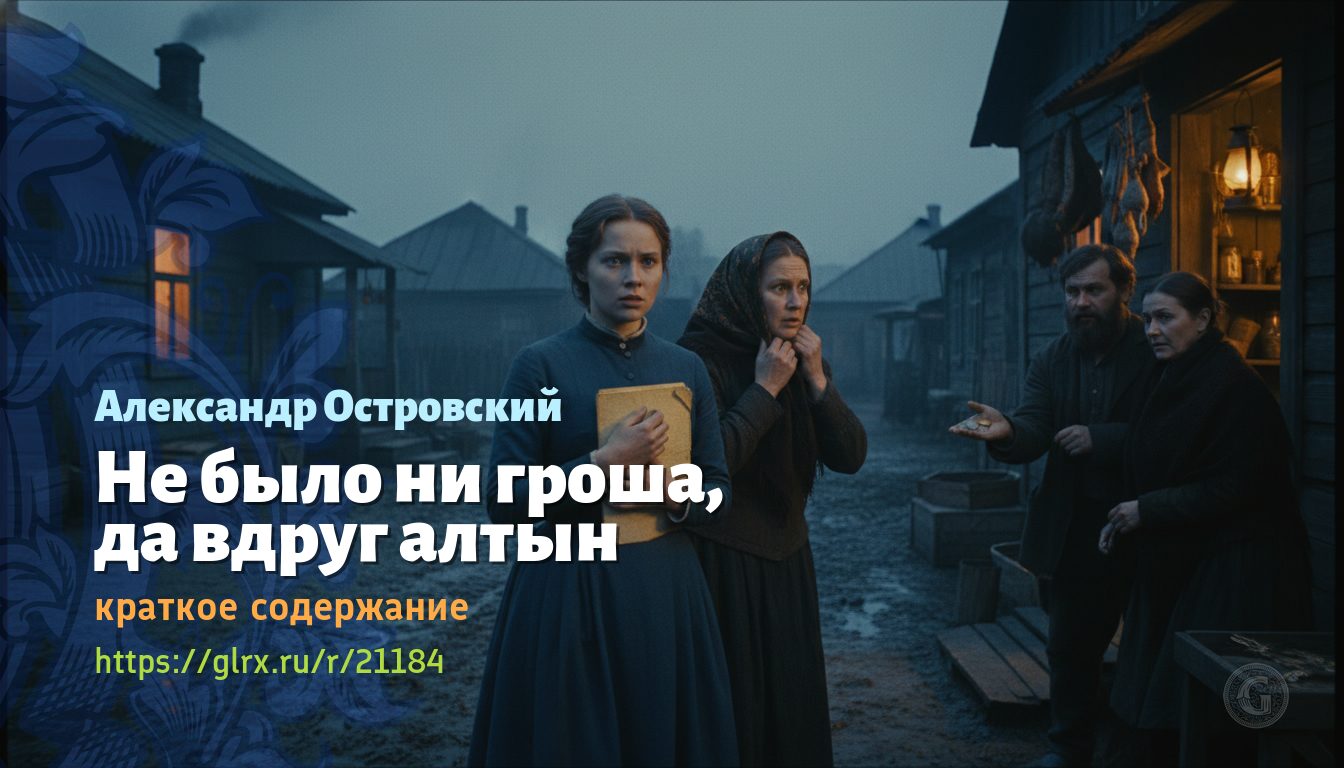
Krutitsky, wanting to get rid of an extra mouth and at the same time profit from his niece’s misfortune, obtains a certificate of indifference for Nastya. With this document, Anna Tikhonovna and Nastya are supposed to go from shop to shop begging for alms. The scene of the collection is very rigidly staged: the neighbors instruct the women in detail how to hold the paper, how to cover their faces with a scarf, how far apart to walk, and how to show themselves to others. Nastya is literally led to shame, like a helpless creature, and those around her regard her with a mixture of pity, curiosity, and vulgar businesslike efficiency.
This humiliation provides one of the play’s most poignant episodes. While shopping, Yepishkin gives women money, but his charity is immediately combined with a sordid interest in the young woman. He gives ten rubles and makes it clear that he would like to come and "talk" to Nastya — that is, to exploit her poverty for his own ends. The insult is twofold: Nastya is being bought before any agreement is reached, and her poverty becomes a bargaining chip.
Having received this money, Nastya acts not according to the logic of survival, but according to the logic of dignity. She spends part of the sum on tea and small purchases, trying to receive Baklushin as a human being and, at least for a little while, hide the extreme nature of her situation from him. This small, domestic arrangement is especially touching because it reveals no well-being — it’s an attempt to hold on to the remnants of a normal life. Nastya’s conversation with Baklushin afterwards is even more poignant: they like each other, but an environment has already developed around them where affection constantly gives way to duty, dowry, and financial gain.
Gradually, the play reveals the central contradiction of the Krutitsky household. The old man is not poor in the traditional sense. He has long been saving, lending money at interest, holding mortgages, and maniacally hoarding every penny. His tattered clothes and his family’s starvation are part of this pathology of hoarding: he lives worse than a beggar, despite possessing a large fortune. He hides his money, gropes it, hides it again, and fears for it more than for his own life.
This secret wealth gives all subsequent events an almost criminal undertone. Krutitsky trusts no one, sees only those around him who are after his property, and drives himself to a complete nervous breakdown. The more he saves, the poorer his house appears and the more dire the situation for Anna and Nastya. Anna Tikhonovna, exhausted by poverty, can no longer think calmly and at times is ready to push her niece to take a disastrous step, just to escape hunger and cold.
By nightfall, tensions reach breaking point. Krutitsky loses the money he was carrying. He immediately shouts that he’s been robbed and accuses everyone around him of stealing. Meanwhile, it turns out that Yelesya, while sweeping the street, actually found the money and is rushing to report the find in front of witnesses, not forgetting his own profit, as he expects to receive his share. The commotion brings police officer Lyutov and his guards, and the scene devolves into a farcical investigation where greed, fear, and officialdom are entangled.
For Krutitsky, this blow proves unbearable. The loss of his capital destroys the last vestiges of his sanity. His speech becomes incoherent, he oscillates between cries of robbery, frantic listings of sums, and the painful feeling that everyone wants to divide up his money. At this moment, it becomes especially clear that his accumulated fortune has brought him neither power, nor peace, nor respect, but only driven him to savagery.
At dawn, the women’s situation seems hopeless. Nastya faces a choice that poverty has essentially already made for her: either continue to endure humiliation or surrender herself to the wealthy merchant. Anna Tikhonovna suffers a painful moral breakdown, having almost agreed to this outcome and then realizing she nearly ruined her niece. Ostrovsky is not showing an abstract vice here, but the direct impact of poverty on human will: hunger deprives a person of clarity and pushes them to make terrible decisions.
The denouement comes suddenly and yet predictably. Krutitsky commits suicide by hanging himself in Yepishkin’s garden. After his death, the true extent of his accumulated wealth is revealed: over two hundred thousand rubles. Those who yesterday viewed Nastya as a pitiful, poor girl immediately change their tune, as she becomes a wealthy heiress. The most dramatic turn of events concerns Baklushin: it turns out he owes Krutitsky a debt, meaning he now owes Nastya a debt.
The final scenes build on this reversal of fate. Nastya can now speak to Baklushin with mocking reproach, almost playing with her newfound power. He asks permission to court her again, and she agrees. The envious, rude, and humorous remarks of the neighbors echo around her, and Nastya herself laughs at the idea that she and Baklushin will likely squander the money quickly. This light phrase is aimed directly at the dead Krutitsky: better to squander a fortune in life than to let it rot in fear and bring oneself to the noose.
Anna Tikhonovna has the final say. She recalls the proverb "the morning is wiser than the evening," which poor people use to console themselves when it’s pitch dark, and this time it comes true, literally. Overnight, Nastya’s life changes completely, but the joy of the ending doesn’t erase what she’s been through: before the money suddenly arrived, this house had already demonstrated the full horror of stinginess, humiliation, and human trafficking.
- Anniversary exhibition of the monumental artist Ivan Bondarenko "With love for life"
- Sights of Moscow that often remain behind the scenes
- "Enough Stupidity in Every Wise Man" by Alexander Ostrovsky, summary
- Winner of the Kinotavr short-film program announced
- Street Art Exhibition "Reverse Side"
- "The Magic Sparkles of the Sun" by Anna Jane, summary
You cannot comment Why?