Robert Sheckley’s "The Cost of Living" Summary
 Automatic translate
This collection of satirical science fiction by Robert Sheckley was written throughout the 1950s and 1960s, with the title story published in 1952. The book exposes the paradoxes of unbridled consumerism, the robotization of everyday life, and the transformation of human life into a cheap consumable for the sake of corporate profits. Technological comfort devolves into total alienation, debt slavery, and public displays of violence.
In 1970, West German television released the film "The Million-Year Game," based on the novella "Risk Prize." Later, in 1983, French director Yves Boisset released a film adaptation of the same name, "The Price of Risk."
Consumer dead end and family life
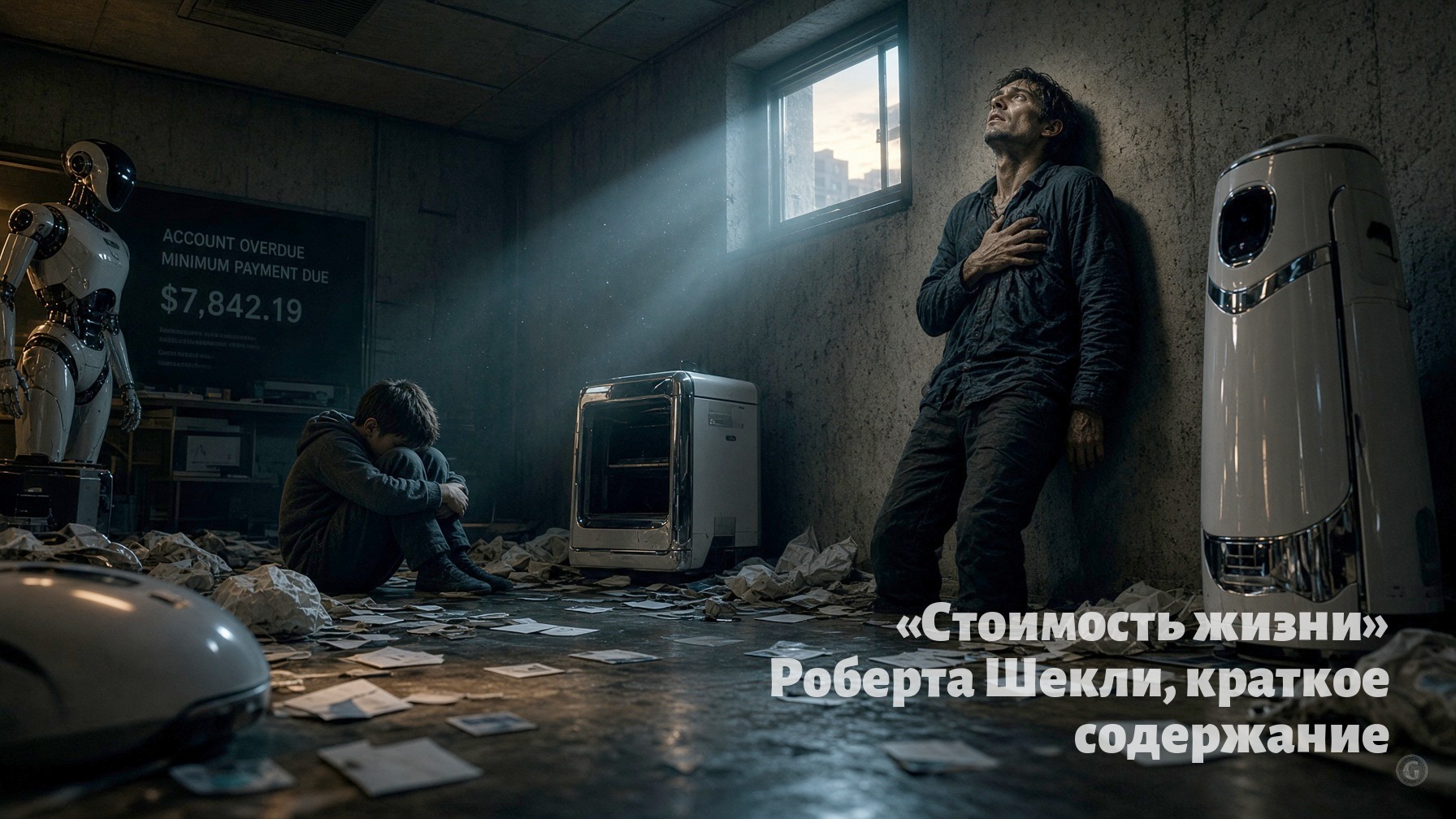
Carrin begins her day off surrounded by state-of-the-art Avignon Electric appliances, methodically accumulating astronomical financial obligations for automated service, synthetic clothing, and a wall-mounted secretary. In the living room, Inspector Pathis is taking out a new loan. The debt exceeds two hundred and three thousand dollars, forcing the head of the family to mortgage his teenage son Billy’s future earnings for thirty years to buy a one-button controller. The last of their savings are spent on sex-enhancing robes and stereoscopic televisions. Her son is crushed by the debt. On the night shift at the factory, Carrin spends hours pressing buttons on the washing machine conveyor, recalling with dull irritation the recent suicide of her well-off neighbor, Miller. A false peace reigns at home.
In the Museum of Descriptive Anthropology, the unassuming ornithologist Mr. Grant finds an unconventional way to rid himself of his domineering wife. Her frail husband leads his companion into a secret room containing live South American natives. Inside a reed hut, the natives lure a large woman into a trap to add to their collection of dried human heads, while a cleric boils water in a ritual cauldron. The scientist returns to the stuffed birds.
In his office, Ferguson listens to the respectable agent Esmond’s proposal to eliminate his nagging wife. He’s tempted to have an affair with his secretary, Miss Dale. He hesitates until evening, and then rejects the deal over the phone. On the doorstep, two burly henchmen stuff the poor fellow into a sack, saying, "Destruction Service," one of the uninvited visitors replied. It was his wife who had initiated the order.
Dictatorship of the norm and social revolt
A sanity monitoring device mercilessly registers the critical mental deviation of employee Firmen from the established state norm of a stable society. The domestic robot leaves the apartment. After a scandalous incident at the gate, Morgan, the boss, fires the unruly employee, the landlady throws the tenant out onto the street, and the guards, without further ado, deliver the fugitive to a suburban hospital. In the emergency room, a sleepy, bespectacled employee casually declares, "During the full moon, we see the most tens." The doctor administers a sedative injection. The drug-induced sleep transports consciousness into an illusory battle, where the hero fights phantom enemies on a fog-shrouded plain for the sake of a false sense of social well-being.
In a lengthy written appeal to a Washington senator, a poor man named Johnny bitterly recounts the agonizing death of his ninety-two-year-old grandfather after purchasing a defective synthetic torso from a used model shop on Broadway. The retailer denies the claim. Recognizing the impunity of the ruling elite and the monstrous inequality in the distribution of medical immortality technologies, the urban poor form a secret underground organization dedicated to the wholesale physical extermination of the rich, bankers, congressmen, and labor leaders. The dispossessed begin a guerrilla war.
Deadly rides for public amusement
In 2031, millions of viewers watch with rapture the brutal broadcasts from the Infinite Western shooting range, where performers die for real under the gun of hidden cameras. Manager Simms renews his deadly contract. For the sake of a quiet family life, Tom Washburn unsuccessfully tries to avoid a duel with Little Joe Potter, tosses his derby hat to his opponent, and drives to the stone bridge at the edge of the shooting range. The outcome of the confrontation is decided by the gun. Returning to the dusty streets of Brimstone, the celebrated gunslinger knocks out his opponent with a shot from a.44 revolver and immediately falls to the bullets of the freckled debutant. The man turns off the television.
In the TV action thriller "Jeopardy," unemployed Jim Rader flees Claude Thompson’s gang of professional hitmen for a colossal reward of two hundred thousand dollars. Previously, the contender has endured car crashes, a plane crash landing, and a scuba-diving knife fight. Producers orchestrate a brutal spectacle. To boost ratings, the company hires a fake rescuer, Janice Morrow, deploys helicopters with cameras, and continuously broadcasts pathetic proclamations: "Jim Rader fought wild bulls — now he fights jackals." In an old cemetery, the wounded fugitive crawls into an open grave. The stopwatch records the final scene. Stunned by the suffering he’s endured, the man finally loses his mind, turning into an incoherent puppet used to advertise the channel’s future commercials.
The struggle for survival in overcrowded megacities
Cities are suffocating in a demographic trap. Before the start of the Land Race, the judge reads the main rule: "Each finalist will be provided with free government transport to transport them and their family to the land plot." Modest consultant Steve Baxter navigates through bandit ambushes. At the cost of her own life, red-haired Flame Steinmetz helps the hero scale the cyclopean wall of an unfinished skyscraper and dies in a fall in Times Square, allowing the fugitive to win the coveted rocky plot in the mountains. The family moves into a clapboard shack.
In trench warfare using bacteria and shock bullets, army medics implement tissue repair technology, reviving seriously wounded soldiers up to six times in a row, despite their pleas for final death. The Brahmins ignore the soldier’s protests. Another attack on an enemy trench results in another head wound, a medal for bravery, and immediate resuscitation in a field hospital. The soldier is sent back to the front lines.
Loneliness among the ruins of civilization
A survivor of a Patagonian meteorological station builds a five-room house, learns surgical procedures with assistance, paints, and prepares to carve a tombstone before his inevitable death from radiation poisoning. In the desert, radiation has destroyed all life. Amid the radioactive ash, Mr. Wayne finds Tompkins’s dilapidated shack, marked "Warehouse of Worlds." The visitor gives up cans of stew, coils of copper wire, army boots, and an entire decade of his life for the narcotic liberation of his mind. Memories of a boat ride evoke. Sated by the fleeting vision of a quiet family hearth amidst the ruins and ashes, the traveler returns to the evening distribution of potatoes.
On a scorched planet, the captain of a rescue cruiser discovers the ability to materialize any object with a force of will, destroys unnecessary things, and chisels an eternal monument to his lost race into a rock: "I ARISEN FROM THE PLANETARY DIRT. NAKED AND DEFENSELESS, I BEGAN TO MAKE TOOLS OF WORK." The sudden arrival of a dark-haired girl, Joan, confronts the pilot with an insoluble philosophical dilemma. The pilot builds palaces. Creating a fairytale oriental city with sapphire towers, rose gardens, and pleasure boats on a tranquil pond amidst lifeless basalt plains, the demiurge vainly searches for proof of his beloved’s reality, remaining eternally captive to his own illusions. Illusion replaces reality.
You cannot comment Why?