A summary of "Wilhelm’s Gold" by Fazil Iskander
 Automatic translate
The author’s collection "Wilhelm’s Gold," composed of works from 1956 to 1999, combines autobiographical prose, satirical short stories, and philosophical parables. This book is a sprawling narrative that spans the protagonist’s Abkhazian childhood, Stalin’s repressions, the war years, and post-Soviet reality. The author combines subtle humor with the profound drama of human existence.
The stories from this collection brought the author national recognition. Individual stories, such as "The Thirteenth Labor of Hercules" and "The Time of Happy Finds," were successfully adapted into films in 1969 and 1982. The writer himself was awarded the State Prizes of the USSR and the Russian Federation in 1989 and 1999.
Many of the stories in the collection are related to the well-known cycle of works about Abkhazia and Chegem, forming a single semantic space with it.
Childhood and school years in Mukhus
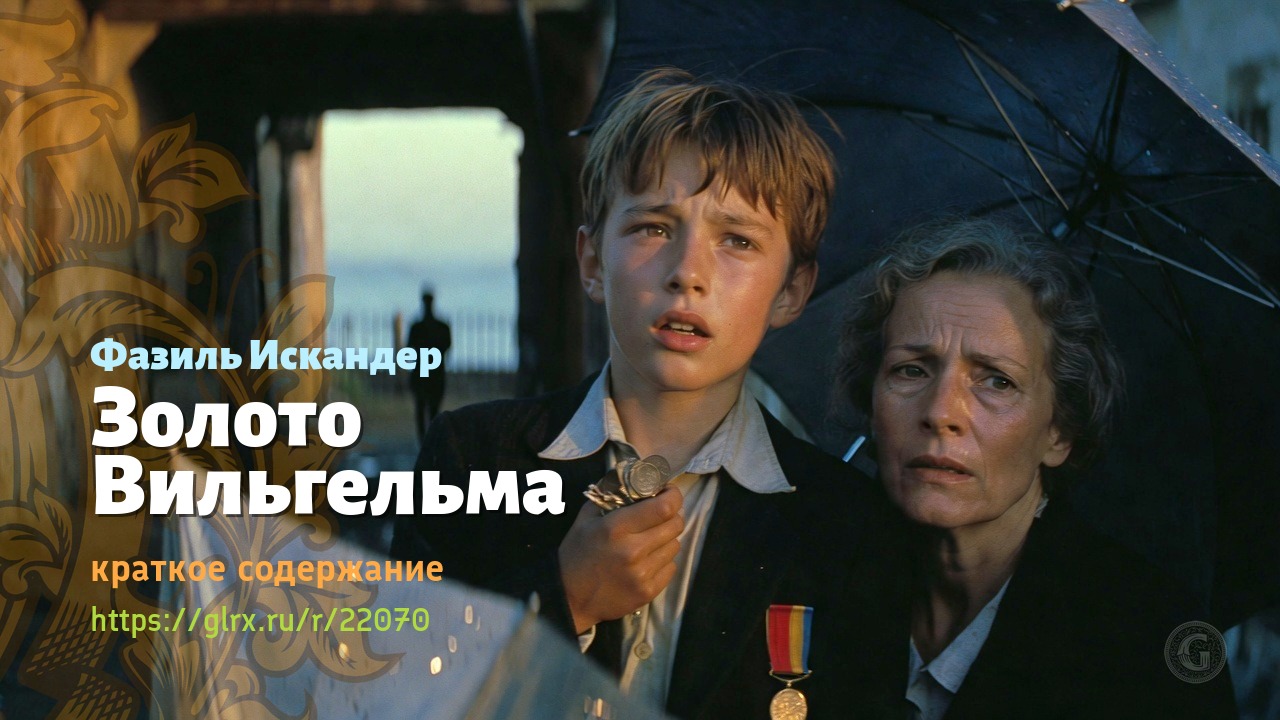
The narrative begins with the story "School Waltz, or the Energy of Shame," in which the author recalls his school years in the seaside town of Mukhus. Branded a "notorious lazybones," the protagonist is forced to play out his imposed image, half-heartedly listening to teachers and earning excellent grades. Intensive pedagogical training leads him to the level of a medal candidate. At his final exams, he receives a gold medal instead of a silver one, prompting the mother of a failed competitor to repeatedly smear him across the neck with a wet umbrella. Subsequently, the protagonist enrolls in the Literary Institute and moves to Moscow.
In the story "The Rooster," a boy wages a constant war with a pugnacious red rooster, ending with the hero’s victory and the bird’s tragic transformation into soup. The story "The Tale of the Sea" describes learning to swim, searching for coins near an old fortress, and a young man’s rescue of a drowning boy. In the novella "The Kindergarten," the hero donates a large pear he finds to the group for compote, but later bitterly notices it in the basket of the teacher, Vera.
In the story "My First Day of School," the author describes entering school with the help of his neighbor Uncle Volodya, the noisy arguments between Uncle Samad and his Karaite neighbor Samuil about the Great Soviet Encyclopedia and the New Economic Policy, and an accidental blow from a cobblestone during a street brawl.
Lessons in humor and first trials
In the short story "A Time of Happy Finds," a boy discovers a wad of money in the twilight and then gains a reputation as a domestic bloodhound, capable of finding a lost earring, a missing chicken, or an ancient Greek stele at the bottom of the sea.
In the story "The Thirteenth Labor of Hercules," mathematics teacher Harlampy Diogenovich disciplines his class by ridiculing his students. To avoid being called to the board for an unsolved problem about an artillery shell, the hero tricks a nurse into coming to the classroom for a typhus vaccination. The teacher solves this "thirteenth labor" and still ridicules the student in front of the entire class.
The short story "Martyrs of the Stage" describes a school production of Pushkin’s fairy tale about the Priest and his Worker Balda, where the hero is relegated to the role of a horse’s hind legs due to his lackluster performance. The story "Alexandra Ivanovna" describes lessons taught by a beloved teacher couple, a reading of "The Captain’s Daughter," and the unexpected ban on the use of the word "fascist" after the signing of the 1939 pact.
The Family Circle and the Repressions of 1937
The story "My Uncle of the Most Honest Principles…" is dedicated to the insane Uncle Kolya, who fell from an Arabian horse in his youth. He suffers from a morbid obsession with cleanliness, fears the commission from the city education department, and is hopelessly in love with the freckled seamstress Faina.
The short story "Beloved Uncle" describes the fate of Uncle Riza, a former football player. In 1937, he was arrested and sent to Nagaevskaya Bay in Kolyma. His family sells his new children’s bicycle to send him essentials. After 1956, he is declared fully rehabilitated.
The story of the hero’s father, Ibrahim, is revealed in the story "Father." A former underground fighter who escaped to Odessa thanks to Commissar Vasilyevich, he experiences constant hardships in life. In the late 1930s, as a Persian citizen, he is exiled to Iran. His family maintains a long correspondence with him, but in 1957 they receive notice of his death.
In the short story "Forbidden Fruit," the strictly observed family taboo on pork is violated by the sister, who eats the neighbors’ lard. The hero attempts to blackmail her, but his father harshly punishes his son for informing on her.
The story "The Human Campsite" and portraits of fellow countrymen
The chapters of the novella "The Human Encampment" feature Viktor Maksimovich Kartashov, a former pilot who served time in the camps for telling a joke about Stalin and dedicated his life to building an ornithopter. He recounts his past in Kolyma, where he tried to protect the former factory director, Alexei Ivanovich, from the bullying of the criminal Tikhon, and also recounts his rescue of a drowning boy during a boat trip.
The story "Pancakes of ’37" conveys an atmosphere of fear when a mother accuses her son of missing the twelfth pancake and pressures him into confessing until the missing pancake is discovered behind the nightstand.
The short story "The Rich Tailor and the Palmist" describes the rivalry between the tailor Suren and a wandering palmist, who was kicked out of his garden for distilling moonshine from fallen fruit. During the war, the palmist’s cave becomes a bomb shelter, where he sells alcohol and later helps capture two German pilots.
The story "Broken Arm" is dedicated to Shaaban Larba, who was wounded in the arm. When he is mistakenly believed dead, he prepares for his death by transplanting a tung tree to his future grave, and after his actual death, he pulls one last prank: his horse refuses to jump over the coffin.
Reflections on Culture and Society
In the short story "The Uninvited Guest," a woman named Tamara Ivanovna is afraid to recognize her former White Guard relative who came from France, fearing security officials.
In the story "Grandfather," an old man recalls the migration of Abkhazians to Turkey in the 19th century and his return to his homeland.
The novella "The Route from the Varangians to the Greeks" reveals the traditions of Abkhazian winemaking and describes the first tasting of wine from an underground jug. In the story "There Lived an Old Man with His Old Woman," a dying husband asks the old woman in a dream to pass on his crutches through the first fellow villager to die.
The novella "On a Summer Day" describes the author’s meeting with a German physicist at a seaside café. The novella "My Police Protect Me" describes a curious mix-up with suitcases at a Moscow airport.
In the chapter "The Plot of Existence," the author visits the only remaining resident of the highland Chegem, Manitsa, who has preserved her grandfather’s house.
The collection concludes with satirical and philosophical works. "The Russian Thinker and the American" is an ironic dialogue about the peculiarities of the Russian mentality, theft, and philosophy. The final text, "A Dream of God and the Devil," is a philosophical debate between the Supreme Mind and the Devil about free will, conscience, human sin, and the fate of the world.
- Works by V. Milashevsky from the Voronezh Museum at an exhibition in Moscow
- "Christmas Parade" takes place on the stages of famous theaters in St. Petersburg
- "Chick’s Childhood" by Fazil Iskander, summary
- “Girl” by Jamaica Kincaid
- "The Sleeping Angel" by Alice Clover, summary
- A summary of Maria Semenova’s "Valkyrie"
You cannot comment Why?