"Violets for Dessert" by Maria Metlitskaya, summary
 Automatic translate
This collection by renowned writer Maria Metlitskaya, published in 2017, consists of two realistic stories. The author focuses on the lives of ordinary women facing betrayal, loneliness, and the search for family happiness. The book explores in detail the fragility of family ties, the psychology of motherhood, and the ability to find inner strength during difficult times.
The work was published by Eksmo as part of the author’s popular "Behind Other People’s Windows" series. This cycle also includes the author’s other well-known works, including "Mother-in-Law’s Diary" and "Can I Be Happy?"
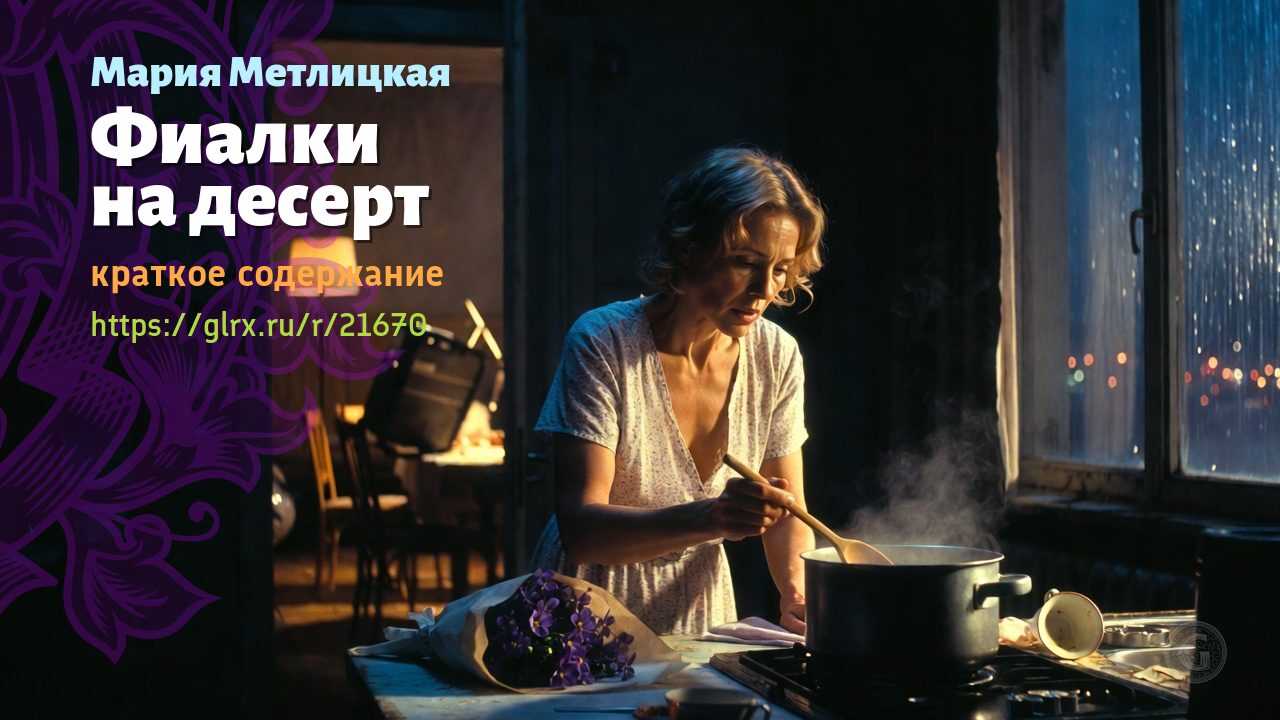
Violets for dessert
The story of forty-two-year-old Tatyana Evgenyevna begins with a painful anticipation. Her only son, Mitya, who had left to live in Paris, is returning to Moscow with his French fiancée, Genevieve. Tatyana prepared a celebratory dinner, hoping to see the refined Frenchwoman. However, reality proves harsh.
Genevieve turns out to be a large, unkempt woman. She wears dirty shoes all the time, walks on the expensive beige carpet, and defiantly refuses a celebratory dinner because she dislikes mayonnaise. A guest smokes unceremoniously in the room. Mitya uses Tatyana’s fragile Japanese teacup as an ashtray. The conversation falters, and the atmosphere becomes tense. Mitya announces there will be no lavish wedding — they’ll simply register and return to Paris.
Tatyana feels abandoned. Her son is drifting off to another life, submitting to the will of another woman. After the newlyweds leave, Tatyana cries for a long time and calls her childless friend Svetlana. Her nighttime reflections take her back to the past, reminding her of the price of motherhood.
Tanya’s parents divorced when she was 10 years old. Her father, Evgeny, left her for Lilya, a young woman. Lilya turned out to be a seriously ill alcoholic whose handsome brother had drowned in the Caucasus. Tanya’s mother married Mikhail, a physicist — a kind but completely unsuited man. At sixteen, Tanya experienced acute loneliness. On New Year’s Eve, she left her father’s dacha and lay down in a snowdrift, trying to sleep forever. She was rescued in time, but due to severe frostbite and pneumonia, doctors predicted she would be infertile.
Mitya’s birth was a true miracle. Tanya gave birth to him at eighteen after a casual affair with her classmate Pavel. She devoted herself entirely to her son, showering him with excessive care. To be always close, she even took a job as a math teacher at his school. The only man who remained in her life was Bogomolov — a reliable but reserved man, often away on dangerous business trips.
Mitya’s marriage to Genevieve shatters Tatyana’s world. A year after their departure, she decides to fly to Paris without an official invitation. Her son tries to dissuade her, citing an urgent business trip to Oslo and his fiancée’s leg injury. But Tatyana remains stubborn and buys a plane ticket.
In Paris, Tatiana is met by Jean-Louis, Genevieve’s awkward brother. She arrives at a tiny rented apartment on the outskirts of the city. The place is squalid: dirty clothes are scattered everywhere, dishes are unwashed, and the refrigerator is empty. Tatiana refuses to give in to despair. In a few hours, she tidies up the apartment, buys groceries, and makes chicken soup.
Genevieve, bedridden with a broken leg, is initially embarrassed. Gradually, the ice melts. Tatyana lovingly feeds her daughter-in-law, gives her a pain-relieving injection, and sings her a Russian lullaby. The girl cries and admits she’s always felt lonely. Her parents had long ago left for India to practice yoga, leaving their children behind. Genevieve feared Tatyana, seeing her as an enemy who was taking her son away.
Mitya returns from his trip. The family reconciles, they stroll through the French capital together, and visit a famous café. There, they try an unusual delicacy — candied violets for dessert. Tatyana returns to Moscow with a light heart. At the airport, she receives a message from Bogomolov inviting her to meet. She realizes that her personal life is moving on.
Dark chocolate
The second story introduces the reader to Larisa Alexandrovna Neznamova, known to her family as Lelya. Larisa is almost 50 years old and the successful owner of the Zebra chocolate factory. Her character was shaped by the influence of her beloved grandfather, Semyon Yakovlevich, a former engraver at the Preobrazhensky Market. Grandfather Semyon secretly dealt in antiques for many years and provided a comfortable life for his capricious wife, Dusya. Before his death, he left Lelya precious stones, which saved her business during the crisis.
Lyolya’s husband, Viktor, is a handsome intellectual who spent his entire life working at a scientific institute. He always treated his wife’s commercial activities with mild disdain, but enjoyed their material benefits. Their daughter, Katya, is studying in Paris.
Tragedy strikes their home: Viktor is diagnosed with a serious illness. Lelya takes on all the responsibilities and takes her husband to Frankfurt for surgery. There, she meets her school friend Galina. Galina once lived in a communal apartment in extreme poverty. Lelya often fed her and gave her her things. Galina later emigrated to Germany with her mother, where she found work as an operating room nurse.
The operation is a success, but Lyolya runs into problems with her business in Moscow. Her partners are failing her, and the bank is denying her a loan. Her deputy, Vladimir, and accountant, Raisa Semyonovna, can’t cope without her. Lyolya is forced to fly to Russia urgently. Galochka generously offers to take Viktor into her two-room apartment to provide him with home care. Lyolya agrees.
In Moscow, Larisa is working herself to the bone. She’s dating an influential acquaintance, Georgy. Several years ago, they had a brief fling, after which Georgy helped her resolve her financial problems. Now he’s again promising support, but he’s gone on a business trip and stops answering her calls. Lyolya’s business is in danger of closing. She realizes she’ll have to sell her beloved country house to pay off her debts.
The situation is complicated by her daughter, Katya. She calls hysterically from Paris — her French boyfriend has dumped her. Katya screams that she doesn’t want to live, but refuses her mother’s help. Lelya drops everything and flies to Paris. The daughter refuses to open the apartment door, claiming her mother irritates her. Frustrated, Lelya spends the night in a cheap hotel with the symbolic name "Chocolate" and returns to Moscow.
Soon, alarming news arrives from Germany: Viktor’s condition has worsened. Lelya urgently flies to Frankfurt and rushes to the hospital. Opening the door to the hospital room, she sees Galina, who affectionately calls Viktor "darling" and promises to take him "home."
Her husband accuses Lelya of callousness and selfishness. He claims he’s tired of her strong character, her drive, and her endless plans. Victor found peace with the quiet, caring Galina, who cooked him oatmeal and did his laundry. Galina feels no guilt, reminding Lelya of her own words: that there was no love left in their marriage long ago.
Lelya leaves the hospital, crushed by the double betrayal. Sick and with a high fever, she returns to Moscow. At the airport, she’s met by chance by Dmitry, Semyon’s former driver, who served in Afghanistan. He now works as a chef and drives an expensive car.
Dmitry brings the sick Lelya home, buys her medicine, makes her chicken broth, and carefully wraps her in a blanket. He admits that he’d long read about her successes and always thought of her.
On New Year’s Eve, Lyolya’s daughter Katya unexpectedly arrives at her apartment. She brings a fluffy Christmas tree and a festive cake with a marzipan bunny. The daughter apologizes to her mother. Lyolya looks out the window, sees Dmitry’s car driving away, and realizes that the dark patch in her life is gradually giving way to a brighter one. She’s ready to believe in the best again.
- The international music festival "Crazy Days" was held in Yekaterinburg
- "Bitter Chocolate" by Maria Metlitskaya, summary
- Social structure of the ancient Incas
- "Poverty is no vice" by Alexander Ostrovsky, summary
- "Luminaries of Darkness" by Tatyana Korsakova, summary
- "The Thundering Brook" by Tatyana Korsakova, summary
You cannot comment Why?