"Lucky City" by Nikolai Svechin, summary
 Automatic translate
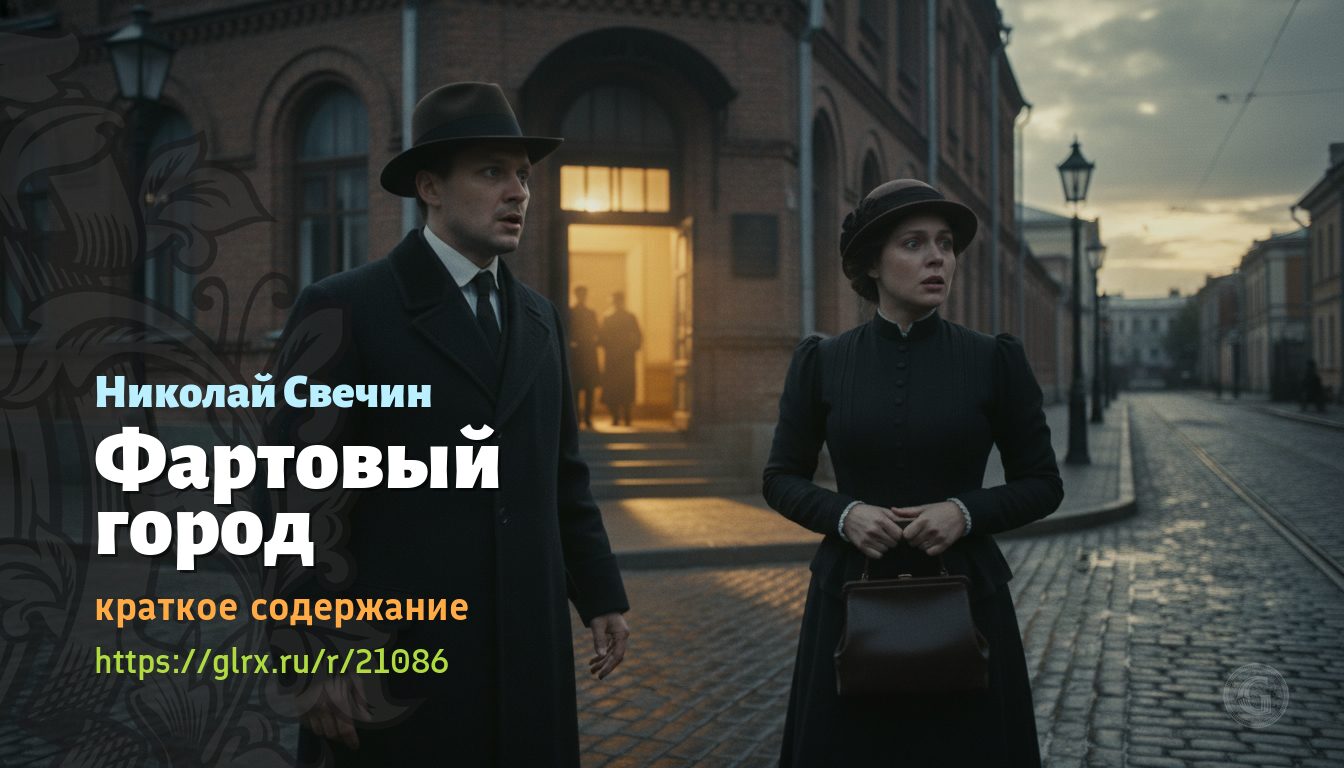
"Lucky City" is a 2018 historical detective novel, the eighteenth in a series about detective Alexei Lykov, a special assignments officer in the Imperial Police Department. The action takes place in May 1907, when the country is emerging from revolutionary upheaval: open uprisings have been suppressed, but peasant revolts, street killings, and armed gangs remain a constant presence. Rostov-on-Don is depicted as a vibrant and recognizable city — with trams, the Armenian quarters of Nakhichevan, thieves’ settlements, Greek swindlers, and escaped convicts.
Business trip to the south
Police Department Director Trusevich summons Lykov to his office. The St. Petersburg mayor, Major General Drachevsky, unexpectedly appears at the meeting, requesting that Lykov be sent as an inspector to the Rostov mayor’s office, which he himself had recently headed. Drachevsky fears that old sins — the Jewish pogrom of the autumn of 1905, the shooting of rioters, the Black Hundred pogroms — will surface in a report to the minister and reach the sovereign. He asks Lykov not to rush to conclusions and to contact him before writing anything. Lykov agrees to an objective but balanced approach: he is not a vile man and will not commit unnecessary mischief.
Olga Dmitrievna Okonishnikova, a divorcee with whom he has been living in a common-law marriage for the past three months, is traveling to Rostov with Lykov. For her, this is a return to her hometown after ten years of absence. She secretly hopes to see her first love, Arkady Kordi, whose father refused to allow her to marry him because of his poverty.
Rostov: The City and Its Criminal Underworld
In Rostov, Lykov introduces himself to the acting governor-general and mayor, Colonel Zvorykin. Zvorykin greets him openly: neither fearing an audit nor trying to please, but honestly inviting him to cooperate. There is no real police chief in the city: the position is formally held by Collegiate Assessor Lipko, an experienced man but lacking the will to command.
The leading figure in the local investigation department is Yakov Nikolaevich Blazhkov, the head of the detective department. He is a collegiate registrar, the lowest rank in the Table of Ranks, but he knows Rostov’s criminal underworld firsthand. Blazhkov paints a detailed picture of the local crime scene for Lykov. In Nakhichevan-on-Don, Rostov’s Armenian neighbor, they prefer "clean" crimes: high-quality counterfeiting, scams involving bills of exchange and diplomas. In Rostov itself, through which three railways and a river port pass, cargo theft is rampant, from dockworkers to track department managers. The villages of Bogatyanovka, Nakhalovka, Berberovka, and the Tsatemernitskoye settlement operate under the laws of the criminal community; the police do not bother there.
A separate threat is the "Devil’s Squad," a gang of fugitive "hundred-and-desyatniki" (soldier-of-the-hundreds), soldiers convicted of participating in uprisings and escaping from penal servitude. The leader is Prokopiy Tsetsokho, a former rebel leader in the Voronezh Disciplinary Battalion. The gang includes Greeks — Papaianidi and Dobudoglo. Intelligence has reported its presence in the city, but its exact location has not yet been determined.
Tragedy with Arkady Kordi
Olga meets with Arkady Kordi and discovers him in the surgical ward of Nikolaev Hospital: bandits had broken into his home, robbed him, and gouged out his eyes — so the victim couldn’t identify them. Before leaving, one of the attackers mentioned the leader’s name: "The Lesser Tsar ordered it." Grief-stricken, Kordi, a proud man, managed to tell Olga some of the attack, but shortly after she left, he committed suicide — smashing a glass and slitting the veins on both hands with a sharp shard.
Olga, in desperation, begs Lykov to find the killers. According to her, Kordy uttered the following words before the attack: "They’ve achieved their goal. Now they’ll fire me, and I can steal with impunity." This gives Lykov his first theory: the blinding is connected to Kordy’s position as an assistant accountant at the Don Girls’ Committee, which oversaw shipping in the Don Delta. The collegiate councilor takes Kordy’s case into his own hands, exercising his right to choose the investigation.
Investigation: The Lesser King and the Devil’s Squad
Blazhkov explains to Lykov who the Lesser Tsar is: three criminal clans operate in Rostov — the "Senior Tsar," the "Middle Tsar," and the "Lesser Tsar," each with its own territory and guards. Overseer Pyotr Anglichenkov — tall, bold, and not very cautious — becomes the St. Petersburg guest’s guide to the city’s drinking spots.
That night, Lykov and Anglichenkov visit the "Kazachikha" brothel on Bogatyanovka Street — the establishment of a certain Olga-Henrietta Kolbasenko, the widow of a cornet. There, Lykov, disguised as the bailiff’s new assistant, inspects the patrons. The purpose of the raid is to frighten the bandits so that an agent inside will immediately report their new hideout. The plan allows them to take part of the gang by surprise during the night.
At the same time, Blazhkov is interrogating Olimpiy Shramkov, nicknamed Shlyonda, a petty criminal who once fought for Sakhalin and has now killed a random person in a cemetery. Shlyonda offers to provide information about the murder of a crew member at Morozovskaya station, hoping for leniency. There, Kuznetsov was shot dead with nine bullets and several thousand rubles were stolen. The suspect is Rufin Tusuzov, a skilled dockworker who carried out raids between unloadings.
Meanwhile, Tsetsokho himself, along with Captain Azvestopulo, is preparing an attack on the factory manager, Voskoboinikov, who transports money along the Temernik River. Azvestopulo devises a ruse: before the attack, he will tell Voskoboinikov the name of the "Middle Tsar," so that the investigation will later look in a different direction.
Denouement
Lykov unravels the threads one by one: interrogating witnesses, delving into the financial affairs of the Don Girls’ Committee, where, under Kordi, double-entry bookkeeping was practiced and state funds were embezzled for the repair of shipping canals. The mastermind behind Kordi’s blinding turns out to be one of the committee’s officials, who feared exposure. The connection to the Lesser Tsar’s gang is confirmed through intelligence data and the testimony of those detained.
Tsetsokho’s gang was ultimately destroyed in a raid organized jointly by Lykov, Blazhkov, and Anglichenkov. Tsetsokho himself and his closest accomplices were captured; the mastermind behind the murder was identified and handed over to the investigator. Lykov wrote an audit report: Zvorykin’s actions were assessed positively, and Blazhkov, at the request of the St. Petersburg guest, was promoted to the next rank. Regarding Drachevsky, the report contained only what could be documented — no lies in favor of the general.
Olga Dmitrievna leaves Rostov with a heavy heart: she didn’t have time to say goodbye to Arkady, who was still alive, and the guilt over his death will haunt her for a long time. Lykov remains in place until the end of his assignment, finishing up the paperwork and returning to St. Petersburg.
You cannot comment Why?