"Zuleikha Opens Her Eyes" by Guzel Yakhina, summary
 Automatic translate
This book is a historical novel, written in 2015, that tells the story of a Tatar peasant woman who endured dispossession and exile to Siberia, where she was forced to survive inhumane conditions and rediscover the meaning of life. The work won the prestigious Bolshaya Kniga and Yasnaya Polyana literary awards, and in 2020, a television series starring Chulpan Khamatova was made based on it.
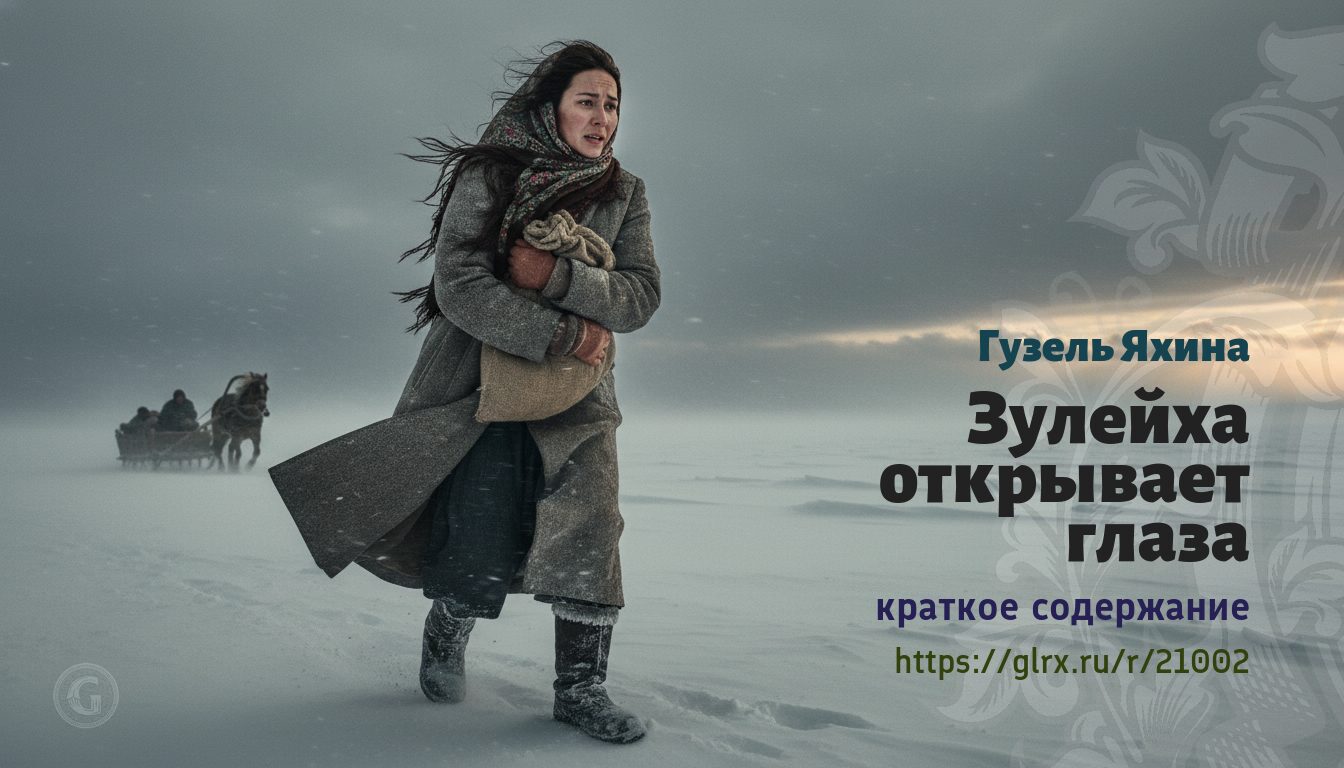
Life in a Tatar village
Winter 1930. Thirty-year-old Zuleikha lives in the village of Yulbash with her husband, Murtaza, and her mother-in-law, whom she mentally calls "Upyrikha." Her husband, significantly older than her, is stern-tempered and physically strong, constantly burdening his wife with heavy housework. The blind and cruel mother-in-law bullies her daughter-in-law, forcing her to serve her, wash her in the bathhouse, and endure daily humiliation.
Zuleikha accepts her difficult lot as a given, not daring to complain or contradict her elders. In the past, she bore Murtaza four daughters, but all the girls died in infancy. Their deaths only intensified her husband’s coldness and her mother-in-law’s hatred.
The death of Murtaza
The peaceful peasant life is interrupted by the arrival of the Red Army. A detachment under the command of Ivan Ignatov carries out dispossession — the forced confiscation of peasant property for the benefit of the state. Murtaza decides to hide some of his supplies.
That night, he sets out with Zuleikha into the forest to bury sacks of grain in an old cemetery and kill the remaining cow, categorically refusing to hand it over to the Soviet authorities. On their way back from the forest, they accidentally encounter Ignatov’s detachment.
Murtaza, in a fit of rage, lunges at Ignatov with an axe, but the Red Army soldier reacts faster, fires his service revolver, and kills the peasant. The widowed Zuleikha is returned to the village, her meager belongings are gathered, and soon sent by sleigh to Kazan along with other arrested families. The blind Vampire Hag is left to die in the empty house.
Stay in Kazan prison
Zuleikha is being carried by sleigh through a brutal snowstorm. On the way, she is in a state of profound shock, not fully comprehending the scale of the tragedy and grieving for her murdered husband.
In Kazan, the exiles are placed in an overcrowded transit prison — a temporary gathering point for prisoners before they are transported. Here, in cramped cells, people of all social classes, professions, and nationalities gather: Tatar peasants, urban intellectuals, former nobles, and criminals. Within the prison walls, Zuleikha suddenly realizes she is pregnant with the deceased Murtaza’s child.
Several prominent figures stand out among the prisoners. Leningrad medical professor Wolf Karlovich Leibe, due to severe mental trauma, lives in his own imaginary world (he calls this state "the egg") and is completely oblivious to the horrors of Soviet reality. Also among the exiles are the talented artist Ilya Ikonnikov and the criminal Gorelov.
The Long Road to Siberia
In the spring, a huge mass of exiles is loaded onto railway trains and sent to the east of the country. The grueling journey in boxcars lasts several long months.
People are desperately short of food, clean water, and fresh air; they suffer from disease, filth, and extreme exhaustion. Ignatov, appointed commandant of the train, tries to maintain order in the cars and, whenever possible, obtain provisions for the prisoners at the stations. Despite his efforts, the mortality rate in the freight cars remains horrifyingly high.
A typhus epidemic breaks out along the way, claiming many lives. Zuleikha selflessly cares for the deranged Dr. Leibe, gradually becoming accustomed to this strange man. During the difficult journey, Dr. Leibe suddenly regains consciousness, his mind completely clears, and he begins actively helping the sick prisoners like a true doctor.
Barge wreck on the river
Upon reaching Krasnoyarsk, the surviving exiles were transferred to old barges for transport down the affluent Angara River. Due to the criminal negligence of local authorities, the barge carrying Ignatov’s party was severely overloaded with people and belongings. During stormy weather, the dilapidated vessel sprang a leak and began to sink rapidly.
Ignatov, risking his own life, manages to save only a small portion of the crew — about thirty people who were on the upper deck or who miraculously escaped from the flooded hold. The remaining hundreds of unfortunate prisoners perish in the icy waters of the Siberian river.
The rescued people find themselves on the absolutely remote shore of the taiga without food, warm clothing, medicine, or construction tools, on the eve of a harsh winter.
Hard survival in the taiga
A small group of emaciated people, including Zuleikha, Dr. Leibe, the artist Ikonnikov, a pair of Leningrad intellectuals, Isabella and Konstantin, and the brutal criminal Gorelov, are forced to make a living in the wild Siberian taiga. Ignatov assumes strict leadership of the detachment, fully aware that without strict discipline, they will all inevitably perish.
The men laboriously dig a large dugout in preparation for the approaching cold weather. A terrible famine sets in, and people weaken from malnutrition and scurvy, but they continue to gather firewood and hunt small game daily.
Ignatov demonstrates an incredible will to live and saves his charges, although he himself suffers from a deep sense of guilt and complete hopelessness.
Birth of son Yusuf
During a cold winter, Zuleikha goes into premature labor right in the frozen dugout. Thanks to the high level of professionalism of Dr. Leibe, who delivers the baby in extremely unsanitary conditions, a premature baby boy is safely born.
Zuleikha names her son Yusuf. The weak child becomes the young mother’s primary reason for living, for whom she is willing to endure any hardship and fight death.
To feed her crying baby, Zuleikha secretly cuts her finger with a knife. She lets Yusuf suck her blood when she runs out of breast milk due to extreme exhaustion.
Construction of the village of Semruk
In the spring, help unexpectedly arrives for the survivors on the banks of the Angara. On the site of their dugout, large-scale construction begins on a large labor settlement, officially named Semruk. New convoys of exiled workers arrive by river, and wooden barracks, a commandant’s office, a sawmill, and a communal dining hall are hastily erected.
Semruk quickly became a full-fledged special settlement — a closed, high-security zone for the forced detention and forced labor of politically unreliable citizens. Ignatov was officially appointed commandant of this taiga settlement.
Zuleikha initially works hard in the logging camp, felling enormous trees, and later, thanks to her natural skills and endurance, she becomes a professional hunter. She goes into the taiga for several days, shooting game with precision and collecting valuable furs and meat for the entire village. In the forest, she feels free and confident.
Relationship between Zuleikha and Ignatov
Over the years, complex, deeply conflicting feelings develop between Zuleikha and Ivan Ignatov. Ignatov, who personally killed her first husband, Murtaza, is now the absolute power in the village and, at the same time, the only person who has repeatedly saved her and her son’s lives. They are irresistibly drawn to each other, but their bloody past and vast social inequality become a solid barrier to open love.
Ignatov suffers greatly from inner loneliness and gradually becomes an alcoholic, becoming disillusioned with the cruel Soviet system, which he had faithfully served for many years.
In the harsh conditions of the taiga, Zuleikha finds true inner freedom and self-confidence, transforming from a downtrodden, mute peasant woman into a strong, proud, and independent woman.
The growing up of the talented Yusuf
Yusuf grows up in Semruk, eagerly absorbing the diverse knowledge of the educated exiles surrounding him. Dr. Leibe, the aristocratic Isabella, and the talented artist Ikonnikov completely replace the boy’s real schooling. Yusuf enthusiastically studies French and world literature and displays a tremendous innate talent for drawing and sketching.
Zuleikha tries her best to protect her beloved son from the harsh dangers of the taiga, but gradually realizes that an eternal life in exile without rights will inevitably ruin his great future.
Yusuf passionately dreams of leaving for faraway Leningrad forever to enroll in a proper art school. But his humiliating status as the son of a dispossessed woman prevents him from legally leaving Semruk.
Liberation of Yusuf
The post-war year of 1946 dawns. Yusuf turns sixteen — the age to receive official documents. A strict inspection committee unexpectedly arrives at Semruk, and Ignatov is permanently removed from his high position as commandant for being too lenient toward the exiled workers and for chronic drunkenness.
Realizing that the talented Yusuf must be given his only chance at a normal, free life, Ignatov boldly decides to commit a serious official crime. He secretly uses a blank passport he’s kept for years just in case and personally writes the boy’s name on it, giving him his own patronymic and a fictitious Russian surname.
Now, according to all official documents, Yusuf becomes Iosif Ivanovich Ignatov, a complete orphan, which gives him the full right to leave Siberia.
Departure to meet destiny
With an incredibly heavy heart, Zuleikha lets go of her beloved son, clearly understanding that this is the only reliable way to save him from captivity in the taiga. In the novel’s final scene, she stands alone on a high rocky cliff above the Angara River and silently watches as Yusuf sails off into the distance in a small wooden boat, toward his new, great life.
The searing pain of irreparable separation fills her heart, but she finds the strength to simply breathe. When the fragile boat finally disappears from view around a bend in the river, Zuleikha calmly walks over the cliff.
In a forest clearing, she unexpectedly encounters a much-aged and limping Ignatov. They gaze at each other for a long moment, silently recognizing that they’ve walked this unbearably difficult path together.
- "Octopus Garden" in Perm, or how to fall in love with a child in an opera
- "Improvisionism in persons" - the name of his exhibition in Tver Vladimir artist Sergei Ignatov
- "Marquez. Without words"
- Exhibition "Rostislav Gorelov. Camp etudes"
- "Text" by Dmitry Glukhovsky, summary
- Fedor Telkov "The Right of Faith"
You cannot comment Why?