"The Door in the Mirror" by Elena Topilskaya, summary
 Automatic translate
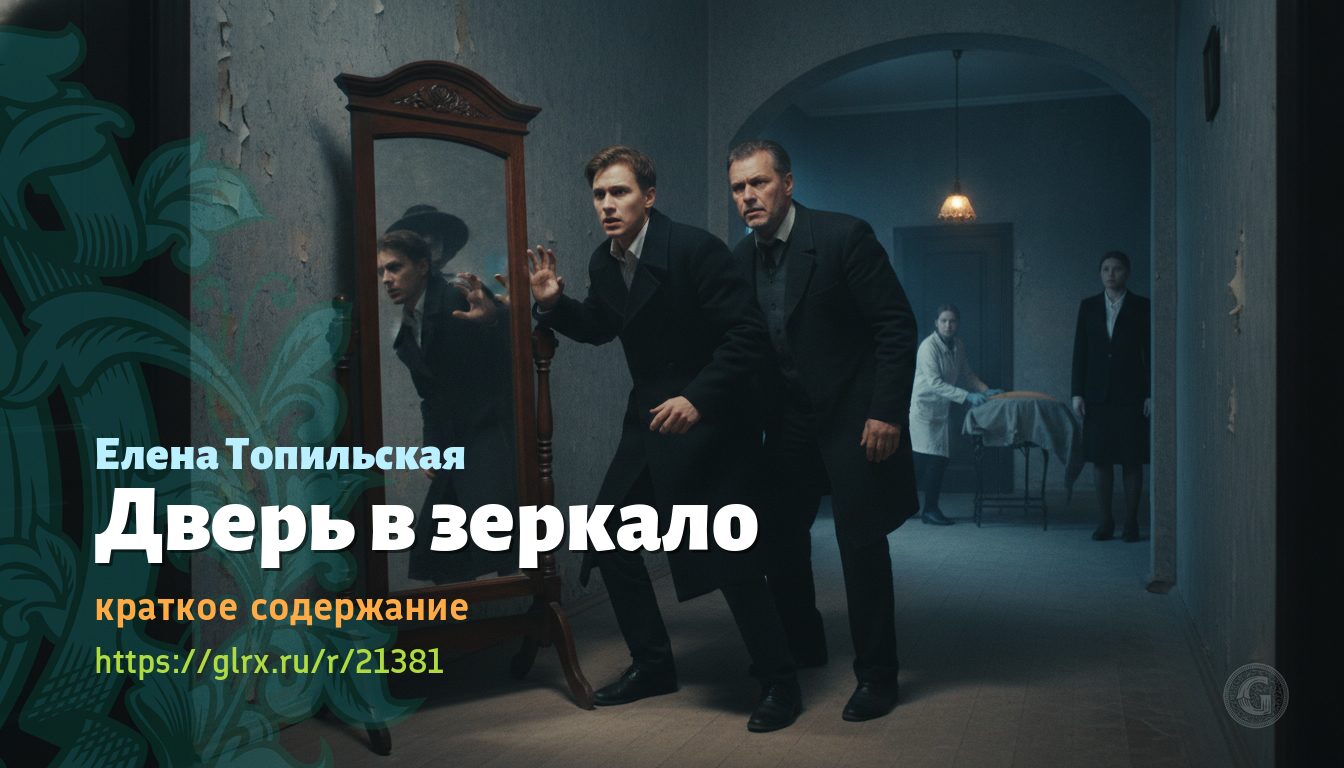
A detective story with a mystical twist, written in 2005, is the first case of a young prosecutor, unfolding against the backdrop of a mysterious mirror in a carved mahogany frame, through which the ghost of a woman in a wide-brimmed hat appears to anyone who looks into it alone. People die in fear and loneliness near the mirror for eighty years.
The book is part of the "Secrets of the Investigation" series. Elena Topilskaya is a practicing lawyer and prosecutor’s investigator, which lends the prose a genuine detail.
First working day
Twenty-three-year-old Anton Korsakov, the son of law professor Nina Urusovskaya and the late forensic expert Boris Korsakov, arrives for his first day as an investigator at the St. Petersburg District Prosecutor’s Office. Before he can even get his bearings in the dusty office, he falls under the tutelage of experienced officer Spartak Ivanovich, who takes him on a case: the body of an elderly man has been discovered in an old pre-revolutionary house, sitting on a chair in front of a tall floor mirror in a carved mahogany frame.
The elderly man, Godlevich, born in 1930, died without visible external injuries. His neighbors in the communal apartment heard his terrifying screams the night before, but they didn’t go in on him or allow strangers into the apartment. Forensic expert Larisa arrives, examines the body, and determines there is no foul play. Anton, left almost alone in the room, writes the examination report.
Mirror and woman in a hat
In the deceased’s room, Anton sees in the mirror behind him the silhouette of a woman in a long dress and a wide-brimmed hat obscuring her face. When he turns around, there’s no one there. He checks the vision several times: it repeats. The forensic scientist, awakened from the kitchen, sees nothing and chuckles skeptically. Anton manages to press the shutter just as the silhouette appears.
Returning to the prosecutor’s office, he recounts what happened to his secretary, Tanya, and his mentor, investigator Antonina Grigoryevna Odintsova — a striking red-haired woman in her forties, dressed in an impeccable black suit. Odintsova isn’t surprised. Twenty-five years ago, during a similar investigation at a similar apartment, an elderly man named Pammel died in exactly the same way before this very mirror. And just like that, a woman in a hat appeared in the mirror — not Odintsova, but a young intern, Nina, Anton’s mother. It was then that Nina met Boris Korsakov, who had come to photograph the crime scene.
Thirty years - one story
Odintsova recounts: after that long-ago death, the mirror disappeared from Pammel’s room when Nina tried to examine it. And now it has resurfaced — at Godlevich’s. Anton falls ill with a sore throat and lies at home with a fever, but his thoughts never leave him. Tanya visits him — Anton’s mother, Nina Vikentyevna, meets her at the door. That evening, he notices the date 1909 in a diary found behind volumes of Brockhaus and Efron on Godlevich’s bookshelf, along with an old, yellowed photograph: the slender silhouette of a woman in a wide-brimmed hat. It was her he saw in the mirror. And it was precisely this photograph he once found among the papers of his great-grandfather, the lawyer Mikhail Urusovsky.
Threads through the decades
Among the papers in the box are documents written in fountain pen. One note is addressed to Dzerzhinsky and marked "Urgent check," while another is a response from a certain V. Polyakov, an agent of the All-Russian Extraordinary Commission (VChK), in defense of Toivo Savolainen and Mikhail Urusovsky, who was hired by the VChK in 1918. This means that Anton’s great-grandfather was saved from execution by Polyakov. Anton recalls that a certain Gerard Vasilyevich Polyakov, an elderly man with wrinkled skin, was present as a witness at the examination of Godlevich’s body. Later, two grumpy neighbors informed him at the police station that this Polyakov had recently died. This means the mirror could have changed hands again.
Newspaper chronicle of 1923
Anton finds a pasted-in newspaper article from 1923 in his diary: in November, Vasily Polyakov, a former Cheka-OGPU officer, died in an apartment near the Vvedensky Canal. He was sitting in a chair in front of a tall mirror in a carved frame, the mirror pulled away from the wall. Neighbors saw a woman wearing a hat in their mirror at the same time as a scream was heard from Polyakov’s room. OGPU officers arrived, took the body away, and confiscated the mirror. Same pattern, same mirror, same woman — it’s no longer a coincidence.
Family knots
The circle closes: the mirror travels from death to death over the course of decades. Pammel, Polyakov, Godlevich — each of them had one in their room, each of them died in terror before it. Before each death, neighbors heard screams. The same woman in a hat appears in the mirror, and only individuals — not investigators, not a group of forensic experts, but one person alone with the mirror — see her silhouette. Anton realizes that the woman in the mirror was connected to Pammel’s family back in 1909, to his great-grandfather Urusovsky, and now she has appeared to him — on his very first day at work at the prosecutor’s office, at the very moment that could prove decisive for his fate.
The investigation continues: Anton plans to find the witness Gerard Polyakov — or what’s left of him — and figure out where the mirror in the carved frame that leaves no survivors is now.
- Social Criticism in Ivan Turgenev’s Novel "Fathers and Sons"
- "The City Accepted" by Arkady and Georgy Vainer, summary
- Exhibition of one painting by Karl (Kirill) Vikentievich Lemokh (1841-1910) "Parental Joy"
- Collection of graphics by Vladimir Falinsky
- Vienna Leopold Museum will pay $ 19 million for Egon Schiele’s painting "Portrait of Wally"
- Picasso’s stolen paintings found in Serbia
You cannot comment Why?