"Notes of a Mad Investigator" by Elena Topilskaya, summary
 Automatic translate
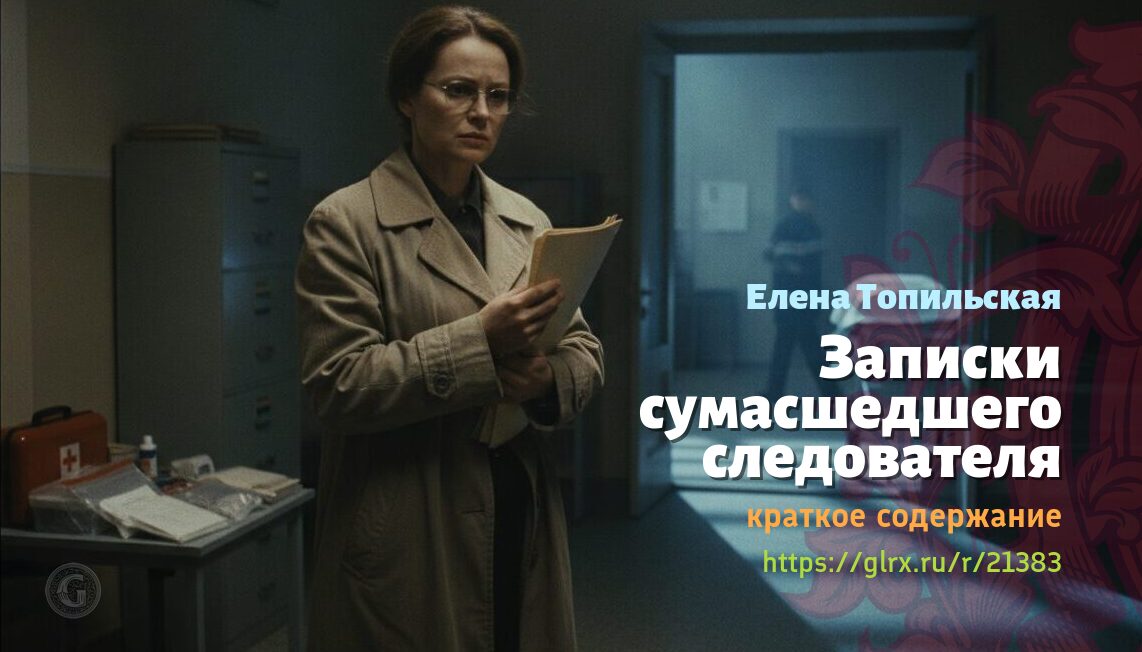
The book was published in 2002 by Olma-Press. Its author, Elena Valentinovna Topilskaya, worked as an investigator in the prosecutor’s office from 1982 to 1999, rose to the position of investigator for especially important cases, defended her PhD dissertation, and subsequently became a screenwriter for the television series "Secrets of the Investigation." "Notes" is not a detective story in the traditional sense, but a collection of stories, sketches, and memoirs from real-life investigative work, written in the first person.
A profession that changes perceptions
The book opens with the author’s reflection on what makes investigators a special breed: a peculiar sense of humor, a mindset warped by the profession, and a paradoxical approach to death. Topilskaya describes her colleagues — investigator Mokrelov, who delayed burying a homeless man named Lenin for months and invariably answered calls from the morgue: "Lenin lived, Lenin lives, Lenin will live!"; and investigator Barbarisov, who pranked random visitors by posing as a transsexual.
The author openly discusses her own psychological duality: she maintains complete composure while examining corpses, while the sight of living blood can cause her to faint. This paradox once played out right on a call — when an ambulance doctor removed a knife from a wound on a living victim, Topilskaya fainted, and the forensic pathologist treated her. This same psychological defense mechanism allowed her to calmly investigate the case of the child-murdering maniac Irtyshev — even though, before the case was accepted for trial, she could not read about his crimes in the newspaper without shuddering.
Path to the profession
The desire to become an investigator first emerged in fifth grade, in a school essay about her future profession. Her family tried to dissuade Elena from working in the police, sending a friend from the police department’s youth department to describe the hardships of the service. However, the opposite happened: her colleagues enthusiastically shared stories, and the atmosphere was so contagious that Topilskaya’s decision was finalized.
She failed to get into law school on her first try — she missed half a point by forgetting to include her diploma from the city literature olympiad on her application. She went to work as a court clerk at a district court, then transferred to the city court and simultaneously enrolled in the evening program at the law school. She graduated early as an external student, passing two courses in one year. On July 2, two days after receiving her diploma, she began working at the prosecutor’s office.
Cases and people from the courtroom
Working as a court clerk, Topilskaya observed a wide variety of people who found themselves on opposite sides of the divide. She describes a woman whose jealous Caucasian husband stabbed their neighbor to death: she testified with undisguised pleasure and, when the prosecutor remarked about two ruined lives, replied, "Well, that means I’m worth it!" Another defendant — a one-legged, one-armed invalid who killed his wife and her lover — wrote his indictment in verse and concluded his closing argument with the poem "Auto-Obituary."
The case of Solovyov and Demidov, two lazy young men inspired by a radio drama based on Rodionov’s novella "Criminal Talent," was also heard there. They obtained the sleeping pill Hexonal, but were unable to use it at the crucial moment because the powder clouded the cheap wine. They then murdered an elderly barmaid with improvised weapons — an iron and a hatchet. They were turned in by Demidov’s mistress, upset that he had abandoned her while she was pregnant. In court, the two waitresses pleaded for permission to marry the defendants.
A special place is occupied by the case of Fryazin, the son of a law professor who raped and murdered his ex-fiancée (she chose to marry his father), dismembered her body, and scattered the parts throughout the suburbs of Leningrad. During his trial, Fryazin wrote to the American consulate requesting political asylum.
The case of two Armenians, Movgasyan and Khalityan, who murdered and burned an Azerbaijani who had come to buy a car with a letter of credit for ten thousand rubles, was also memorable. The cold-blooded organizer, Movgasyan, left no evidence, but the uncouth executioner, Khalityan, never made it home: halfway there, he bought a ticket to Moscow to turn himself in to the Moscow Criminal Investigation Department. Before he even got there, he told his neighbor in the compartment — ironically, a police captain.
The trial of Madame Süülle
One of the most notable episodes is the case of the smuggler Seregina, who had fictitiously married a Finn named Syyllé. The lawyer organized a group of artists, an antiques scholar, Sovtransavto drivers, and an international con man from Sweden: they speculated in imported goods — leather coats and gold chains — and invested the proceeds in buying antiques for export to the West. Seregina dreamed of opening an antique shop near Rome. In court, she refused legal representation, gave up all her accomplices, and exposed corrupt ties with judges, which led to the conviction of several city and regional judges, a number of dismissals, and several suicides. Receiving half the sentence of her accomplices, she emerged victorious.
It was then that Topilskaya first noticed the painting left by her grandmother and lying on the mezzanine: removing the frame, she read the signature “Bogolyubov, 1896” and ceremoniously hung the painting on the wall.
The Vladimirov case and threats
The final section of the book describes an investigation Topilskaya conducted at the city prosecutor’s office — the case of a certain Vladimirov, connected to a police officer nicknamed "Chuma." The investigation was plagued by leaks: the author discovered that her office was bugged. A colleague issued a direct threat: if even one hair fell on Vladimirov, her fate would be disastrous.
Topilskaya reacts to this with her signature detective humor: she arranges in advance with her superiors for the highest-ranking officials to visit her body, and personally calls the morgue to find out who will perform the autopsy. The head of the morgue solemnly assures them that he will do it personally and even sprinkle them with French cologne.
Meanwhile, meticulous evidence processing is underway: the lab manages to establish from a manufacturing defect in the store that it was used in Chuma’s service pistol; subcutaneous fat cells from the victim are found on the pistol’s handle. Fraudulent real estate schemes involving employees of the same police department, including the chief and his deputy, are extracted from the seized computer of the real estate agency.
The book is part of Topilskaya’s series of nonfiction and fiction about investigative work. The author herself described it as a collection of "interesting cases from judicial practice."
- Meeting with famous artist Vladimirov Maksimov at the exhibition "Space"
- Exhibition "Graphics of Russian and Western European Artists of the XVII - Early XXI Centuries"
- Exhibition "On Both Sides of Man"
- "Diamonds for the Dictatorship of the Proletariat" by Yulian Semyonov, summary
- Exhibition "Codes. Sounds. Signs"
You cannot comment Why?