Aristonomy by Boris Akunin, summary
 Automatic translate
The novel "Aristonomy" was published in 2012. The book was written by Boris Akunin. The author’s real name is Grigory Shalvovich Chkhartishvili (in Georgian: გრიგოლ შალვას ძე ჩხარტიშვილი). The work opens the "Family Album" cycle. The text connects two parallel narratives. The first part contains a philosophical treatise by an unnamed thinker. This man lives in the USSR in the mid-twentieth century. The second part describes the fate of a young St. Petersburg resident, Anton Klobukov. His story unfolds against the backdrop of revolutionary Petrograd in 1917. The chapters of the treatise strictly alternate with the events of the plot. The word "aristonomy" itself is derived from Greek roots. It denotes a special internal law. This law determines the moral level of an individual.
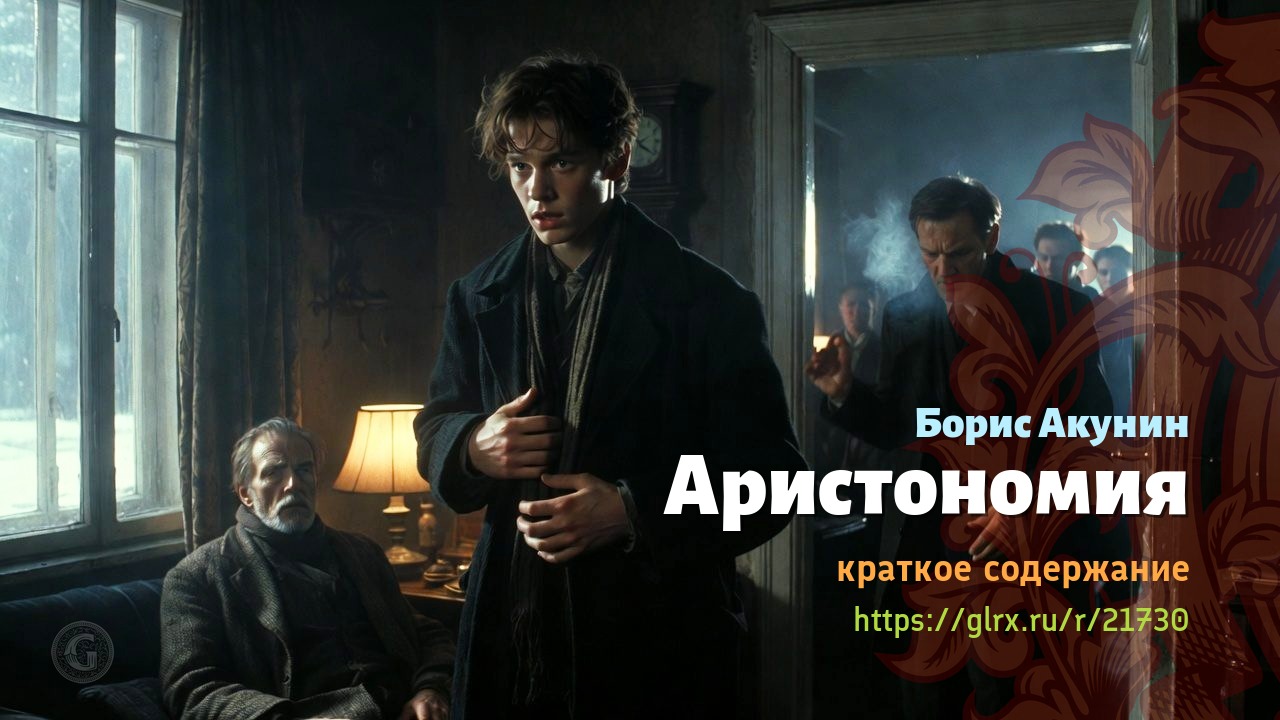
The term itself is artificially constructed. The first part of the word comes from the Greek "arete," meaning valor or excellence. The second part refers to "nomos," meaning law. The writer seeks a formula for the quality of man. This formula is starkly contrasted with chaos. The historical backdrop is deliberate. The city is experiencing the collapse of the old regime. The streets of Petrograd are filled with armed men. Society is losing its traditional bearings. Under such conditions, the test of moral character becomes extremely severe.
Philosophical treatise
The author of the treatise begins work on the preface in his declining years. He admits to purely personal motives. The Thinker is writing the book solely for himself. He needs to make sense of his own existence. He wants to understand the tragic fate of his native country. Various theories of progress are categorically rejected by him. Technocratic ideas have proven their inadequacy. Social utopias led to world wars. Totalitarian dictatorships created concentration camps. The Thinker proposes an alternative concept. "Aristonomy" becomes the main force behind human development. This is a special fusion of human qualities. It unites responsibility, endurance, courage, self-respect, the desire for development, empathy, and respect for others.
A person with such qualities is defined as an "ariston." The author formulates a system of acronyms. Each letter represents a separate component: R — development, S — self-esteem, O — responsibility. The letter V stands for endurance, M — courage, U — respect for others, E — empathy. The treatise traces the evolution of the closely related term "dignity." The reader sees the development of the idea in the ancient works of Cicero and Seneca. Medieval theology is then examined. The thinker examines the ideas of Immanuel Kant. He mentions the US Declaration of Independence and examines in detail the UN Universal Declaration of Human Rights. The thinker criticizes the philosophy of Arthur Schopenhauer. He consistently refutes the positions of Friedrich Nietzsche.
The theory of social division occupies a special place. People are divided into the "light," "dark," and "gray" percent. This scheme explains the nature of dictatorship. Cruel regimes seized power in Russia, Italy, and Germany. The "gray" percent simply submitted to force. To test his formula, the author uses literary heroes. An example is Staff Captain Maxim Maksimovich. This character from Mikhail Lermontov’s novel "A Hero of Our Time" possesses almost all the necessary qualities. He lacks only one component: the desire to develop.
Anton Klobukov’s storyline
The story begins in January 1917. The setting is Petrograd. Nineteen-year-old Anton Klobukov is a law student. He lives with his parents. His father, Mark Konstantinovich, was previously a private lecturer in the criminal law department. In 1897, he was exiled from the capital. The reason was his support for student unrest. At home, this long-ago event is ironically called "Holocaustos," a word meaning "catastrophe." Anton’s mother, Tatyana Ipatyevna, cares for her ailing husband. His father suffers from a severe form of tuberculosis. Anton himself has a secret obsession. The young man searches for mystical signs around him. He wants to find confirmation of his chosenness.
On the evening of January 27th, the family celebrates the anniversary of the Holocaust. Former students of the assistant professor arrive at the apartment. Factory owner Pyotr Kirillovich Berdyshev appears with his wife, Zinaida Alekseyevna. Lawyer Arkady Lvovich Znamensky arrives with his wife, Rimma Vitalyevna. Among the guests is the theological publicist Innokenty Ivanovich Bakh. Unexpectedly, Privy Councilor Fyodor Kondratyevich Oznobishin appears on the threshold. In his youth, he was nicknamed "Primus." Twenty years ago, he alone supported the repression of rebellious students. Since then, the former friends have ceased to communicate. His appearance shocks everyone present. The situation is reminiscent of a silent scene from "The Government Inspector." However, Mark Konstantinovich defuses the conflict. He calmly invites his guest to sit.
At the same time, the reader uncovers Oznobishin’s personal drama. He is tormented by dreams at night. He dreams of his ex-wife, Elena. Many years ago, she left him for the lawyer Lyubimtsev. She later tried to return, but Oznobishin rejected her. In reality, the privy councilor faces cruelty. He is arrested. The new revolutionary government holds him in a cell. Drunken guards beat him. They try to take a gold medallion. Hidden inside are photographs of his children — Lucy and Seryozha.
Soon, Anton’s father dies of illness. Tatyana Ipatyevna cannot bear the loss. She takes poison. His mother leaves a farewell letter for her son, writing that she cannot live without her husband. Anton is left completely alone. Revolutionary Petrograd frightens with its hostility. New tenants move into the Klobukovs’ apartment without permission. Orderly Shmakov and former servant Pasha share rooms. Pasha tries to seduce Anton. The young man rudely rejects her. Anton begins to avoid his own apartment. He takes a job as a night watchman. He watches in other people’s building entrances for food. One day, unknown assailants attack him. They accuse Anton of espionage. The young man narrowly escapes death.
Later, Anton accidentally sees the arrested Oznobishin. He encounters the former privy councilor in a gloomy prison corridor. The young man buries his father. Berdyshev is present at the cemetery. This factory owner always demonstrates meticulous honesty. He discreetly hands Anton an envelope of money. On the fortieth day after his parents’ death, Bach appears. The theologian displays a profound religious altruism. He offers a mystical interpretation of what is happening. Bach says, "Revolution is a fiery forge." In his view, this is how God tempers human souls.
A separate episode describes a meeting with Pankrat Evtikhievich Rogachev-Mikhailov. Anton sees him near the mansion of the ballerina Kshesinskaya. The building has been seized by the Bolsheviks, and protesters constantly flock there. Each of these people faces a harsh reality. Oznobishin’s unwavering integrity leads to personal tragedy. The chaos of the era tests all the characters’ mettle.
You cannot comment Why?