"Leviathan" by Boris Akunin, summary
 Automatic translate
This detective novel was created in 1998. It is written in the form of a classic hermetic detective story, strictly limited to the confined space of a floating ship. The story is told from the perspectives of various characters, who recount the events through personal diary entries, private letters, and police reports. Describing the same scenes through the eyes of different people allows the reader to piece together disparate facts into a coherent picture.
The novel is part of a series of historical detective stories about the adventures of Erast Fandorin. The book is the third installment in this extensive cycle. It follows the novels "Azazel" and "The Turkish Gambit." It is followed by "The Death of Achilles," "Special Assignments," and other well-known works by the author.
Tragedy on the Rue de Grenelle
In March 1878, tranquil Paris was rocked by a brutal mass murder. Ten people were poisoned in the opulent mansion of Lord Littleby. Police found the servants and guards sitting at the kitchen table. The killer had administered a lethal dose of morphine to the victims, including two young children. The owner of the house died on the second floor from an incredibly powerful blow to the head with a heavy object. A massive gold statue of the god Shiva and an antique Indian handkerchief were stolen from the lord’s collection. The statue was soon found washed up on the Seine.
Detective Commissioner Gustave Gauche discovers a valuable clue at the murder scene. The frozen fingers of the dead Littleby clutch a gold whale badge. It is the official emblem of the newest giant steamship, the Leviathan, departing from Southampton for Calcutta. The badge is issued exclusively to the ship’s senior officers and first-class passengers. Gauche sets sail disguised as a wealthy Parisian rentier, hoping to identify and arrest the criminal.
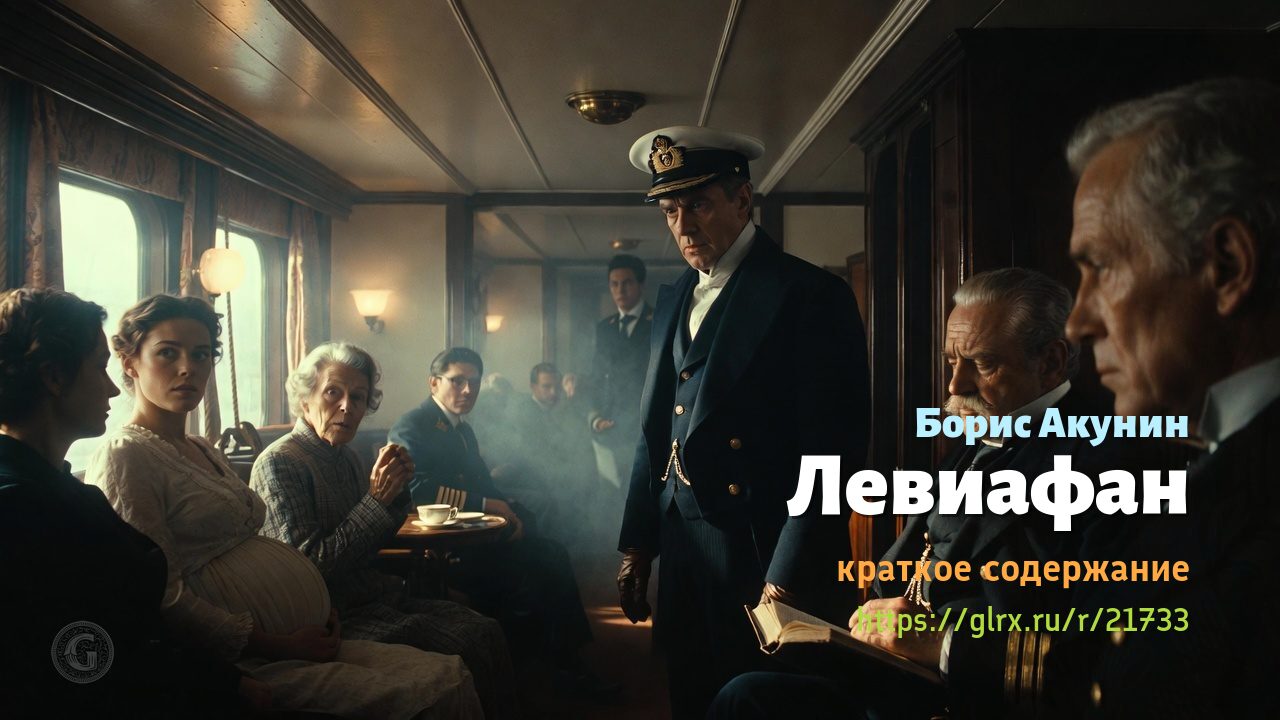
Passengers in the Windsor cabin
The detective surveys the onboard crew and discovers that several passengers are missing their gold badges. Ghosh gathers the suspects at a communal table in the Windsor’s forward dining saloon. Among them are the eccentric English baronet Reginald Milford-Stokes, who writes his diaries in milk, and the capricious, pregnant Swiss woman Renata Kleber. They are joined by the aging English maiden Clarissa Stamp and the taciturn Japanese officer Gintaro Aono. To broaden the search, Ghosh adds the ship’s doctor, Truffo, and his wife, as well as the British Indologist Sweetchild.
During a stopover in Port Said, Russian diplomat Erast Fandorin boards the ship. He, too, is sailing without a first-class badge, unwilling to wear the official insignia. Fandorin, a keen intellect, deciphers Gosh’s clumsy disguise. The commissioner is forced to reveal his true position to all the Windsorians. He declares that the ruthless killer from the Rue de Grenelle is among those present in the cabin.
The Secret of the Emerald Rajah
Professor Sweetchild tells his fellow travelers an ancient legend about a countless Eastern treasure. Long ago, the Indian rajah Bagdassar collected five hundred and twelve enormous precious stones of impeccable purity. During the Sepoy Mutiny, the raja committed suicide, fearing the shame of captivity. He left only a copy of the Koran and a painted silk scarf to his young son, who lived in France. It is this scarf, from the murdered lord’s collection, that holds the key to the Emerald Rajah’s fabulous wealth.
Events on the ship take a sinister turn. A gigantic black savage enters Renata Kléber’s cabin. Hearing the woman’s terrified screams, First Mate Charles Rainier runs in and kills the African with a naval dagger. Everyone attributes the incident to the native’s natural aggression. However, Fandorin doubts the veracity of this version. The diplomat has encountered members of this African tribe before and knows of their gentle, peaceful nature.
New victims on board
Upon arrival in Aden, Professor Sweetchild makes inquiries at the telegraph office and informs the passengers that he has solved the mystery of the Indian scarf. The scientist has also identified the heir of the legendary rajah. Sweetchild doesn’t have time to name the name. A fire alarm sounds on the ship. In the confusion, the professor’s throat is slit with a surgical scalpel.
Commissioner Gauche immediately arrests the Japanese man, Aono. The detective discovers that the Asian has a medical degree in surgery, is skilled in lethal hand-to-hand combat, and has lost a scalpel from his medical bag. The policeman saw the Japanese man smashing hard pumpkins with his bare hands and accuses him of fracturing Lord Littleby’s skull. The evidence seems irrefutable. However, Fandorin saves the Japanese man from certain execution. The diplomat proves that the samurai Aono concealed his peaceful profession as a physician out of shame before his warlike ancestors. Fandorin finds the stowaway African man’s whereabouts on the boat deck and confirms that it was the savage who stole the scalpel.
The true face of criminals
Fandorin exposes the true heir to the Rajah of Baghdassary. It turns out to be the captain’s first mate, Charles Rainier. The sailor is half French and half Indian. Rainier killed the professor, fearing exposure. The mate then deceived the ship’s commander, leading him to believe his daughter was gravely ill. Rainier attempted to steer the ship into underwater rocks. The criminal intended to destroy a thousand lives and hide his tracks, escaping in a pre-arranged boat. Fandorin, Gosh, and navigator Fox averted the disaster in time and save the ship.
The commissioner arrests Rainier. Soon, the sailor is found dead in solitary confinement with a blow to the head. Nearby lies a letter in which Rainier takes responsibility for all the recent murders and claims to have burned his father’s handkerchief. Gauche declares the investigation closed.
The denouement in the salon
Fandorin gathers all the passengers in the cabin and refutes Gauche’s story. He publicly accuses Renata Kléber. In reality, this woman is the elusive international adventurer Marie Sanfon. She became Rainier’s secret wife and encouraged her husband to search for the treasure. Marie disguised herself as a Catholic nun and cold-bloodedly poisoned Lord Littleby’s servants, pretending to administer a prophylactic injection. She also killed Gauche in his cabin. A policeman found a handkerchief on Rainier and intended to take the treasure for himself.
Marie Sanfon shot Gosh, staged her husband’s suicide in solitary confinement, and took the silk scarf. She doesn’t deny the charges, feeling legally immune. She brazenly displays the scarf, intending to legally reclaim the treasure through a European court. Representatives of France and England begin arguing over the treasure’s ownership. Fandorin reveals the secret of the scarf: the triangular fabric mimics the shape of a mountain, and a hole where the bird’s eye should have been indicates the exact location of the hiding place. The diplomat then opens the side window. A strong sea breeze catches the lightweight silk, and the scarf flies away into the raging ocean waves.
Swimming final
In a fit of blind rage, Marie attacks the diplomat with a sharp fruit knife. Then the criminal takes out a hidden double-barreled pistol. She shoots the Japanese soldier, Aono, who rushes to the defense of the unarmed Fandorin. The ship lists heavily on a high wave. A heavy oak grandfather clock falls directly onto the killer’s back, knocking her unconscious.
The Japanese doctor’s wound turns out to be non-life-threatening. The treacherous Marie Sanfon survives, facing a long prison sentence for attempted murder. The Leviathan continues its intended voyage to India. The English baronet Milford-Stokes, plunged into madness, awaits his speedy arrival in Tahiti. There, he hopes to be reunited with his dead wife, whose death he stubbornly refuses to acknowledge.
You cannot comment Why?