A summary of "A Dog’s Death" by Boris Akunin
 Automatic translate
This book is a polyphonic historical and philosophical novel set in 2023, in which the fates of characters in the Soviet 1960s are closely intertwined with the espionage intrigues of the Civil War era and existential reflections on old age. The novel concludes the "Family Album" series, becoming the sixth book in the series (the previous installments were "Aristonomy," "The Other Path," "Happy Russia," "Tresorium," and "Peace and War").
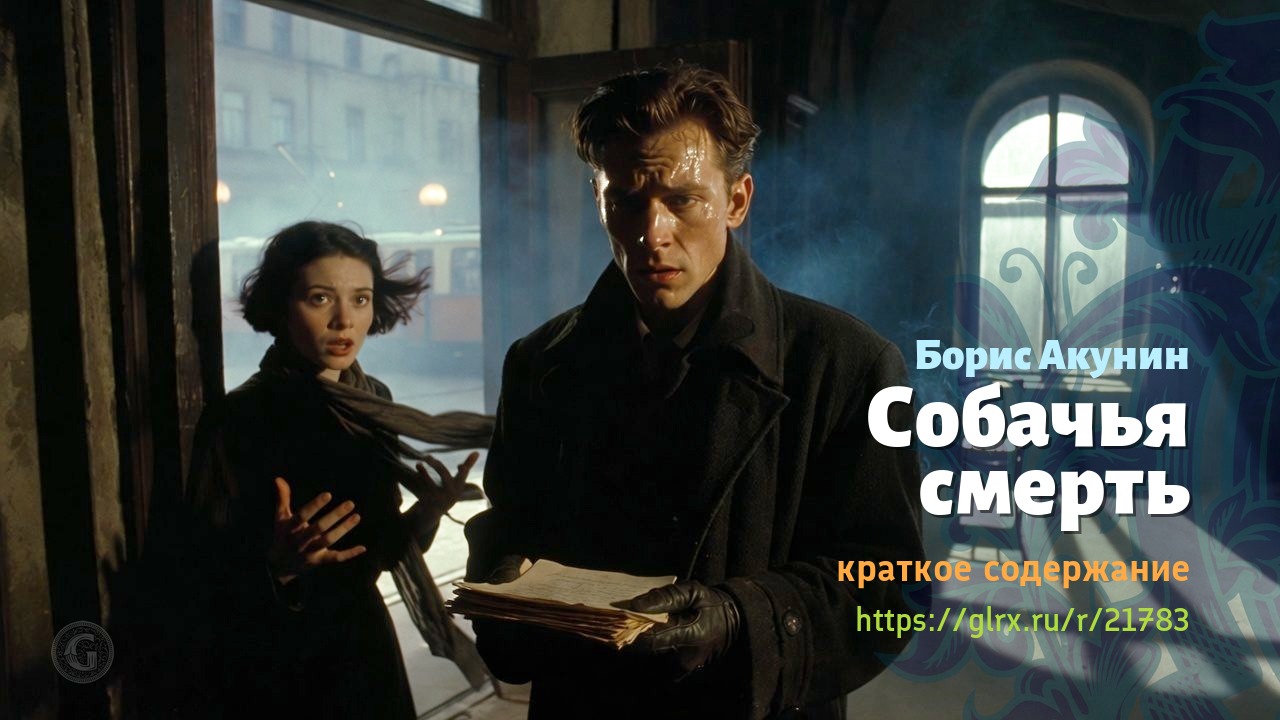
The Soviet Thaw and Double Life
Former orphanage survivor and Stalin Prize laureate Marat Rogachov is experiencing an unprecedented creative surge. Following the advice of his late mentor, Kondraty Grigoryevich, he adopts a new literary approach: he writes freely, in draft form, and then ruthlessly emasculates the text for official publications. The remaining phantom pains draw readers. Success comes with the novella "Sunday Trip" and the script for the television series about the Chekists, "Clean Hands."
Access to the departmental archives allows Rogachov to commit a desperate act: he steals old notes from Sidney Reilly. The famous British agent left excerpts from the Japanese samurai treatise "Hagakure" on them. Fascinated by Reilly’s personality, Marat secretly works on a novel entitled "Seijitsu."
Rogachov’s sudden success attracts his ex-wife Antonina, the daughter of Stalin’s playwright Chumak. The pragmatic woman returns to her husband and takes firm control of his career. Antonina convinces Marat to fight for the right to write the screenplay for a monumental film epic and to reestablish the broken relationship with his teenage daughter, Masha.
At the same time, Marat immerses himself in the bohemian life. The literary salon of the novelist Grivas brings together the most brilliant minds of Moscow: the poet Jack Vozrozhdensky, the Marxist Koschei, and the party reformer Koryaga. There, the writer meets the young nonconformist Agata Stern. This uncompromising woman refuses to consume Soviet culture and bluntly calls official prose false. Wanting to prove his sincerity, Marat takes Agata to the Donskoye Cemetery. He shows her the authentic memorial sites associated with the characters excised from his novella. Among them are the writer’s repressed mother, who emerged from the camps a broken, chain-smoking old woman, and his Bolshevik father, executed in 1936.
A novel within a novel
Marat’s secretly written text, "Seijitsu," describes the Moscow events of 1918. Sidney Reilly, posing as a Greek businessman, plots the overthrow of the Bolsheviks. He views the Red dictatorship as a dragon threatening the entire world.
Deputy Chairman of the Cheka, Yakov Peters, learns of the Latvian Riflemen’s plot through his secret agents, Sprogis and Buikis. The cold-blooded Peters sets a cunning trap for the British, using artillery commander Eduard Berzin as bait. Reilly hands over millions of rubles to the Latvian to finance the rebellion, naively believing he is buying the Kremlin’s security detail, but Berzin is acting on instructions from the Cheka.
The Briton himself leads a double life, torn between two women — the impetuous actress Lisa Otten and the quiet typist Olenka. A perfect plan to attack the Soviet government at the Bolshoi Theater is thwarted by spontaneous assassination attempts by lone Socialist Revolutionaries on Uritsky and Lenin. Fearing sudden arrest, Reilly flees, but his beloved Lisa is imprisoned in the Lubyanka prison. To save the trusting Olenka, he convinces her to voluntarily hand over her remaining money to the Chekists and renounce him. Later, in Odessa in 1919, Reilly loses a covert battle to the Chekist Georges Lafar, who manages to bribe the French command and thwart the Entente intervention. In 1925, GPU agents lured Sydney to the USSR, subjected him to prolonged psychological torture, and shot him while he was walking in Bogorodsk.
Dissent and the collapse of hopes
Agatha leads Marat away from bourgeois salons and into a genuine dissident circle of "seminarists." The meetings take place at a dacha outside Moscow, where an atmosphere of free and risky exchange of opinions reigns. The writer meets the librarian Shubin, who publishes his stories abroad under pseudonyms, and the former nuclear physicist Zelikman.
One day, a spontaneous rebel nicknamed "Ryzhiy" wanders into the area. He travels freely around the country, posting handwritten calls for a violent revolt against the party establishment at train stations. Moscow intellectuals regard the agitator with suspicion and distrust. But Agatha chooses the simple-minded Ryzhiy, rejecting the writer’s timid advances. She appreciates the simple man’s lack of intellectual pretension.
The August days of 1968 brought terrible news to Moscow: Warsaw Pact tanks were entering Czechoslovakia to suppress the Prague Spring. Freedom-loving thought was crushed. While salon frondeurs sank into depression and hid their bold poems in drawers, desperate "seminarians" attempted to stage a public protest on Red Square, but were immediately subdued by KGB agents.
Antonina’s father, the elderly playwright Chumak, is genuinely jubilant. He has received a lucrative commission for an anti-Semitic play about the Aswan Dam and anticipates a return to Stalinist rule. Unable to bear the cynicism, Marat openly insults his father-in-law.
A Treatise on Old Age and the Burden of Choice
Fate brings Rogachov together with the elderly anesthesiologist Anton Markovich Klobukov. Before the revolution, the professor knew Marat’s father. Anton Markovich is happily married to a young translator, Tina, and the couple is raising their son, Mark.
After suffering a severe heart attack, a physician wrote his own treatise, "The Science of Old Age." In the manuscript, he methodically discusses how to endure illness, how to find new reasons for happiness after the fading of passions, and how to overcome the primal fear of death. The old man perceives the loss of physical strength and social status as a beneficial exchange for free time and independence. Klobukov cites the peace of mind that comes from atoning for past moral mistakes as the main condition for a peaceful decline. He once betrayed his university friend, Innokenty Bakh, but from a conversation with Marat, he learns that the latter forgave him before his death.
The professor’s hopes for a comfortable retirement are dashed immediately after the events in Prague. On the eve of the invasion, Klobukov naively allowed the Czech doctor František Kvapil to address his Moscow colleagues. The enraged party leadership issued a harsh ultimatum: either Anton Markovich publicly repents and denounces the foreign guest, or the entire clinic will be disbanded and his subordinates will be put under investigation. Realizing the absolute hopelessness of his situation, Klobukov decides to sacrifice his own good name to save his innocent colleagues. During a humiliating speech of repentance at an institute meeting, the old man’s heart stops.
The dark events of that crucial era are reflected in the diary entries of KGB Colonel Serafim Blyakhin. The cynical officer coolly forges a career by assisting the all-powerful committee leadership in coordinating the Czechoslovak crisis. The KGB officer regularly burns his secret diary in an ashtray after writing it. Blyakhin masterfully uses Marat to suppress the publication of his own veteran father’s hackneyed memoirs. In exchange, the colonel allows the writer access to the closed investigation file of Pankrat Rogachov. Marat bitterly reads the execution reports of 1935. He learns that his illustrious Bolshevik father succumbed to the investigators’ pressure and completely broke down, incriminating himself and his comrades.
The true value of life
The climax of the political tragedy occurs at the stone walls of the Rossiya Hotel. The desperate Redhead, disguised as a repairman, climbs a tall lamppost in front of a crowd of foreign tourists and unfurls a banner that reads, "Prague, we are with you!" Agatha records the entire incident with a portable camera, hoping to smuggle the incriminating footage abroad.
State security officers immediately push the confused foreigners back inside the building. During a brutal attempt to pull a protester off a pole, Ryzhiy falls to his death on the cobblestones. The brave Agatha is brutally detained on the spot, and the film she’d exposed is confiscated. Marat watches the horrific scene from behind the thick glass of the hotel lobby, physically unable to intervene or help.
The story of the fiery Narodnaya Volya member Stepnyak-Kravchinsky, about whom Rogachov wrote an official book commissioned by the editorial board, naturally ends with his death. Having abandoned individual terror in favor of systemic party building, Kravchinsky strides through the streets of London. He optimistically contemplates the future of a free state, fails to notice the impending danger, and is absurdly struck by a shunting train.
In the final lines, the author cites an ancient parable from the Japanese text Hagakure, which conceptually inspired the novel’s title. The philosopher Muzai finds himself adrift in a fierce storm. There are not enough seats in the only lifeboat. The sage consciously gives up his place to two low-class women, handing them his priceless final manuscript. He calmly explains to his astonished student: "Wisdom on paper, saved by prostitutes, will be worthless." It is far more dignified to go down with the great book and forever remain a "dead treasure," nobly avoiding the shameful fate of "living nonentity."
You cannot comment Why?