"Cool" by Victor Pelevin, summary
 Automatic translate
"Cool" was published in 2024; it is Viktor Pelevin’s 21st novel, a direct sequel to "Journey to Eleusis" and a new installment in the Transhumanism Inc. series. The action takes place in the third century of the Green Era, and at the center once again is the canned operative Markus Sorgenfrei, who, after his previous mission, has been restored to his operational status, given a second tier, and assigned a new task, this time related not to an ancient simulation, but to a threat to the entire world.
Beginning of the investigation
The novel opens with the death of Emperor Porphyry in the Senate Curia — an echo of Marcus’s previous mission, who, in the previous book, was associated with the figure of Porphyry and, after leaving that role, undergoes a difficult rehabilitation. Admiral-Bishop Lomas, his senior mentor and curator, brings him out of this state, and then reveals the essence of his new mission: an ancient evil known as Achilles is attempting to return to the world.
According to the novel’s version, presented through religious and pseudo-historical constructs, after Christ’s descent into hell, the satanic force did not disappear completely, but continued to seek a host in earthly history. Achilles was once one of these hosts, and now this spirit is once again seeking a path to incarnation. If it succeeds in gaining a foothold in the human world, Earth faces a return to a prehistoric order, where the monsters of the Mesozoic era will once again reign supreme.
Marcus also learns another condition: Achilles cannot complete his plan alone; he needs an earthly accomplice, a great warrior who will embrace his power and become the instrument of the apocalypse. The search for this person leads not to the highest taers or the corporation’s elite clusters, but to northern Siberia, to Wind Colony No. 72 named after Kai and Gerda, already familiar from the universe of Pelevin’s latest books.
Wind Colony and Kuker
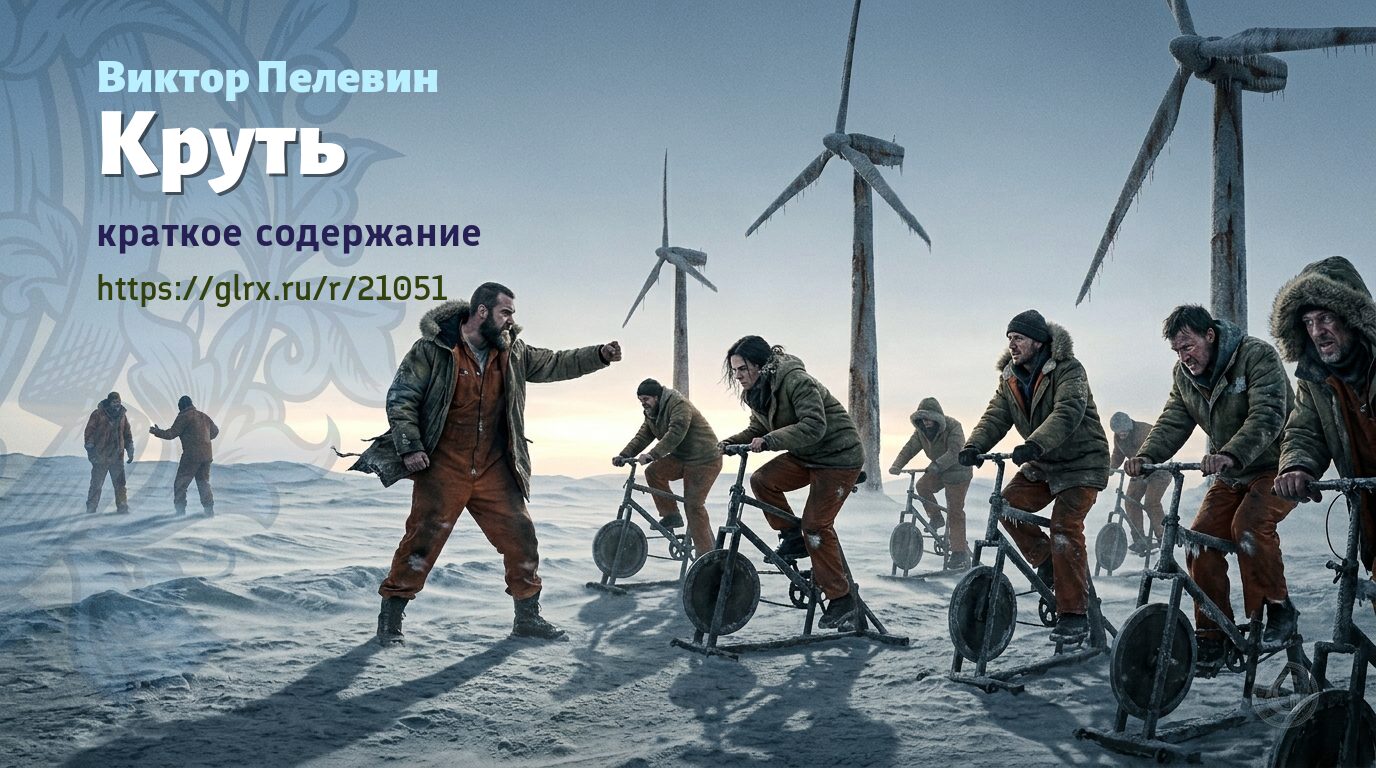
The wind colony is designed as a grotesque prison of the future, where prisoners pedal and, through their labor, participate in "windogenesis," literally supporting the global atmospheric system. This is also the source of the title term: "cool" in the novel signifies both the ideology of the Good State, the cycle of violence and subjugation, and the prison-industrial mechanism that sustains this order.
The prison’s traditional hierarchy is inverted: at the top are the "roosters," and next to them is a hostile camp of "chickens" — feminized prisoners for whom assaulting men has become both practice and doctrine. The leader of the roosters is Kuker, a conscientious objector and authority figure, a figure at once comical, sinister, and downright dangerous.
It is Kuker who quickly finds himself at the center of the case. On the one hand, he maintains control of the entire local order and repels attacks from opponents, primarily Daria Troedirkina, the leader of the chickens. On the other hand, the investigation concludes that he may be the vessel of Achilles, meaning he must be killed before the ancient spirit fully gains power.
Captain Serdyukov, the head of the prison’s reeducation department, is also connected to Kuker — a scientist, gendarme, and psychiatrist of the future all rolled into one. He’s searching for a cure for "piking" — the painful impulse that drives the prison hens to kill men — and, as an experiment, sends Kuker to an artificial Mesozoic, where he gains the body of a dinosaur. Marcus also joins this virtual environment, because only then can the inner bond between Kuker and Achilles be understood.
In the Mesozoic storyline, Kuker encounters Achilles almost without his disguises. The ancient spirit seduces him with exceptionalism, instills the idea of warrior eligibility, and gradually transforms the prison warlord into a candidate for the final bearer of hellish power. Their conversations in the guise of dinosaurs reveal that Kuker is not simply consumed by a thirst for power, but by an almost mystical readiness to become the hero of a global catastrophe.
Varvara Zugunder and the Hidden History
At some point, the investigation extends beyond the prison and turns into a search for a person long considered almost a myth: Varvara Tsugunder. Legend has it that she became the spiritual mentor of the imprisoned hens, established their code, and became a symbol of the vengeful feminist underground of the future.
The paradox is that Kuker himself, having already entered into a relationship with Achilles, calls Varvara Zugunder the only being who can defeat him. The higher powers take this answer seriously, and from that moment on, finding Varvara becomes as important as observing Kuker himself.
Here, the novel enters another major thread — the story of the Carboniferous era writer Sharaban-Mukhlyuev and the literary scholar nicknamed "Ryba." Through forbidden texts, diaries, other people’s comments, and traces of an old love affair, Marcus uncovers a secret that the official culture of the future carefully concealed. It is this layer that explains how the figure of Varvara Zugunder emerged and why an almost religious cult formed around her.
The connection between Ryba and Varvara gradually ceases to be a guess and begins to function as an operational hypothesis. It’s no longer an abstract legend, but a concrete biography, hidden under several layers of literary play, prison folklore, and ideological substitution. Here, Pelevin combines two narrative threads — a satire on the cultural milieu and a detective intrigue, where an old romance, someone else’s notes, and a forgotten love story become tangible evidence in a case about the end of the world.
At the same time, the novel shows how big ideas in this world are born from cultural detritus, prison legends, and neural network reworkings of the past. Therefore, Varvara’s search proceeds through archives, codes, secondary texts, and digital conjectures, rather than direct evidence. This is especially difficult for Marcus, because his own memory repeatedly proves to be a corporate tool rather than his personal support.
Denouement
When the preparations are complete, several forces gather around Kuker: Achilles himself, the prison administration, the corporation, Marcus, and the camp of imprisoned hens. The solution is based not on open battle, but on a precisely calculated chain of psychological and causal influences, with Marcus acting as the transmission link, and Varvara’s old story gaining practical meaning.
In the finale, the plot unfolds, whereby Kuker encounters the force he once recognized as his only threat. Daria Troedirkina and the female prisoner of the world cease to be a backdrop to someone else’s heroic deed: it is through them that the attack on Kuker becomes possible. A chain of coincidences, tips, other people’s words, and old injuries leads to the rooster falling, Achilles losing his footing, and the plan to return the Mesozoic era collapsing at the last moment.
The world is saved again, but salvation brings Marcus neither clarity nor peace. As before, he remains an operative, paid for his mission with an extension of his existence and the right to continue living in the bank, after which he is deprived of his memory of what matters most. The final pages leave him in a familiar position for this series: he has done his job, seen more than he should have, and understands that soon his life will be erased again.
The entire book moves from imperial mystery to prison satire, from dinosaurs and hellish spirits to the personal story of a writer, critic, and the fictional, then almost real, Varvara Zugunder. It is precisely this connection that holds the plot together: the apocalypse here depends not on a massive army or technology, but on how the past text, someone else’s passion, the camp hierarchy, and one precisely induced death converge at a single point.
You cannot comment Why?