A summary of "The Art of Light Touch" by Victor Pelevin
 Automatic translate
The collection, published in 2019, brings together three works — two novellas and one short story. The entire collection is based on a common theme: the invisible control of people and societies through symbols, rituals, and informational influence. The book is written in Pelevin’s signature style — ironically, with references to conspiracy theories, mythology, and current politics.
In 2020, the book became a finalist for the ABS Prize in the Fiction category.
Part One: Saturn is barely visible
Hyacinth
Four Moscow friends set off on a mountain hike in the North Caucasus. Timofey is a television pundit with a beautiful glint in his eye, a regular at political debates. Andron is a bank broker, hiding the unyielding will of a trader behind his hipster "Big Lebowski" image. Ivan works as a surveyor for a plastic window installation company. Valentin, quiet and observant, brings up the rear.
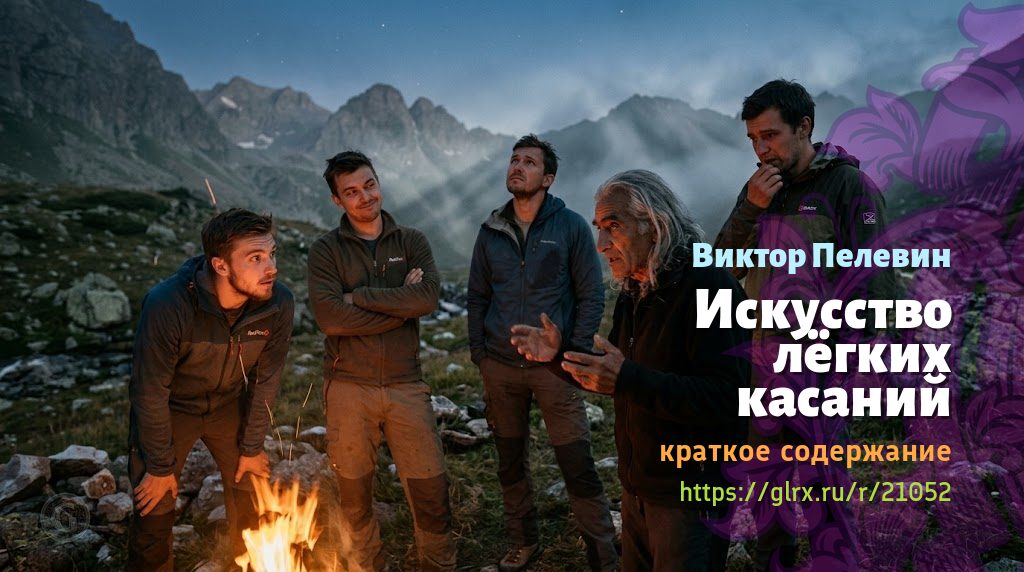
In the mountain village, they hire a guide, Akinfiy Ivanovich: an elderly man with long gray hair, a youthful face, and sparkling dark eyes. It’s impossible to guess his age — he could be forty or sixty. He lives in a small shed, which he calls his "office."
From the very first evening by the campfire, Akinfiy Ivanovich begins telling tourists the story of his life — strange, lengthy, and increasingly sinister. In his youth, he worked as a psychic, dealing in charged water and biofields during the heyday of telehypnotists in the 1990s. His medical education helped him "know how to package noodles." But one day, fate brought him together with a certain Zhores — a man who revealed something far more profound to him.
Zhores took Akinfiy to a mountain in the foothills of the Caucasus, where two enormous horns were carved into the rock — ancient remnants of the cult of Baal, a Punic god to whom sacrifices were made in Carthage. Zhores explained that the cult had not disappeared — it had merely changed form. Akinfiy Ivanovich gradually uncovered a theory about "border spirits" — beings whose time scale is incomparably longer than that of humans, yet still not infinite. It is precisely such spirits that become gods because they are able to engage in meaningful exchanges with humans.
Philosophical nighttime conversations around the campfire are interspersed with mountain hikes, the tourists’ irony, and the growing sense that the guide is leading the group along more than just a trail. The young people listen to Akinfiy with irony, but gradually the atmosphere of the hike becomes unsettling. Akinfiy Ivanovich leads them to an ancient site associated with the cult of Baal, and the story ends — the subsequent fate of the four friends remains unseen.
The art of light touches
The second novella is structured as a retelling of the massive two-volume documentary investigation by renowned conspiracy theorist Konstantin Paramonovich Golgofsky. The reader receives not the novel itself, but rather its "digest for VIPs" — an ironic construct that Pelevin uses to simultaneously critique the conspiracy genre and seriously exploit it.
Golgofsky, the author of a monumental work on Russian Freemasonry, lives in a dacha near Moscow next door to retired GRU General Izyumin. The general is under unofficial house arrest: a Land Cruiser is constantly parked near his dacha, burly men stroll by, and drones fly overhead. Golgofsky watches his neighbor from his bedroom window and invites him to a barbecue, but he invariably declines, citing his vegetarianism.
One day, Golgofsky notices Izyumin sitting in the gazebo for too long. There’s a broken cup on the floor, and his gray socked foot is twitching uncomfortably. Golgofsky climbs over the fence. The general is green, swollen, paralyzed, the floor is covered in vomit — but conscious. Before losing him, Izyumin cups his hands and flaps his fingers like wings. He doesn’t have time to say anything else.
An ambulance arrives. The next day, plainclothes men search the dacha, carrying away computers and boxes of papers. Izyumin’s daughter, Irina, arrives from Holland: her father is alive but in a coma, poisoned by a rare chemical compound based on arsenic and thallium — a "GRU signature." Irina leaves in fear, leaving Golgofsky the keys to the dacha and a request to water the bonsai.
In Izyumin’s office, Golgofsky discovers black-and-white photographs of stone monsters — chimeras and gargoyles from the roofs of European cathedrals, primarily Notre-Dame de Paris — on the walls. This becomes the starting point for his investigation. Golgofsky studies medieval treatises, archival documents, and the works of the Marquis de Custine, hypothesizing that gargoyles are not simply a decorative element of Gothic architecture, but encrypted messages connected to ancient ritual practices of collective consciousness control.
The historian’s investigation leads him to the topic of "light touches" — invisible informational influence capable of changing mass behavior. Golgofsky concludes that such technologies have existed since ancient times and are used by secret structures to manipulate historical processes. In the modern context, these practices are embodied in information warfare: the Notre Dame fire, the US presidential election, "Russian hackers," the "yellow vest" movement — all of these, according to Golgofsky, are links in the same chain.
The historian concludes that World War III has already happened — quietly, soundlessly, through the intelligence services, which exchanged "terrible blows" that no one noticed. There are no victors. The story’s ending is written in the first person — a monologue by Golgofsky himself, who sits in Moscow’s Sanduny district, awaiting the "GRU assassins," whose mailboxes have been flooded with sports nutrition ads for three days.
Part Two: The Fight After Victory
Stolypin
The story unfolds in a prison train car — a "Stolypin" — and returns the reader to the characters of the novel "Secret Views of Mount Fuji." The train car gently sways on the rails, transporting prisoners to their places of confinement. Among the prisoners is Fyodor Semyonovich, one of the wealthy businessmen from the previous novel, who has been arrested.
Long, leisurely conversations ensue in the compartment — about life, money, justice, and the structure of society. Fyodor Semyonovich’s compartment neighbor, a seasoned prisoner, waxes philosophical about the nature of wealth and poverty, about how "enlightenment and wealth trickle down" at a snail’s pace. As an example, he points to the bathhouse set up right in the train car — complete with sawdust, soda, and periodic electric shocks: "People will now be able to wash themselves on the road — if, of course, the guards allow it. That’s what social partnership is all about."
Fyodor Semyonovich nods and utters the final words of the entire collection: "That’s true. But how damn slow. How much remains to be done. And how short life is…"
You cannot comment Why?