A summary of "Yellow Arrow" by Victor Pelevin
 Automatic translate
The collection "Yellow Arrow" brings together an allegorical novella from 1993 and the short story "The Prince of Gosplan" from 1991. Both works were written in Pelevin’s early period and are linked by a common theme: reality as an illusion in which people live, oblivious to its structure and the possibility of transcending it. In the novella, this idea is embodied through the image of a train, and in the short story, through a computer game.
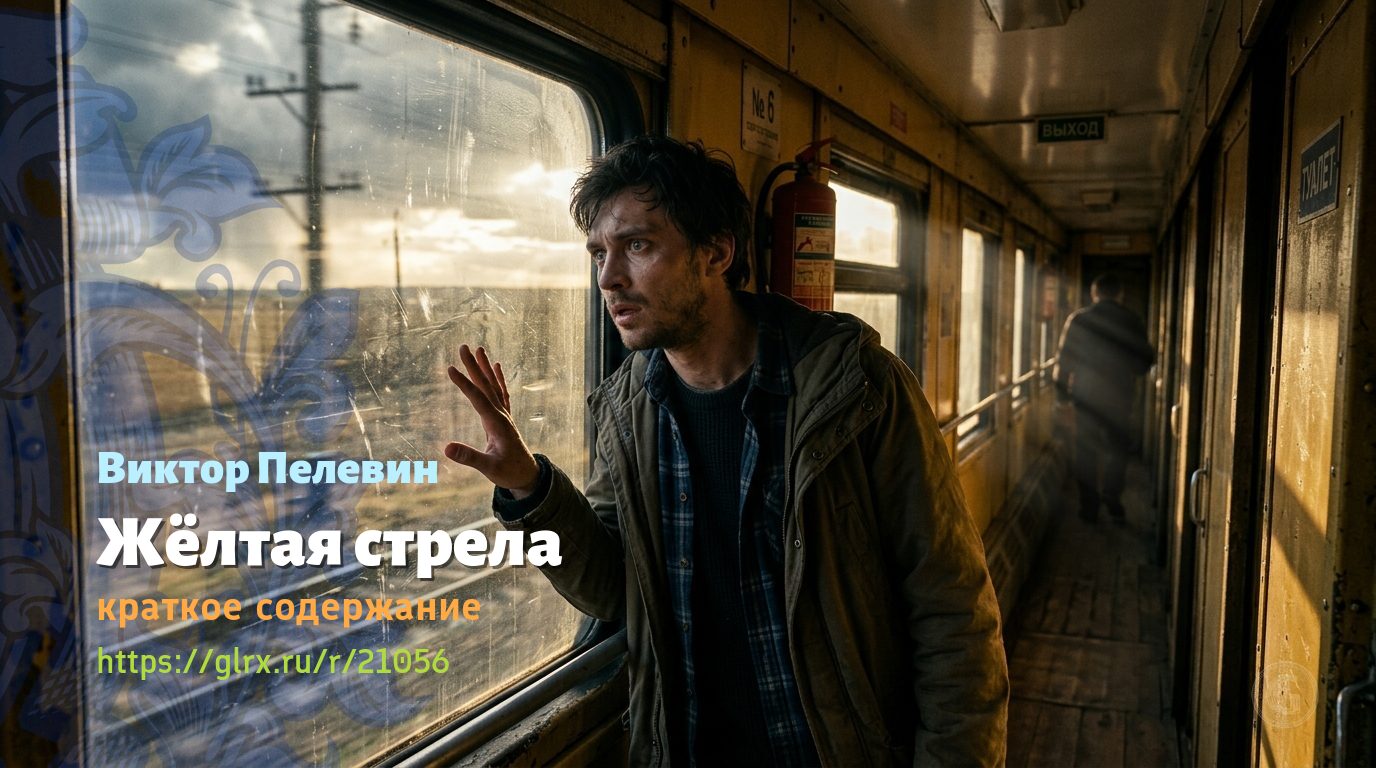
The story "The Yellow Arrow"
The protagonist, Andrei, wakes up in a compartment car to the sound of Estonian singer Guna Tamas playing over the radio. His neighbor, Pyotr Sergeyevich, has been snoring all night. It’s an ordinary morning on the Yellow Arrow train, a train carrying its passengers to a destroyed bridge. None of them realize it: for most, the train is the entire world.
Andrei goes to a restaurant for breakfast. There, he watches the sun’s rays fall on the dirty tablecloth and thinks that he himself may be just one of those "yellow arrows" flying somewhere through the dirty glass of life. A stranger in a black jacket with silver crosses appears at his table — a guide, though Andrei doesn’t initially recognize him in his civilian clothes. The guide discusses the need for people to find meaning and beauty in their surroundings, to submit to a "grand design." Andrei leaves, pocketing the booklet he gave him with the winged note on the cover.
Conversation with Khan
Then Andrei visits the only person on the train with whom he can truly speak — the enigmatic Khan, who lives in a compartment marked "XV." Khan greets him in an Angels of California tracksuit and immediately notices that Andrei has just been "a passenger": he didn’t hear the rumble of the wheels, mistaking the bustle of the train for the only reality. Khan shakes him and asks: what is the "Yellow Arrow"?
Andrey recalls: it’s a train heading toward a destroyed bridge. Khan explains the difference between those who simply ride and those who know they’re riding. The average passenger would never question the reality of the train car — they’ve long since stopped hearing the clatter of the wheels, just as one stops hearing background noise. The real challenge is "to ride the train and not be its passenger."
That same morning, Andrey’s neighbor, Soskin, dies in the train car. The conductors slowly and solemnly push the body out the window, followed by a pillow and a towel. Andrey stands by the glass and watches as the dead head, its hair flying, hurtles over the embankment — and disappears.
Traveling by train
At the restaurant, Andrei meets an old friend, Grisha Strupin, a businessman who sold cigarettes and beer in the vestibules during the Soviet era, but has now "expanded into the big time." Grisha discusses trade schemes with his partner, Ivan: aluminum spoons, brass cup holders, toilet paper with Saddam Hussein. The conversation takes place in very real terms — exchange rates, kickbacks to the foreman, racketeering, the vestibule — but all this activity is confined to the train and leads nowhere beyond its boundaries. Late in the evening, Grisha comes running to Andrei with a broken face: he was robbed in the vestibule, and all his money was taken after settling accounts with Ivan.
Together with Khan, Andrei walks through the entire train — from the compartment cars, to the reserved seats, then through the general cars where they sing "Train on Fire," past a prison car with an armed conductor — to the very last, abandoned cars with broken windows and bullet-scarred walls. Here, in a dark corner by a rusty stove, Khan shows Andrei an inscription scratched on the wall many years ago. It’s a few lines — about the world as "a yellow arrow that hit you" and about a train heading toward a destroyed bridge. Who wrote it is unknown. Khan says: there are plenty of such "letters" around, if there is someone to read them. Even the word "Earth" itself is a letter with the same meaning: the same word describes the soil beneath your feet, the world of people, and the place where the dead are buried.
Andrei remains alone in the empty train car. Looking out the window at the bushes rushing past, he thinks about how every second disappears without a trace, how there’s no guarantee the next one will come. "I want to get off this train alive," he says to himself, not quite understanding what these words mean.
The newspaper "Put" and the cinema
Pelevin inserts two ironic episodes into the fabric of the story. The first is an article from the newspaper Put’ (Put’) titled "Total Anthropology," which lists onomatopoeias for the sound of wheels in various languages: Americans have "gingerel," Tibetans have "dzogchen," Irish people have "blah-blah-blah," and in Russia, of course, the most beautiful and tender of all is "tam-tam." The second is a radio program called "Morning Cinema" about Akira Kurosawa’s 1970 film Dodeskaden, in which the hero imagines himself a tram driver on a nonexistent tram — and the host explains that all the other characters in the film are doing the same thing, simply without realizing it.
The Finale: Andrey’s Departure
The denouement comes at night. Andrei puts on dark glasses, a cap, and gloves, inserts a wooden wedge into the toilet lock of an empty train car, opens the window, and climbs out onto the train’s roof. This is described as an ordinary physical act, although in the occult books sold in the vestibule near the restaurant, the procedure is called "ritual death." On the roof, he meets Khan, and they walk west in silence, jumping over the gaps between the cars.
The rest isn’t directly described in the text, but the ending is unambiguous: Andrei leaves the train just as those who left the inscription on the wall of the abandoned train car did. Khan said they "got off one night when the train stopped."
The story "The Prince of Gosplan"
The story "The Prince of Gosplan" was written in 1991 and is based on another metaphor of the same kind — a computer game. The protagonist, Sasha Lapin, works at an ordinary Soviet Gosplan office. His boss, Boris Grigorievich — a heavyset, bald bureaucrat obsessed with samurai swords and the newspaper Argumenty i Fakty — inspires in Sasha a quiet, ingrained hatred, like that of a Siamese cat with a cruel master.
During the day, when the boss isn’t around, Sasha plays a computer arcade game — a Prince of Persia-type game where a small figure runs through stone corridors, jumps over spiked wells, pulls himself up on the edges of platforms, and fights guards. The goal is to reach the princess on the final level.
The gist of the story is that the boundary between the game and life turns out to be arbitrary. Sasha is so immersed in the game that he begins to perceive the office space as the levels of a labyrinth: doors open like grates when a plate is pressed, colleagues resemble monsters, and phone calls signal the transition to the next level. Control plates, torches on the walls, jugs of life force — all of this seeps into his perception of real space.
Boris Grigorievich is also playing — Abrams, a tank simulator — and asks Sasha to show him how to rotate the turret. A business traveler from Penza is playing Starglider and dies right at the table when his starship is destroyed by a missile. He is "booted" again from a floppy disk. Emma Nikolaevna from the neighboring department recalls that she couldn’t get past the second tier of the "Prince" — the guards did whatever they wanted to her.
The story ends the same way as the novella, only in a different setting: the hero presses the keys, the door to the next level rises — and it’s unclear where exactly he’s ending up. The princess is waiting, but the only way to reach her is to forget about pressing the keys and become that figure running through the corridors yourself.
- "TRANSHUMANISM INC." by Victor Pelevin, summary
- "The Caretaker. Book 2. The Iron Abyss" by Victor Pelevin, summary
- Viktor Pelevin’s "KGBT+" Summary
- "Methuselah’s Lamp, or the Ultimate Battle of the Chekists with the Masons" by Victor Pelevin, summary
- A summary of Victor Pelevin’s "Journey to Eleusis"
- Names of winners of the festival "East Pomerania" announced
You cannot comment Why?