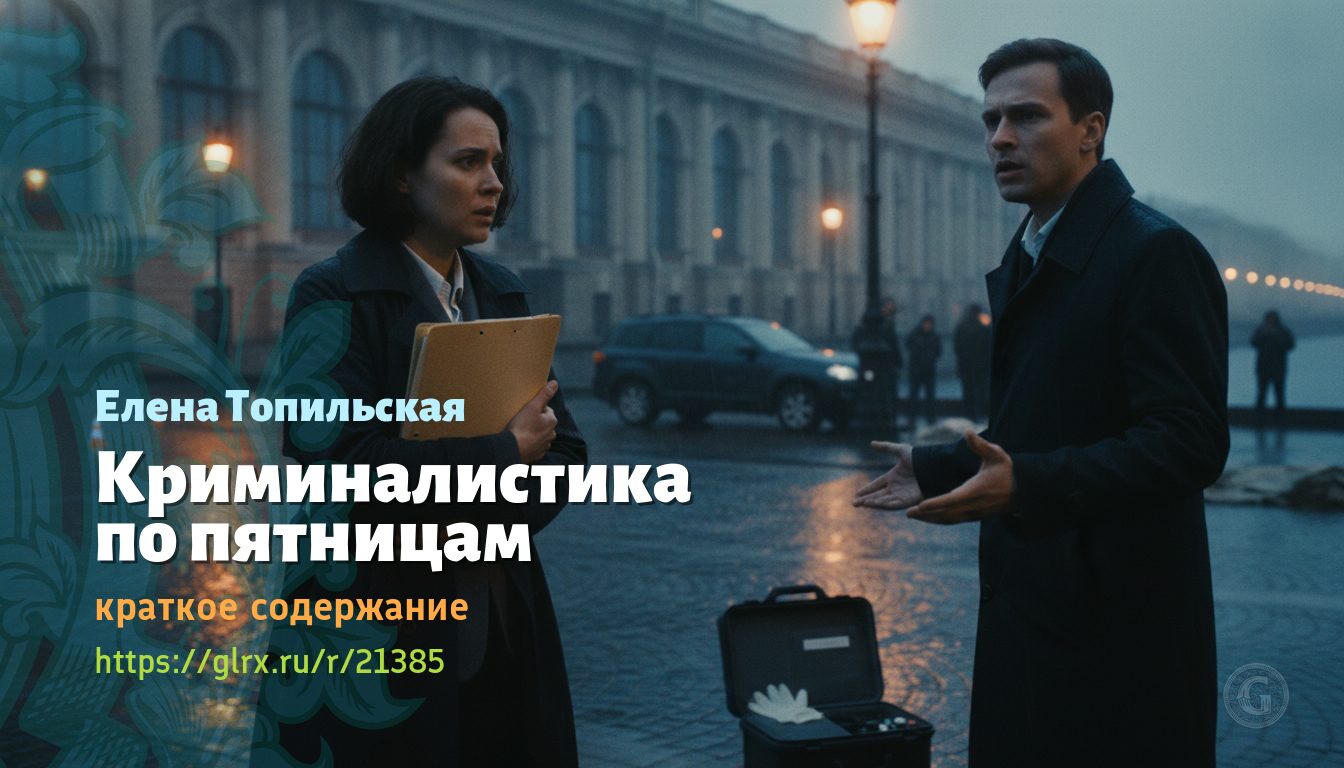
"Forensics on Fridays" by Elena Topilskaya, summary
 Automatic translate
"Forensics on Fridays" is a detective novel by Elena Valentinovna Topilskaya, published in 2018. Topilskaya, a long-time former investigator in the St. Petersburg prosecutor’s office and screenwriter for the television series "Secrets of the Investigation," captures the atmosphere of real-life investigative work with genuine insight. The protagonist, investigator Maria Sergeevna Shvetsova (Masha), talks about the city, her colleagues, her daily life, and, most importantly, the case of a serial criminal known colloquially as "The Modest One."
The book is part of a series of novels about investigator Masha Shvetsova. The series also includes "Notes of a Mad Investigator," "Spanish Night," "Door in the Mirror," "The Scarlet Mask," "The Role of the Victim," "A Trap for Blondes," and others.
Everyday life in the prosecutor’s office
The action takes place in St. Petersburg during the period of investigative reform — on the eve of the creation of the Investigative Committee. Masha works in the district prosecutor’s office alongside her friend and colleague, Alexei Gorchakov. Both are experienced investigators of the "old school," experiencing the gradual collapse of the system: transit prosecutors replace each other every few months, young colleagues are busy searching for ill-gotten gains, and cases are investigated for show.
On Fridays, Masha regularly receives calls from expert psychologist Katushkin, a specialist in criminal homicidal behavior, a terrifying presence but undeniably brilliant. He can deduce a criminal’s motive where investigators are stumped: it was his psychological assessment that once helped Masha explain the logic of a repeat offender who killed drunk people in their sleep — he considered them "wayward" and sincerely believed himself to be a social sanitizer.
Serial "Modest"
Meanwhile, a serial rapist is operating in the city. A young, fair-haired man in his twenties or thirties methodically stalks lonely teenage girls: he rings their doorbells under the pretext of looking for a certain Nikolaev family, asks them to write a note to the neighbors and bring water. When the gullible victim complies, he threatens them with a knife, blindfolds them, and sexually assaults them. Four incidents have been reported across the city.
The case is being handled by detective Andrei Sintsov, a man capable of getting any maniac to talk. However, the system works against him: the investigator refuses to add additional cases from other districts to the case, citing "targeted targets," and even secures a ban on Sintsov communicating with a suspect already detained in another case. The story culminates in a sex shop: a saleswoman reports that a man was interested in "means to prevent the rape of minors" and schedules a follow-up meeting for Friday, but the district police department and the main department squabble for days over who should go to the ambush, and in the end, no one shows up. When Sintsov rushes there himself, it turns out the customer had already been there half an hour earlier.
Decapitated corpse and identification
Meanwhile, the headless body of a young blond man is found in the city. Sintsov and Masha conclude that "Skromnik" is the murdered man: the victim, Kristina Butenko, one of the rapist’s victims, recognizes the corpse’s hand from her own pencil sketch, made from memory in art school — the girl drew the attacker’s hand immediately after the incident.
Despite an extensive search, the victim’s head has not been found: it has not been found in nearby dumpsters or trash. Possible burial sites — the bottom of a reservoir, buried in the ground, or burned — remain speculative. A biological examination is difficult: the suspect is not an excretor, and it is impossible to determine his blood type from biological traces.
Sex doll and tattoo mark
Masha comes to a belated but important conclusion: when "Skromnik" entered the sex shop, he picked up an anime-style doll. The saleswoman, Olesya, had prudently hidden the toy, and forensic scientist Fedorchuk discovers useful fingerprints on it. Meanwhile, experts examine the corpse’s fingertips: they bear traces of a homemade tattoo — several barely legible letters, which, after weeks of exposure to infrared and ultraviolet light, form a partial gibberish: "M" or "P," "E," "U," "N," "N," or "P."
Skromnik’s fingerprints were not found at the crime scenes — at the victims’ apartment doors — as the perpetrator acted cautiously. Sintsov and Masha are discussing the possibility that the blond man may have been visiting the city on business from another region, and they plan to expand their search by checking related businesses near the attack sites.
Background: People and the System
The book’s criminal narrative is woven through a detailed panorama of life in the investigative community in the late 2000s: kitchen conversations over shurpa prepared by Masha’s husband, Dr. Stetsenko; Gorchakov’s daughter, whose father nearly deprived her of her prom; memories of a ten-pound trip to England and a whole bag of tasteless licorice; flat spoons in the police canteen, impossible to slurp soup with. Behind this everyday life lies a keen sense that the honest work of investigators and detectives is increasingly devalued: corruption, bureaucracy, and the system’s indifference are eroding the results of even the most meticulous operational work.
- "New Painting" with the latest works of Peter Shvetsov presented ANNA NOVA
- "White, Black, Scarlet…" by Elena Topilskaya, summary
- "Heroes Are Not Killed" by Elena Topilskaya, summary
- "Sheep’s Skin" by Elena Topilskaya, summary
- A summary of "The Blonde Trap" by Elena Topilskaya
- “Hills Like White Elephants” by Ernest Hemingway
You cannot comment Why?