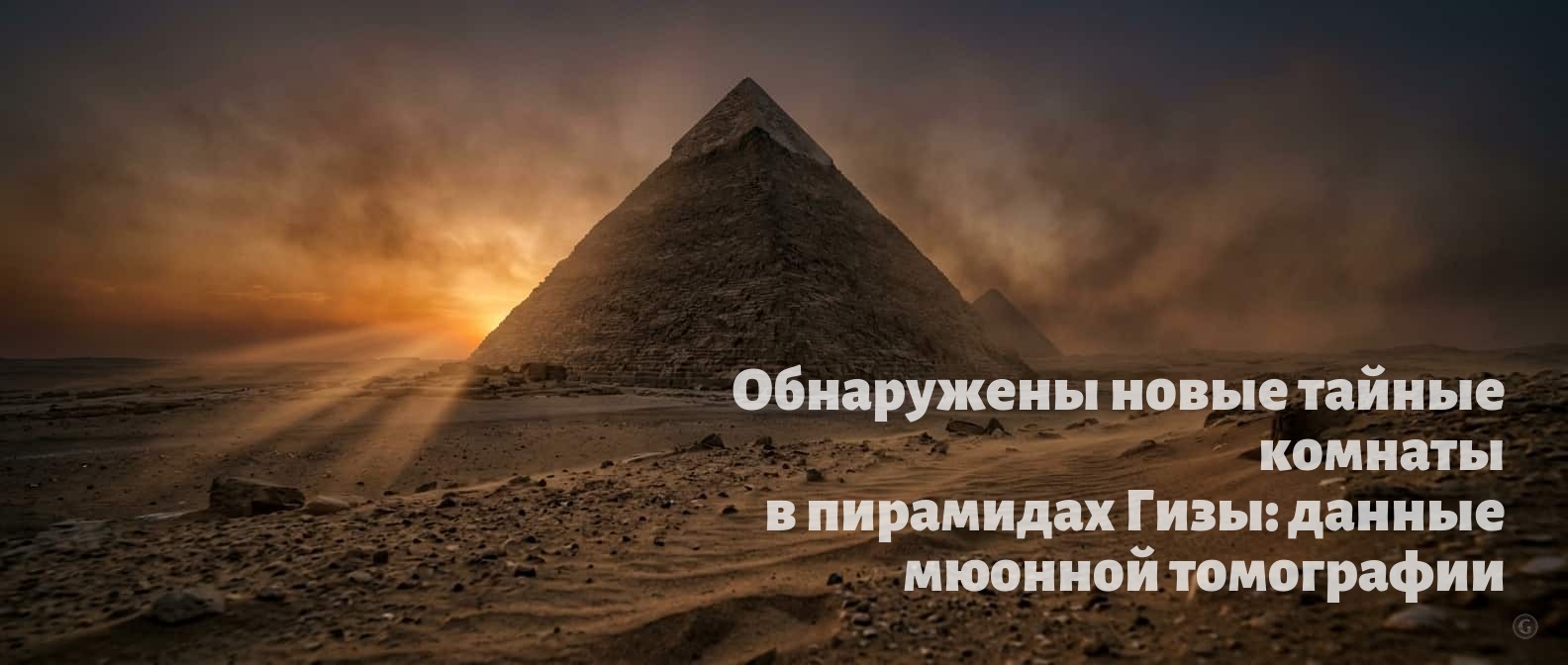
New secret chambers discovered in the Giza pyramids:
muon tomography data
 Automatic translate
Researchers from Cairo University and the Technical University of Munich have identified hidden spaces within structures on the Giza plateau. The scientists used non-destructive testing methods. Analysis of muon tomography data revealed two previously unknown cavities behind the eastern façade of the Pyramid of Menkaure. Experts suspect the presence of a second, previously hidden entrance to the structure. Meanwhile, the international ScanPyramids project confirmed the existence of a hidden corridor on the northern side of the Pyramid of Khufu. This corridor is located above the main historic entrance.
The discovered corridor in the Khufu pyramid is 9 meters long and 2 meters wide. The cavity’s shape resembles a corridor extending deep into the rock mass. The ScanPyramids project team used a combination of infrared thermography and muon radiography. These methods allow scanning dense rock masses. The technologies operate without physically interfering with the structure of the ancient monument.
Physics of muon radiography
Muon radiography is a method that uses cosmic rays to scan a rock, similar to a medical X-ray. Cosmic rays constantly collide with atoms in the upper layers of the Earth’s atmosphere. These collisions produce new particles called pions. Pions quickly decay, forming muons. Muons travel toward the planet’s surface at speeds close to the speed of light. About 10,000 muons fall on every square meter of the Earth’s surface every minute.
Muons are highly penetrating. They easily pass through empty space. When they collide with dense materials, such as limestone or granite, muons are absorbed or deflected. Scientists place muon detectors inside or outside the object being studied. The detectors record the number of particles passing through the stone from different directions.
If there’s a void in the muons’ path, the detectors register an excess of particles. If there’s a dense block in the path, the detectors register a lack of particles. Researchers collect this data for months. Computer algorithms then construct a three-dimensional map of the object’s density. Physicists have previously used muon radiography to study the structure of volcanoes and nuclear reactors. In archaeology, this technology makes it possible to precisely locate hidden chambers without drilling into walls.
Architecture of the Great Pyramid
The Pyramid of Khufu was built approximately 4,500 years ago. The original height of the structure was 146.6 meters. Currently, due to the lack of external cladding, it stands at 138.8 meters. Each side of the base measures 230.3 meters. The total volume of the structure is estimated at 2.58 million cubic meters. The builders used approximately 2.3 million stone blocks. The average weight of a single block is 2.5 tons. Some granite blocks weigh up to 80 tons.
The interior of Khufu’s pyramid contains three known large chambers. A descending corridor leads to a subterranean chamber. This chamber was carved into the bedrock at a depth of 30 meters and remains unfinished. An ascending corridor branches off from the descending corridor and leads to the Grand Gallery. The Grand Gallery is 46.7 meters long and 8.6 meters high. From the beginning of the Grand Gallery, a horizontal passage leads to the Queen’s Chamber.
At the top of the Grand Gallery is the entrance to the King’s Chamber. The King’s Chamber is lined with massive blocks of Aswan granite. Above the ceiling of this chamber, the builders constructed five relief cavities. These cavities distribute the colossal weight of the stone mass above the tomb. A new 9-meter-long corridor was discovered near the northern edge, directly above the descending corridor of the original entrance.
Features of the Pyramid of Menkaure
The Pyramid of Menkaure is the smallest of the three main pyramids on the Giza plateau. Its original height was 65.5 meters. Today, it stands at 61 meters. The base measures 108.5 meters. The lower part of the pyramid, up to a height of 15 meters, was faced with red Aswan granite. The upper part was covered with white Tura limestone. The interior chambers were carved deep into the bedrock beneath the monument.
New muon scanning data indicates voids behind the building’s eastern façade. Researchers from the Technical University of Munich have recorded density anomalies in this area. Previously, archaeologists knew of only one entrance on the northern side of the structure. The presence of air pockets on the eastern side may indicate the existence of an additional passage.
In the 12th century, Sultan Al-Aziz Uthman attempted to demolish the tombs of Giza. He began with the Pyramid of Menkaure. Workers spent eight months trying to dismantle the stonework. They were only able to create a deep vertical breach on the north side of the structure. This breach is still visible today, revealing the internal structure of the roughly hewn blocks of local limestone.
History of the study of interior spaces
The first documented entry into the Khufu pyramid occurred in 820. Caliph Al-Ma’mun ordered a tunnel to be dug through the northern face. Workers heated the stone with fire and then rapidly cooled it with vinegar. The temperature difference caused the limestone to crack. This tunnel passed the granite plugs of the original entrance and connected with the ascending corridor. Today, tourists use Al-Ma’mun’s passage to enter the pyramid.
In the early 19th century, the Italian explorer Giovanni Battista Belzoni conducted excavations at Giza. He became the first European to enter the Pyramid of Khafre in 1818. In 1837, the British Colonel Howard Vyse explored the Pyramid of Khufu. Vyse used gunpowder charges to find new chambers. Using explosions, he opened up four unloading chambers above the King’s Chamber. There, he found construction graffiti in red ochre with the name of the pharaoh Khufu.
In the 1880s, Flinders Petrie conducted the first accurate trigonometric measurements of monuments. Petrie used specially designed measuring equipment. He determined the precise dimensions of the blocks and the inclinations of their faces. Petrie’s topographic data is used by modern specialists to calibrate muon radiography equipment.
Analysis of new data and scientific discussion
The discovery of voids has sparked heated debate among Egyptologists. Representatives of the Egyptian Ministry of Tourism and Antiquities confirmed the anomalies. The documented 9-meter-long passage in the Khufu pyramid has a chevron vault. This type of ceiling design was used by ancient architects to redistribute the weight of the stone over the voids. Similar chevron blocks are visible on the exterior above the original entrance.
Former Egyptian Antiquities Minister Zahi Hawass expressed skepticism about the interpretation of the voids as secret chambers. Hawass called claims of massive hidden tunnel networks completely false and lacking scientific basis. The archaeologist asserts that the density anomalies are related to specific construction methods. Old Kingdom architects often left construction gaps between the blocks of the inner core.
Ministry of Antiquities representative Mohamed Ismail also commented on the discovery. Ismail dismissed the idea of hidden burial chambers. Any additional burial chamber would have had a clear entrance system. The discovered 9-meter corridor has no visible connections to the known system of internal passages.
Logistics and construction materials
The construction of the monuments required a massive influx of resources. The primary building material was quarried directly from the Giza plateau — local nummulitic limestone, a yellowish color. The limestone blocks vary in size and are often stacked with wide gaps. These gaps were filled with gypsum mortar and crushed stone. The uneven structure of the core creates difficulties for muon tomography. The mortar and crushed stone have a lower density than solid stone.
The exterior cladding was made of high-quality white limestone. This stone was quarried in Tura on the east bank of the Nile. Blocks of Tura limestone were transported to Giza by boat during the river’s annual floods. The surface of the cladding blocks was polished to a high shine. Most of these blocks were removed in the Middle Ages for the construction of buildings in Cairo. Today, remnants of the cladding remain only at the top of the Pyramid of Khafre and at the base of the Pyramid of Khufu.
Granite for the burial chambers and sarcophagi was transported from Aswan. The Aswan quarries are located over 800 kilometers south of Giza. Transporting monoliths weighing up to 80 tons required the construction of special barges. Workers constructed a system of canals and harbors connecting the Nile to the foot of the Giza plateau. French archaeologists recently discovered traces of this ancient port infrastructure near the monuments.
Stone processing technologies
Craftsmen of the Old Kingdom knew nothing of iron tools. They used copper chisels, wooden hammers, and stone sledgehammers made of dolerite. Dolerite is a hard volcanic rock. Dolerite sledgehammers were used to break off chunks of granite in the Aswan quarries. Stonecutters struck the rock thousands of times, gradually forming trenches around the desired block.
Copper saws were used to cut soft limestone. During the sawing process, stonecutters added quartz sand to the saw blade. Quartz sand is harder than copper and limestone. The sand crystals embedded themselves in the stone, acting as an abrasive. The copper saw served as a guide for the abrasive. This precise cutting process allowed for straight cuts.
Drilling of the stone was done with copper tubular drills. Abrasive sand was also fed under the drill. Water was used to cool the tool and remove stone dust. Archaeologists have found granite cores with distinct spiral drill marks. Such marks confirm the use of rotary tools with sand. The accuracy of the fit of stones in the facings and interior chambers often does not exceed fractions of a millimeter.
The specifics of the geological structure of the plateau
The Giza Plateau consists of a massif of limestone rocks called the Moqattam Formation. This geological formation formed during the Eocene, approximately 50 million years ago. The limestone consists primarily of compressed shells of single-celled organisms called nummulites. The limestone layers on the plateau naturally slope from northwest to southeast.
The architects carefully assessed the construction site. The base of Khufu’s pyramid rests on a solid rock core. The builders didn’t completely demolish the hill. They carved a stepped foundation and integrated the natural rock into the lower courses of masonry. Using the natural hill saved a significant amount of construction work. The rock core ensures the stability of the colossal mass of stone.
Geological faults and cracks in the limestone massif complicate the interpretation of geophysical data. Natural karst voids beneath the plateau can produce false signals on detectors. The ScanPyramids team is calibrating the instruments using existing cameras. Calibration helps distinguish natural geological anomalies from artificial architectural elements. The discovered 9-meter corridor is located high in the masonry massif, ruling out its natural origin.
Organization of labor in construction
Excavations of construction workers’ settlements have shed light on the organization of these large-scale projects. Egyptologist Mark Lehner discovered the remains of a large workers’ city south of the plateau wall. Bakeries, breweries, and animal bones discovered indicate a centralized supply system for the workers. The builders received rations of bread, beer, beef, and fish. Medical care was high. The skeletons discovered show well-healed fractures and evidence of successful surgeries.
The workforce was divided into teams. Graffiti on the blocks preserved the names of these units, which often included the name of the reigning pharaoh. The teams were divided into smaller units called phyles. Each phyle was responsible for a specific section of the work or the transport of specific blocks. A strict hierarchy ensured the continuity of the construction process.
Egyptologist Mark Lehner and his colleagues rejected the concept of slave labor. The pyramids were built by free Egyptians. Peasants performed forced labor during the Nile flood season. During the flood months, agricultural work was impossible. The state provided housing, clothing, and food for the workers. Professional stonemasons and engineers worked on the site year-round.
Archaeological finds inside the pyramids
The Giza structures were looted in ancient times. Archaeologists have found only a few artifacts inside. Three small objects were discovered in the Queen’s Chamber of Khufu’s pyramid. In 1872, engineer Waynman Dixon found a copper hook, a granite ball, and a piece of cedar wood. The wood was later radiocarbon dated to approximately 3341-3014 BCE.
The tombs of nobles and relatives of the pharaohs around the main pyramids were better preserved. Mastabas — flat-roofed tombs — contain rich reliefs. The reliefs depict scenes of everyday life, agriculture, and crafts. Near the pyramid of Khufu, archaeologists discovered an underground chamber containing a dismantled wooden boat. The cedar planks of the boat were perfectly preserved in the sealed environment.
The restored boat is 43.6 meters long. The hull width reaches 5.9 meters. The vessel has no metal fasteners in its structure. The wooden parts are held together by a system of esparto ropes. The ropes contract when wet, ensuring the seams are watertight. The boat was intended for the ritual transport of the pharaoh in the afterlife. In 2021, the vessel was transported to the new Grand Egyptian Museum.
Architecture of the Pyramid of Khafre
The Pyramid of Khafre is the second largest on the Giza plateau. Its base is located on a cliff 10 meters higher than the base of Khufu’s pyramid. An optical illusion makes Khafre’s pyramid appear taller. The base measures 215.2 meters on each side. Its original height was 143.5 meters. The slope of Khafre’s pyramid is steeper than that of Khufu’s pyramid, at 53 degrees 10 minutes.
The interior structure of Khafre’s pyramid is distinguished by its simplicity. It has two entrances on the north side. One entrance is located at a height of 11.5 meters. The other entrance is carved into the bedrock in front of the monument. Both passages connect into a single corridor. This corridor leads to a single burial chamber. The chamber is carved into the bedrock beneath the structure’s base. The roof of the chamber is made of massive limestone slabs set at an angle.
The chamber contains a black granite sarcophagus. It is half-buried in the floor of the chamber. The lid is broken in two. The Italian explorer Belzoni discovered bull bones inside. Ancient looters entered the chamber long before European explorers. They tunneled through the granite barrier blocks. A significant portion of the original white limestone casing remains at the top of Khafre’s pyramid.
The Great Sphinx and surrounding temples
To the east of Khafre’s pyramid stands the Great Sphinx. The monument is carved from a single limestone monolith. The statue’s length reaches 73 meters. The height from base to crown is 20 meters. The Sphinx faces east, along the parallel. The statue’s face is traditionally associated with the Pharaoh Khafre.
The Sphinx was carved from the same rock mass that served as the quarry for the blocks. The different layers of limestone in the statue’s body have varying densities. The lower part is composed of durable stone. The middle part of the body is made of soft layers, subject to severe wind erosion. The Sphinx’s head is carved from a solid limestone bed.
Near the Sphinx stands the Valley Temple of Khafre. The temple is constructed of megalithic limestone blocks, faced with polished red granite. Granite columns inside the temple support massive stone ceilings. The temple floor is paved with alabaster slabs. The Valley Temple was connected to the mortuary temple at the foot of Khafre’s pyramid by a long covered corridor. This corridor was approximately 494 meters long.
Details of infrared thermography technology
Infrared thermography was used in the early stages of the ScanPyramids project. Scientists recorded the rate of heating and cooling of the stones. Measurements were taken at sunrise and sunset. The massive stone slowly accumulates solar heat during the day. At night, the stone slowly releases heat into the surrounding environment. The presence of a hidden void behind the wall changes the thermal conductivity of the area. The voids trap air masses of varying temperatures.
High-resolution thermal cameras revealed thermal anomalies on the building’s façades. The instruments recorded temperature differences of several degrees between three adjacent blocks on the eastern side of Khufu’s pyramid. This temperature difference indicated the presence of an air cavity or corridor immediately behind the cladding blocks. The thermography data allowed the targeted installation of muon detectors in specific areas.
Infrared thermography requires ideal weather conditions. Strong winds, clouds, or precipitation distort the thermal image of the stone. Measurements at Giza were taken during dry, cloudless periods. Thermal data analysis takes into account the properties of various materials. Granite and limestone have different heat capacity coefficients. The combination of thermography and muon tomography made it possible to cross-validate the results.
Problems of interpretation of the obtained data
The technology doesn’t produce photographic images of the cavities. Scientists obtain only graphs and 3D point clouds. These points indicate areas of low density. The precise shape of the 9-meter corridor was determined using an additional method. The researchers used a Japanese endoscope with a diameter of 6 millimeters. They inserted the endoscope’s tube into a narrow gap between the stones of the chevron vault above the entrance.
An endoscopic camera has captured the first visual images of the interior. The images reveal a roughly hewn vaulted corridor. The walls of the corridor show no signs of finishing. There are no artifacts or inscriptions on the floor. The rough finish indirectly confirms the corridor’s technical purpose. The architects left unfinished rooms that were not intended for public access after construction was completed. Approved protocols of the Egyptian Ministry of Tourism and Antiquities govern further research, requiring independent verification of the data by several laboratories before making official statements.
- The world’s largest archaeological museum welcomed its first visitors in Cairo.
- Pyramid construction technologies in Ancient Egypt
- The Renaissance of the "Iron" Engineer: How Universities Are Reshaping Education for the Era of Sovereign Microelectronics
- A summary of Emil Braginsky’s "The Room"
- A summary of "The Room of Ancient Keys" by Elena Mikhalkova
- The royal court as an institution of power and a stage for political action
You cannot comment Why?