How to safely lift long and oversized loads with an electric hoist
 Automatic translate
Lifting long and oversized loads requires more careful preparation than working with standard individual items. These include pipes, beams, profiles, guides, metal structures, large panels, equipment housings, tanks, and components with an offset center of gravity. The difficulty here stems not only from the load’s weight. Safety is also affected by the load’s length, shape, rigidity, deflection, the location of the gripping points, and the availability of clearance.
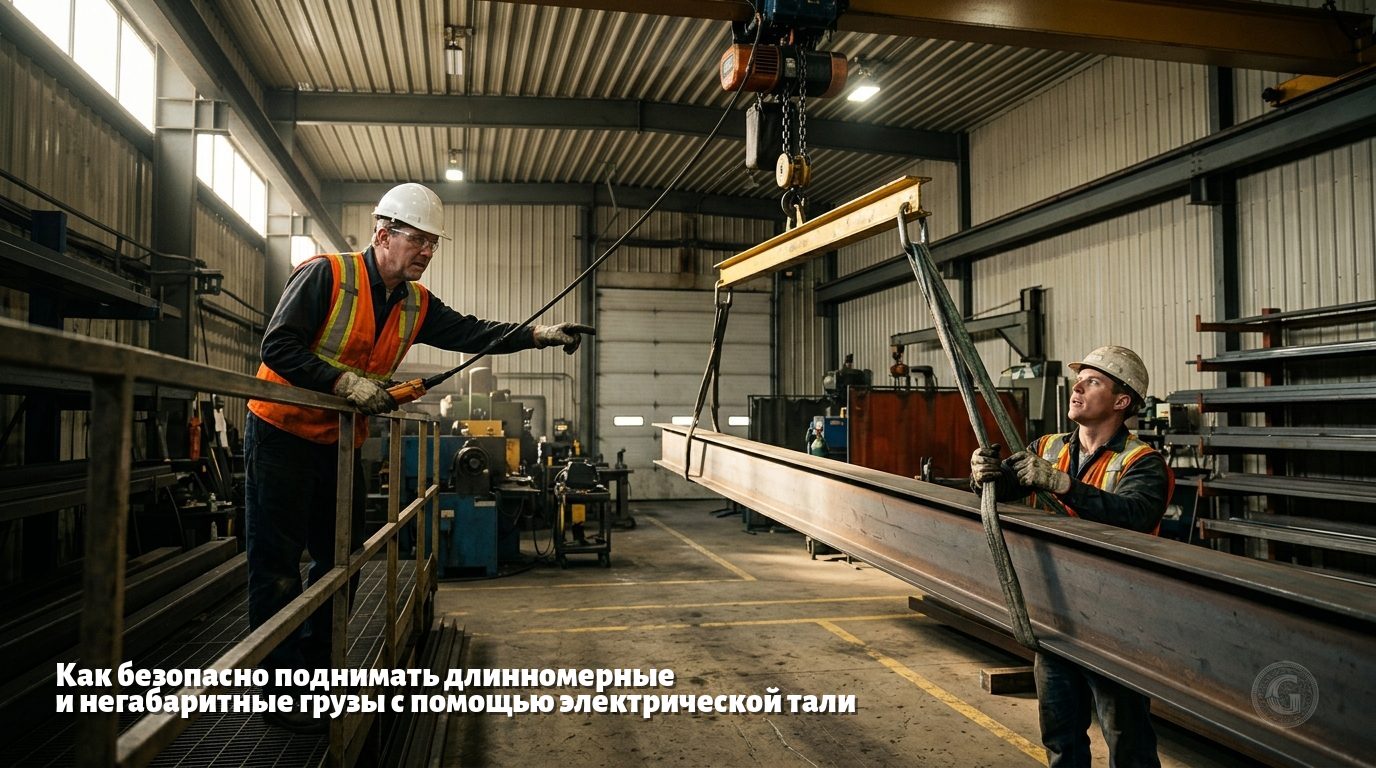
This is why electric hoists are in demand in workshops, assembly areas, repair areas, and warehouses where loads need to be lifted carefully, without jerking, and with precise movement control. However, the hoist itself cannot compensate for errors in slinging, tooling selection, or work area preparation.
Efficiency of an electric hoist when handling non-standard loads
An electric hoist is especially useful where long or oversized loads are lifted regularly and within a designated area. This could include feeding parts to a machine, moving workpieces along a production line, indoor assembly, equipment maintenance, or working on a monorail, beam, or cantilever system.
In such areas, controlled lifting speed and the ability to precisely stop the load at the desired point are crucial. If the load is long, a single suspension point is often insufficient. Safety then depends not only on the lifting mechanism but also on the entire design: the location of the suspension, whether there is sufficient clearance, whether the route can be completed without interference, and how the load is distributed between the lifting points.
Therefore, an electric hoist must be included in a well-thought-out lifting arrangement.
What are the risks involved in lifting long and large items?
The most common problem occurs when the load is lifted from its support. If the center of gravity is inaccurately determined or the slinging points are poorly chosen, the load begins to tilt. This is especially dangerous for long items, as even a slight tilt at takeoff can cause the load to swing, rotate, and collide with adjacent structures.
Additional risks are associated with the following factors:
- uneven load on the sling branches or grips;
- bending of a long load due to incorrect distribution of lifting points;
- touching walls, racks, equipment, shelves and fences;
- overloading of an individual piece of equipment;
- loss of stability when trying to lift a long load from one point.
Electric hoists reduce the likelihood of harsh jerks that often occur when a lift is started carelessly. However, they do not eliminate errors if the load is improperly secured or the route is not prepared in advance.
How to prepare a safe lifting plan before starting work
Ensuring safety begins with assessing the load itself. Before lifting, determine its weight, length, shape, rigidity, presence of protruding parts, and center of gravity. For long items, it’s important to determine whether deflection will occur during suspension and how the load will behave after lifting.
What to check before lifting
- Is the load capacity of the entire system sufficient?
- where are the acceptable capture points;
- Is there enough lift height for a safe maneuver?
- is the trajectory of movement free;
- one or two lifting points are needed;
- who controls the position of the cargo during movement.
For long loads, a test lift to a small height is important. This allows one to detect any distortion, assess stability, and stop the operation promptly while the risk is still minimal. This approach is consistent with the general logic of industrial safety requirements: first, check the load’s behavior, then move it.
What equipment is needed with an electric hoist?
When lifting non-standard loads, the hoist doesn’t operate on its own. Safety depends directly on the equipment. In most cases, slings of the appropriate type and length, spreader bars, grips, guy lines, and auxiliary elements are used to protect the load from damage.
Spreaders and multi-point slings are especially important. For beams, pipes, long frames, and metal structures, they help distribute the load more evenly, reduce bending moment, and hold the load more stable. Guy lines help control the rotation of the structure during movement, and protective elements reduce the risk of surface damage.
If the task is repeated regularly, the issue of equipment should be decided in advance, rather than selecting suitable elements immediately before the work.
What is important to consider when choosing and using an electric hoist?
When handling long and oversized loads, not only the lifting capacity is important, but also the hoist’s design, ease of operation, braking reliability, the condition of the chain or rope, the hook suspension, and the overhead track. A stationary hoist may be suitable for one application, while another requires a mobile model with a beam.
It’s important for a hoist to provide controlled lifting and precise positioning. This is especially true in areas where maneuvering space is limited and any unnecessary movement increases the risk of the load coming into contact with the structure. Therefore, when planning to purchase an electric hoist for handling long or large items, it’s important to evaluate not only the specifications of the mechanism itself but also the parameters of the site, the supporting structure, and the future lifting scheme.
Mistakes that most often lead to dangerous situations
- lifting a long load from one point without checking stability;
- use of unsuitable slings or random equipment;
- lack of test break;
- ignoring the route of movement and the dimensions of the work area;
- too abrupt a start to a climb or movement along a path;
- work without control of the load position using guy ropes;
- operation of the hoist on an unprepared overhead track or when there are doubts about the supporting structure.
Electric hoists improve safety when the lifting process is organized as a system: the load parameters are known, the gripping points are correctly selected, the appropriate equipment is used, the route is prepared, and the condition of the overhead track is checked. Under these conditions, the operator achieves more controlled lifting, accurate positioning, and a reduced risk of sudden movements.
The main conclusion is that for long and oversized loads, it’s essential to understand in advance whether they will remain stable throughout the entire journey. This approach makes an electric hoist an effective and safe choice for indoor use.