How to do homework quickly:
10 effective methods
 Automatic translate
Homework itself is rarely difficult. More often, the problem is how you approach it: without a plan, with your phone in hand, in a "I’ll start later" mood. Teachers and tutors often experience the same scenario: it’s not the assignment that eats up the evening, but the chaos surrounding it.
This article is about organizing the process. If you need help with a specific algebra problem, ask your teacher or use a subject-specific platform. This article is about how to turn a tough evening into a short and predictable study session.
Let’s start with the basic question: is homework necessary at all? A systematic review by the Campbell Collaboration (Guo et al., 2024) compiled experimental studies and found a positive effect: children who did homework had higher academic performance (g = 0.45). This was most pronounced in arithmetic calculations (g = 0.46), less so in problem solving (g = 0.17), and no effect at all in understanding arithmetic concepts (g = -0.02). The authors were unable to determine the optimal daily duration.
Two caveats, without which the figures would be misleading. First, the conclusion applies to younger schoolchildren. Second, the review’s evidence base is outdated: it included only 11 experiments, only one of which was published in 2021, while the rest dated from 1939 to 1995. So the conclusion that "doing homework is beneficial, but stretching it out over an entire evening is pointless" is correct — it’s just based on a shakier foundation than the term "meta-analysis" suggests.
An important caveat regarding sources. There is little research on self-organization in schoolchildren — almost all the high-quality evidence comes from university students. Below, we provide a clear sample for each study. Generalizing conclusions from adults to eight-year-olds should be done with caution: what works for a second-year student may not work at all for a third-grader.
2 How to prepare your workspace before doing homework
3 In what order should I do homework for different subjects?
4 How to quickly do homework if you’re lazy and unmotivated
5 Breaks, schedule, and pace: how to do homework faster without feeling overwhelmed
6 What to do if the task is unclear or you can’t complete it
7 Common mistakes that make homework take up the entire evening
8 When it’s not about organization
9 Frequently asked questions
How to do homework to waste less time
Getting homework done faster requires less heroism and more of a predictable routine. Indirect confirmation comes from a study by Muljana, Dabas, & Luo ) Journal of Research on Technology in Education , 2023): female students with higher final grades had stronger time and learning environment management skills, effort regulation, and metacognitive self-regulation, while those who performed worse consistently submitted assignments at the last minute. The sample was small — female university students taking quantitative courses — but the logic applies: understand the scope of the assignment in advance, eliminate distractions, and choose your first subject before starting, not while working.
It sounds banal, but that’s exactly how it works.
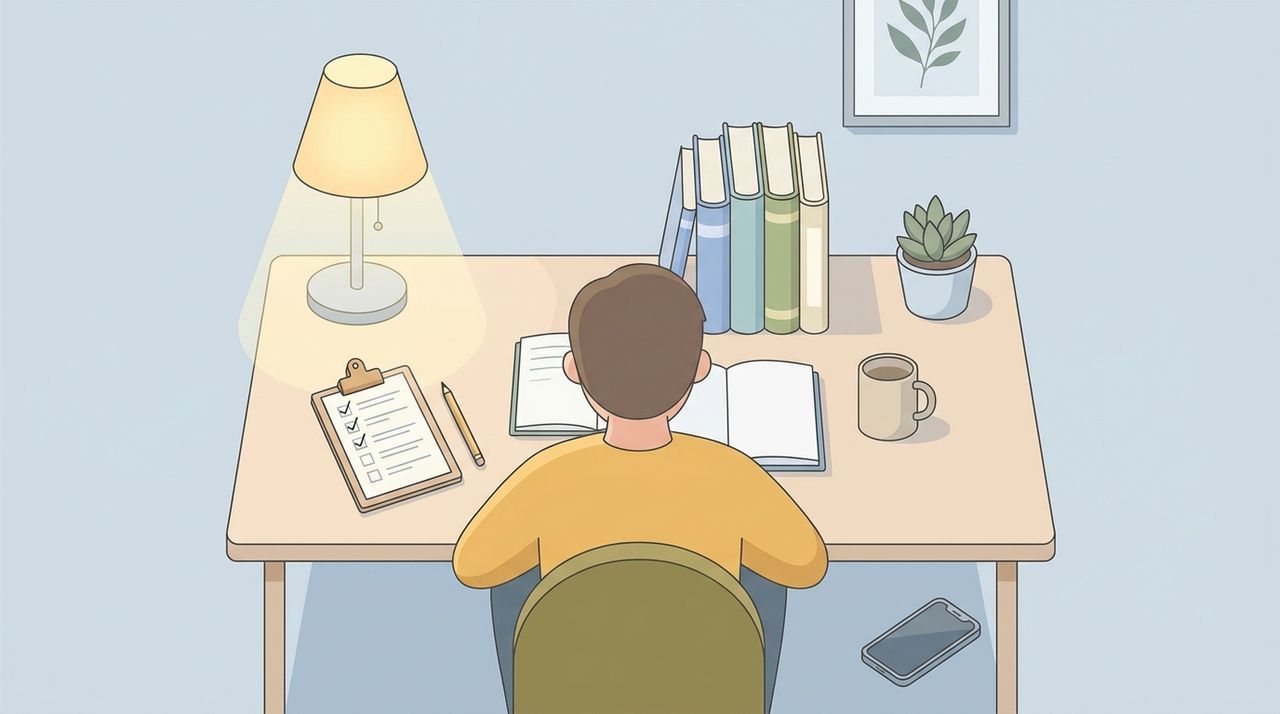
Checklist before the start
- Create a trigger ritual. One action that always precedes work : turn on the lamp, lay out your notebooks, pour water. Repeated every day, it becomes a signal that "we’re working now." The time it takes to form a habit varies from person to person — research shows a range from a few weeks to several months, so don’t expect results by a specific date.
- Remove anything from the table that is not needed for the current subject.
- Prepare your textbook, notebook, pen and draft.
- Open the diary or list where your homework is written down.
- Check which tasks are urgent and which can be done later.
- Place the items in the order they are completed.
- Put your phone on silent mode and put it out of sight.
- Decide in advance which task you will start with.
- Set the timer for the first working block.
- After finishing, put the materials back in place.
Each item is a small action. It’s these actions that create the habit of doing homework quickly, rather than through sheer force.
Why does homework take longer than it should?
Homework usually drags on for three reasons: distractions, a slow start, and a lack of structure. It’s not because the child is lazy.
There are some revealing data on distractions, though not specifically for schoolchildren. In a study examining the impact of phones on young people’s academic performance, participants switched between the task and their phone an average of 3.52 times during an hour-long lecture, and the number of checks was negatively correlated with academic performance. Direct measurements of this kind for younger students are almost nonexistent, but parents typically learn the pattern without any statistics.
A mini-case study. A seventh-grade student complained that he spent the entire evening doing homework. It wasn’t the subjects that were addressed, but the routine: his phone was left on the desk, his assignments were opened out of order, and complex math was put off until nightfall. After a simple reorganization, the time was cut in half — the constant pauses and returns to the beginning disappeared.
What most often prevents you from completing your homework on time:
- notifications and correspondence;
- lack of a to-do list;
- transition from subject to subject without logic;
- attempting to complete too large a task at once;
- work "in the background" of music with text, video or chats.
How much time is normal to spend on homework?
There is an official standard - SanPiN 1.2.3685-21 , Section VI, Table 6.6, Line 19 (approved by Resolution of the Chief State Sanitary Doctor of the Russian Federation dated January 28, 2021 No. 2, valid with amendments):
Duration of homework per day, no more than (SanPiN 1.2.3685-21, table 6.6, clause 19) ClassStandard time for homework 1st grade 1.0 hours 2nd – 3rd grades 1.5 hours 4th – 5th grades 2 hours 6th – 8th grades 2.5 hours 9th – 11th grades 3.5 hours
First grade is a special case. The Sanitary Rules and Regulations (SanPiN) table specifies a time limit for it, but assigning first-graders homework is prohibited under another document: Clause 24 of the Procedure for Organizing Educational Activities (Order No. 115 of the Russian Ministry of Education dated March 22, 2021) stipulates that first-grade instruction is conducted without graded assessment of students’ knowledge or homework. This inconsistency was resolved by Order No. 729 of the Ministry of Education dated October 8, 2025: it removed the time limit from the federal educational program, and starting in the 2026/27 academic year, mandatory homework in first grade will no longer be required.
In practice, standards are often not met. Experts at the Scientific Center for Children’s Health estimated the total workload of students in grades 5–9 at approximately 60 hours per week, taking into account school, commuting, homework, and extracurricular activities — that’s about 12 hours per weekday. This figure has been circulated in various media outlets, so consider it an order of magnitude rather than a precise measurement.
If homework regularly takes up more than the norm: first check the distractions, then the order of the subjects, then the volume of unclear tasks - and only then look for the problem in the child’s abilities.
How to prepare your workspace before doing homework
A workspace should reduce distractions, not create them. There’s a standard for school classrooms: SP 2.4.3648-20 states that the primary natural lighting system for classrooms is left-side lateral lighting, and if the classroom is deeper than 6 meters, right-side lighting is added. This standard doesn’t apply at home, but it’s reasonable to apply the principle: light should fall from the left for right-handed students and from the right for left-handed students, so that the hand doesn’t obscure the notebook. This is noticeable after two hours of work.
What to clear from your desk to avoid distractions
First and foremost, the smartphone. And it’s not just about notifications: in a well-known experiment by Ward and colleagues (2017), participants who simply had their phone turned off and face down nearby performed worse on memory and attention tasks than those who left it in another room. The authors called this "brain drain": some of their resources are spent ignoring the phone.
Regarding desk clutter, it’s more honest to say this: we found no convincing experimental evidence that a cluttered environment directly reduces the number of problems solved. The advice to clear away unnecessary items rests on something else — common sense and the fact that every object in sight potentially triggers an irrelevant thought.
What to remove:
- telephone;
- extra tabs on the computer;
- food if it becomes a constant distraction;
- toys, notebooks, gadgets that are not relevant;
- anything that is not related to the current subject.
What should you have on hand before you start?
Only what’s needed for the current assignment and the next one. Textbook, notebook, pen, scrapbook, diary. If a child asks how to do an assignment, the answer often begins not with the solution, but with preparing the materials — without standing behind the ruler and asking where the diary is. Every such stand disrupts the flow of the discussion, and upon returning, you have to re-examine the problem.
In what order should I do homework for different subjects?
It’s wise to place more difficult tasks at the beginning of the work block, when attention is still fresh. There are few rigorous experiments specifically on schoolchildren and on the order of subjects, so this is more of a rule of thumb than a proven law. But experience is consistent: doing math homework at 5:00 PM and history homework at 6:30 PM are fundamentally different experiences.
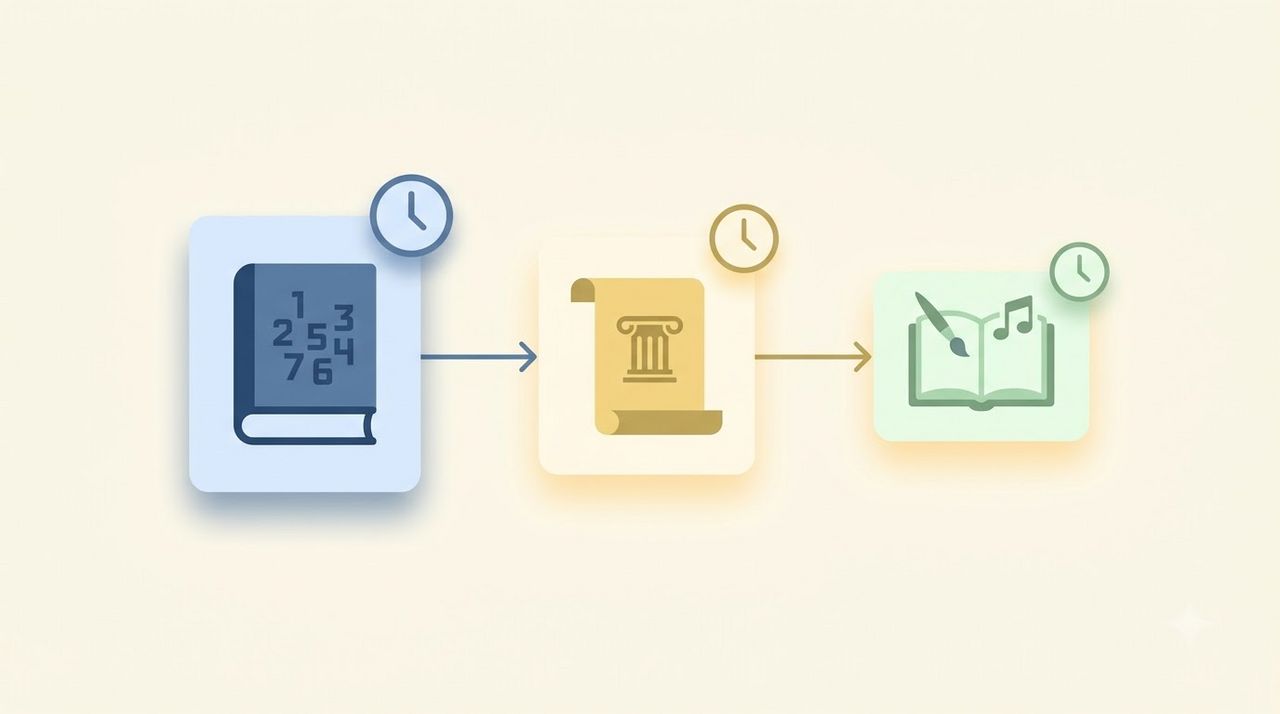
Start with something difficult or easy
Two scenarios:
- You have the energy. Start with something challenging — your concentration is higher at the beginning of the session.
- If you can’t get started at all, try a short , easy 5-10 minute warm-up and then move on to the main task.
The age-based adjustment is a practical guideline, not a standard: in grades 1–4, work blocks are short, 10–15 minutes, with physical breaks; in grades 5–9, 20–25 minutes, with 5–7-minute breaks; in grades 10–11, up to 35 minutes, with a long break every two blocks. Focus not on the number, but on the child: if he starts fidgeting and asking again, it’s time to end the block.
How to break large tasks into short steps
A large assignment almost always needs to be divided. Instead of "write an essay":
- read the topic;
- write down 3 thoughts;
- make a plan;
- write an introduction;
- finish writing the main part;
- add output and check.
The smaller the next step, the easier the start. This works for essays, physics problems, and retelling a paragraph.
How to quickly do homework if you’re lazy and unmotivated
Don’t wait for a surge of inspiration. Procrastination is a conflict between the delayed reward of studying and the desire for immediate gratification. In adolescents, this is amplified physiologically: the limbic system matures before the prefrontal cortex, which is responsible for self-control. In short, it’s not a character weakness.
How to start if you don’t want to at all
Start with a small action that is hard to avoid: open your notebook, read the problem, solve one problem.
The "if-then" technique helps: a pre-written connection between a specific moment and the first action. "If I sit down at my desk at 5:30 PM, I’ll first do 20 minutes of math without my phone." Such plans (implementation intentions) have been studied in adults: in a pre-registered RCT involving 154 university students (Rackemann et al., Stress and Health ), the intervention improved the action planning component. An important caveat: the study focused on stress management, not homework, and did not address behavioral change. So, "if-then" is a useful trigger, but not a magic bullet.
"I’ll do my homework" is an intention. "I’ll open my notebook at 5:30" is a plan. The difference is crucial.
How to maintain momentum and not give up halfway through
One block — one task — one break. Work in chunks and complete a section before taking a break. A task abandoned in the middle must be untangled upon return: remembering the problem, reconstructing the train of thought. This is the main waste of time.
Breaks, schedule, and pace: how to do homework faster without feeling overwhelmed
The most practical study on this topic was by Biwer and colleagues ) British Journal of Educational Psychology , 2023). Eighty-seven Dutch university students studied for one school day either with systematic breaks or by deciding when to take breaks themselves. The result: with self-regulated breaks, both the study blocks and the breaks themselves were longer, while fatigue and distractibility were higher, and concentration and motivation were lower. The amount of tasks completed did not differ. In other words, systematic breaks produced the same results in less time and with better well-being.
The sample consisted of adults, and it was one day, so it couldn’t be applied directly to a second-grader. But the trend is clear: chaotic breaks are less effective than planned ones.
Sample Evening Schedule for Middle School Time What to do 5:00 PM – 5:10 PM Prepare area and materials 5:10 PM – 5:35 PM First block: difficult subject 5:35 PM – 5:40 PM Short break 5:40 PM – 6:05 PM Second block: different subject 6:05 PM – 6:10 PM Short break 6:10 PM – 6:35 PM Third block: finish what you started 6:35 PM – 6:55 PM Long break 6:55 PM – 7:20 PM Check and pack your school bag for tomorrow
Two methods of working in blocks with a predetermined rhythm:
Block Work Methods MethodBlockBreakWho is Pomodoro suitable for? 25 min 5 min Easily distracted; in the Biwer study, this condition was shown to be better than self-regulated Short Cycles 12 min 3 min Younger schoolchildren and those who tire quickly
A special mention goes to the Flowtime method ("work until you’re tired, take breaks when you feel like it"). It’s popular, but this particular principle proved to be unsatisfactory in Biwer’s study: independently choosing the moment to take a break resulted in greater fatigue and poorer concentration. If a child is just learning to organize themselves, it’s best to start with a fixed rhythm.
What to do during your break: get up, stretch, walk around; drink some water; go to the window. What not to do: open social media and instant messaging apps — the new stream of information prevents the brain from recovering; play a video — 5 minutes will turn into 30.
What to do if the task is unclear or you can’t complete it
The goal is to understand, not rewrite a ready-made answer. This is important.
A meta-analysis by Jiang and colleagues ) Frontiers in Psychology , 2023) included 20 studies and 16,338 participants. Supportive parental involvement was positively associated with math achievement (r = 0.076), while intrusive parental involvement was negatively associated (r = -0.153). Intrusive intervention was found to be most detrimental in high school and least detrimental in elementary school. Of all the forms of support, autonomous parental involvement — when an adult asks questions and encourages independent inquiry — had the strongest association.
Let’s be honest about the magnitude: r = 0.076 is a very weak correlation, less than one percent of the variance explained. The variation between studies is large, and we’re only talking about the math. So the correct formulation isn’t "parental support improves grades," but "control interventions do more harm than good, and this is more noticeable than the benefits of the support."
Doing homework together doesn’t mean "the adult solves, the child watches." It means: the adult asks, the child thinks.
Questions that help without making decisions for the child
- "Tell me how you covered this topic in class. How have you solved similar problems?"
- “What exactly is unclear — the condition, the rule, or the transition between steps?”
- "Try to do it the way you understood it. Then we’ll figure out what went wrong."
- "Find a similar example in the textbook. What do they do first?"
- “If you were explaining this to a friend , where would you start?”
- "What question do you want to ask the teacher tomorrow? Let’s write it down."
When to seek help from parents, teachers, or additional resources
What to do if the task fails:
- reread the terms;
- find a similar example in the textbook;
- formulate a specific question;
- contact a parent, teacher, or trusted educational resource;
- After the explanation, solve the problem again on your own.
If a child is angry, cries, or says "I can’t do it," it’s a sign of fatigue or anxiety, not laziness. Three steps for a parent: acknowledge the feeling ("I see that this is really difficult"), scale back ("Let’s do just one task"), and remove the grade — don’t compare with other children or with yourself as a child. Together — yes. Instead of the child — no.

Common mistakes that make homework take up the entire evening
Here’s a list of things that consistently make homework longer — see if anything sounds familiar:
- there is no fixed start time;
- work begins with a phone in hand;
- tasks are not collected into one list;
- a difficult subject is put off until the end;
- there are no breaks or they go to social media;
- a large task is not divided into parts;
- the work is carried out without final verification.
If you want to do your homework early, check the process first, not the character. That’s almost always the problem.
When it’s not about organization
Almost always — but not always. Sometimes it happens: the routine is established, the phone is in another room, tasks are broken down into steps, breaks are timed — and yet the evening still disappears entirely. Then the issue is no longer about the child or time management.
The classic moment when this becomes apparent is third grade. The standard increases to an hour and a half, the volume of written assignments increases, and for the first time, the child is seriously expected to demonstrate independence, for which they are not yet ready. If this is compounded by a commute halfway across town, a conflict with a teacher, or a sports team with practices in the middle of the day, no system of blocks and breaks will save the situation — the arithmetic of the day doesn’t add up.
In such cases, some families change not the evening schedule, but the very format of education. Homeschooling and distance learning are legal (Articles 17 and 63 of Federal Law No. 273-FZ): the child studies outside of school and takes the midterm assessment as an external student. What to look for when choosing: an educational license, compliance with the Federal State Educational Standard (FSES) curriculum, the school assignment process for assessment and receipt of a state-recognized diploma, group size, and the availability of live lessons with a teacher, not just recorded lessons. For third-graders, the amount of handwritten work is especially important — handwriting and literacy skills are still developing at this age, so a good online school should have paper workbooks, dictations, and essays, not just on-screen training. For a detailed analysis of these criteria, see the article " How to Choose an Online School for a Third-Grader ."
It’s also important to understand the limitations of the format. A nine-year-old won’t become independent just because lessons have moved to a laptop: an adult will still have to supervise homework, at least initially. And face-to-face interaction with peers disappears from the schedule — it needs to be consciously reintroduced through clubs, extracurricular activities, and the playground.
Frequently asked questions
How much time is normal to spend on homework?
According to SanPiN 1.2.3685-21 (Table 6.6): 2nd – 3rd grades — up to 1.5 hours; 4th – 5th grades — up to 2 hours; 6th – 8th grades — up to 2.5 hours; 9th – 11th grades — up to 3.5 hours. First-graders are not assigned any required homework at all. If it takes longer, check for distractions and the order of subjects, not the child’s abilities.
Is it true that homework has been abolished for first-graders?
Yes, but this isn’t news from 2026: the ban has been in effect since 2021, according to paragraph 24 of the Procedure (Order of the Ministry of Education No. 115). Order No. 729 of October 8, 2025, merely removed the contradictory provision from the federal educational program; the wording has been harmonized for the 2026/27 academic year. The same paragraph also prohibits assigning grades to first-graders.
Which subject is best to start with?
If you have the energy, start with a challenging one: your child’s attention span is higher at the beginning of the session. If they can’t get started at all, try a short, easy task for 5-10 minutes as a warm-up, then move on to the main task.
How do you quickly do homework when you really don’t feel like it?
Don’t wait for motivation. Start with one small action: open your notebook, read the instructions. A plan like "If I sit down at my desk at 5:30 PM, I’ll do 20 minutes of math" works better than a general intention.
Is it possible to do homework at home with music?
Music with lyrics, videos, and chats can impair concentration. If you need background music, try instrumental music without lyrics or white noise.
How can you do homework with your child without doing it for them?
Ask questions rather than provide answers: "What’s unclear — the problem or the solution steps?" "Find a similar example in the textbook." After explaining, ask them to solve the problem again independently. Meta-analyses show that supervisory interventions significantly harm academic performance more than supportive interventions.
Should homework be turned into a game?
Gamification helps in elementary school: a timer acts as a "race," stickers for completed blocks, and collaborative checking. In middle and high school, it’s more important to establish a stable routine than to make it fun.
You cannot comment Why?