"The Queen of Spades Move" by Elena Topilskaya, summary
 Automatic translate
"The Queen of Spades Move" is a St. Petersburg police detective novel written in 2001 by practicing prosecutor and screenwriter Elena Topilskaya. Written in the first person, the book boasts a genuine understanding of the legal proceedings: the author herself spent many years as an investigator in St. Petersburg, making her descriptions of investigative actions, routine shifts, and interactions with experts truly documented.
The novel is part of the "Secrets of the Investigation" series — a series of detective stories about investigator Maria Shvetsova. "The Queen of Spades Move" is one of the first books in the series; other works in the series include "White, Black, Scarlet" (The Soft Paw of Death, 2000).
The plot: Saturday duty
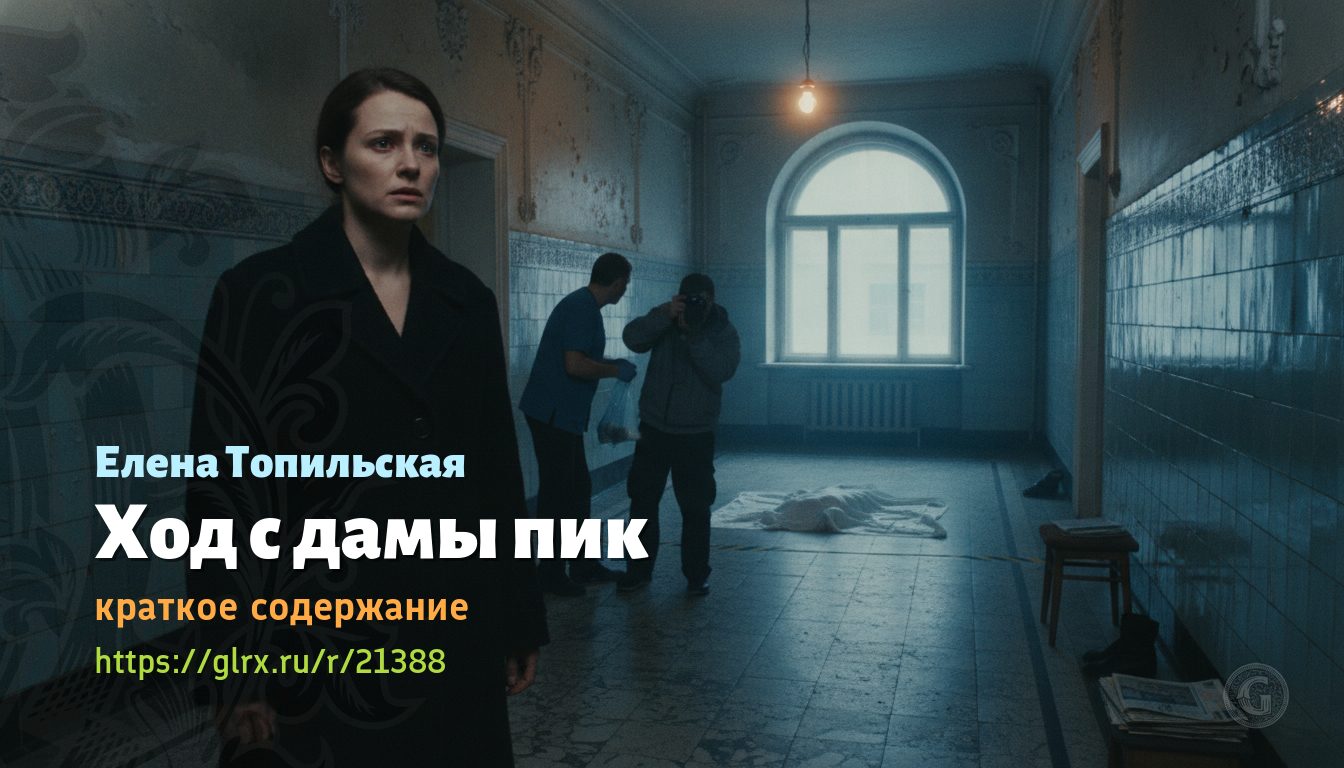
Maria Shvetsova is the duty investigator for the St. Petersburg City Prosecutor’s Office. Her shift begins in the bustling duty room of the headquarters, where two medical colleagues are exchanging stories and drinking beer. A call from the duty officer, Mukha, interrupts this peace: the body of sixteen-year-old Rita Antonicheva, a quiet, home-schooled girl sent out by her mother to buy bread, has been discovered in the front door of an old St. Petersburg building. The body bears twelve penetrating stab wounds and eight superficial ones.
A team arrives at the scene: Shvetsova, forensic pathologist Lev Zadov, and forensic scientist Zhenya Bolelshchikov. An examination of the entrance hall with its marble nymphs and tiled floor yields the first details: the killer acted alone, attacked the girl from behind, grabbing her with the crook of his elbow and holding her mouth shut — which is why there could have been no blood left on him. The only thing stolen was a single cheap earring.
Father from Moscow and the political context
The examination is interrupted by the appearance of a man in a tweed coat and a white scarf — he falls to his knees before his daughter’s body, sobbing. He is followed by the head of the Main Directorate of Internal Affairs, wearing a general’s overcoat. It turns out that the murdered woman is the daughter of a high-ranking official in the presidential administration, long divorced from the girl’s mother and living permanently in Moscow. Antonichev learned of Rita’s death not from the police or his ex-wife, but through an unnamed employee of the presidential administration, who contacted the Main Directorate of Internal Affairs general directly. This fact arouses Shvetsova’s suspicions from the very beginning: how did Antonichev learn of it first?
Serial trail
Detective Pasha tells Shvetsova about a similar murder in a neighboring neighborhood: a thirty-year-old woman was stabbed to death in an elevator, her gold chain stolen, but her wallet containing a large sum of money left untouched. Later, Andrei Sintsov, an operative from the Main Directorate of Internal Affairs’ homicide department, joins the case. He drives the tired Shvetsova home through the nighttime St. Petersburg, and along the way, they stop at an all-night café, where Sintsov recounts the details of Ms. Ivanova’s case: ten stab wounds, a necklace worth several hundred rubles stolen, and a wallet containing five thousand left untouched.
Sintsov is convinced the murders are connected. He offers Shvetsova to take on all the related cases. She understands this is blackmail, but agrees. They both agree: there is a single organizer of the crimes, and different people are the perpetrators. Each victim is robbed not of money, but of a specific item — a fetish. This is what defines the series, not the murder method itself.
The investigation is underway
Shvetsova hangs crime scene photographs in her office, trying to get the eye accustomed to perceiving them as a single picture. Journalist Staroseltsev is drawn into the investigation: his presence at the inspections occasionally irritates the participants, but he proves useful as an unofficial observer.
As the evidence accumulates, Antonichev’s theory takes on more and more weight. Rita’s father neither visited his ex-wife after their daughter’s death nor attended the funeral, even though he paid for it. Shvetsova hypothesizes that Antonichev felt guilty about Rita’s death. The question is, exactly how.
Climax: a corpse in the front door and the denouement
At the next crime scene — again a St. Petersburg front door — the body of a man with gunshot and knife wounds is discovered. Forensic experts Zadov and Panov determine that this is the same "fighter" who killed the women. Krolchevsky, a pathologist from the morgue, who is asked to examine the body, confirms that the injuries are consistent with the previous murders.
Shvetsova immediately launched an operational response: alerting the entire police department, patrolling entryways to search for traces of blood, and dispatching traffic police officers throughout the city with a warrant for Antonichev’s car. Sintsov had already set up posts at his ex-wife’s house and at the airport the day before.
The investigation concludes that the serial murders of women were organized by a single mastermind, with the actual perpetrators rotating. Antonichev, it seems, ordered the execution — not the organizer, but a specific "fighter." The evidence consists of drug microparticles on the corpse’s clothing, matching traces on the clothing of the female victims, forensic examination results, and witness testimony.
Personal against the background of official
Alongside the investigation, the novel chronicles Shvetsova’s private life: her eleven-year-old son, Goshka, is learning to play the electric guitar, mastering the riffs of "Offspring" and "In the Field a Birch Stood," her ex-husband, Igor, still can’t come to terms with their divorce, and Shvetsova lives with a sense of chronic sleep deprivation, a blurred line between work and life, and a professional fatigue that makes it impossible to switch back to normal life even after her shift ends. It is this combination of the mundane and the criminal that gives the novel the authenticity that distinguishes it from purely generic constructs.
- "New Painting" with the latest works of Peter Shvetsov presented ANNA NOVA
- "Heroes Are Not Killed" by Elena Topilskaya, summary
- "The Life of the Honest and the Dishonest" by Elena Topilskaya, summary
- A summary of Elena Topilskaya’s "Fatal Role"
- "Remember Death" by Elena Topilskaya, summary
- "Forensics on Fridays" by Elena Topilskaya, summary
You cannot comment Why?