"The Silver Coat of Arms" by Korney Chukovsky, summary
 Automatic translate
This book is an autobiographical story, written in 1938 and revised by the author in 1961. The narrative is based on the true events of the writer’s youth, when, due to the reactionary decree on "cook’s children," he was unfairly expelled from the fifth grade of an Odessa gymnasium. The teenager’s personal experiences are closely intertwined with scenes of the colorful urban life of the late nineteenth century.
Conflict in the gymnasium and expulsion
The story begins in an Odessa gymnasium, while waiting for a dreadful dictation from the inspector. Wanting to help his friend Timosha Makarov, who’s fallen behind after typhus, and his deskmates, the hero stretches a kite cord under the benches. Kicks are supposed to indicate punctuation: one kick is a comma, two kicks are an exclamation point, three kicks are a question mark, and four kicks are a colon. Due to differences in writing speed, the system malfunctions: classmates insert punctuation marks within words, resulting in zeros.
Soon, a new incident occurs during Religious Studies class. The hero and his deskmate, Grigory Zuyev, begin counting how many times the absent-minded priest Meletius repeats the familiar word "yes." A dispute ensues over the exact number. Noticing the fuss, the priest throws the student out, and during recess, he catches him eating a meat pie on a fast Friday. The touchy Religious Studies teacher sees this as deliberate sacrilege and demands punishment.
Headmaster Burgmeister, nicknamed Six-Eyes, summons the hero to his office, where he’s already scolding Zyuzya Kozelsky. Kozelsky had changed his grades in his report card to Bs and buried the notebook in the garden, but the headmaster’s dog, Aeschylus, uncovered the evidence. Six-Eyes baselessly accuses the hero of inciting Kozelsky and temporarily suspends him from classes.
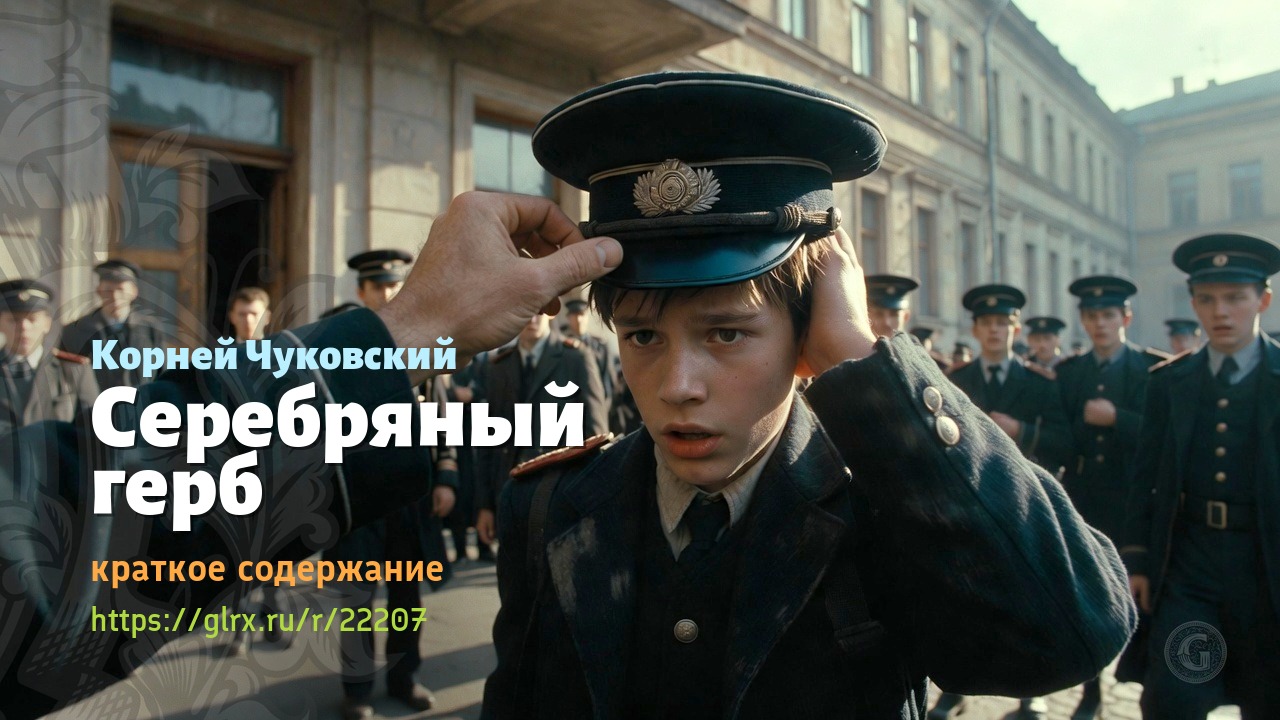
On Saturday, the boy sneaks into class, hoping to disappear behind the back of his classmate, Muni Blokhin. However, during recess, Inspector Prokhor Evgenievich, in front of a hundred witnesses, announces the teachers’ council’s decision to permanently expel him. Before the stunned students’ eyes, the inspector mercilessly snatches the silver coat of arms from the boy’s cap and throws it outside.
The Search for Justice and the Hidden Truth
Unable to upset his laundress mother, the young man tries to get the truth. He approaches his well-fed classmate, Valentin Tyuntin, the real culprit behind the diary incident. Tyuntin’s mother haughtily declares that her son is destined to become a diplomat, and that laundresses’ children have no place in school, and tries to slip the boy a wad of five-ruble notes. The offended teenager throws the money into the parrot’s cage.
A visit to Kozelsky also proves in vain: his father mercilessly beats Zyuzya for her misbehavior. Exhausted from hunger and worry, the hero passes out on the pavement. He comes to in the cozy room of sisters Franziska and Malvina Rikke, who are making fluffy birds from garus. The kind old women urge the boy to immediately tell his mother the truth and give him a toy woodpecker as a keepsake.
That evening, the hero finds himself in Themistocles Drakondidi’s basement establishment, where high school students secretly gather. His friend Timosha reports that the important barber Zhuk is demanding two hundred rubles just for trying to intercede with the principal. Suddenly, the fired history teacher, Ivan Mitrofanovich, nicknamed Finti-Monti, appears in the basement.
The teacher reveals to the teenager the true motives behind the massacre. It has nothing to do with the priest or a damaged diary: a secret circular from Tsar Alexander III demands that the gymnasiums be cleared of children of the lower classes. Returning home, the young man learns that his mother has already received the official notification. The shock of grief washes away the previous isolation and firmly unites the family.
Painting and training on roofs
The hero decides to prove his commitment to his mother to complete his education through action. A family acquaintance, former thief Yuzya Shtok, nicknamed Tin-Tin, finds him a job as an apprentice to the painter Anakhovich. The teenager becomes a spatula worker: under the scorching southern sun, he spends his days scraping rust and old paint off the city’s roofs.
Working at heights forges character and brings his first honest income. Right on the roofing iron, with a piece of chalk, the young man painstakingly writes phrases from Professor Meyendorff’s self-study guide, bought at a flea market, steadily mastering English. In the evenings, in the attic, he and his devoted Timosha master Latin, algebra, and physics.
The boy soon faces disillusionment with his former romantic ideals. During a chance encounter, the most beautiful woman, Rita Vadzinskaya, mockingly calls him a chimney sweep. Having survived the fleeting insult, the hero rejoices at being freed from his obsession. His absurd dreams are replaced by a secure friendship with the kind Leka Kuryndina, who supplies him with textbooks and dictionaries.
To supplement the meager family budget, the young man puts up street posters, gives lessons to the timid clerk Golovatyuk, and reads magazine novels to the elderly colonel’s wife every evening.
Breakdown and overcoming cowardice
A period of diligence suddenly gives way to a prolonged bout of laziness. Having abandoned his textbooks, the hero becomes fascinated with the bike races of youth idol Sergei Utochkin and the creation of a giant kite. Together with his neighbor, Lyonka Aligeraki, he constructs a flying monster with the inscription "Death to the Pechenkinites" to battle the army of street leader Vaska Pechenkin.
The aerial duel ends in disaster: the kite’s tattered tail breaks off, the giant falls, and the boys, in impotent rage, begin a fight in the mud of the road. Overwhelmed by burning shame, the young man quarrels with his family and becomes a vagabond. He spends several weeks in the company of street children, sleeping on the cold coastal sand and subsisting on small fish.
A sudden revelation brings salvation: Timosha has fallen gravely ill with flu and fallen behind in his studies. A sense of duty compels him to return home, where his generous mother welcomes her prodigal son with hot borscht. Resuming his studies with his recovering friend, the young man overcomes his crisis once and for all and takes up his books with renewed vigor.
The Cindylinder Affair and the Triumph of Truth
Gradually, life improves. The young man successfully teaches Latin to the sons of the theater usher, Vartan, and attends opera performances for free. Tsindilinder marries a factory worker, Tsila, and learns the trade of a turner.
Suddenly, Tsindilinder and Tsilya are arrested on charges of a major burglary against Chikuanova’s widow. The police find the stolen items under their floorboards, and a corrupt bailiff coerces a confession. At the rushed trial, the judge implicitly believes the testimony of perjurer Zhora Drakondidi.
The real culprit turns out to be Zhora himself, who leads a gang of thieves along with his brother, Themistocles. Taking revenge on Cindylinder for his break with the criminal world, the bandits planted evidence in his home. The innocent are saved by the observant, hunchbacked realist Iglitsky, who spotted Zhora near the steps of the house. The police discover a secret stash of treasure in Drakondidi’s shop, the couple is cleared of all charges, and the entire court celebrates their release.
Achieving the goal and starting the writing journey
Over the years, the schoolmates’ paths diverge: some join the military, others pursue acting. The hero finds a genuine connection with his sister, Marusya. Joining forces, they successfully earn a living giving private lessons. The mother abandons her grueling work as a laundress and takes up artistic embroidery of Ukrainian towels.
The young man’s main goal is achieved through unwavering persistence. Having failed the biased external studies exams twice, he passes the Richelieu Gymnasium exams flawlessly on his third attempt. Donning his student cap, he gives his mother a long-awaited reason for immense pride.
Soon, the young author’s first published essay appeared in the city newspaper. This publication marked the beginning of Korney Chukovsky’s literary work, which would become his life’s work.
You cannot comment Why?