"The Lonely White Sail" by Valentin Kataev, summary
 Automatic translate
The novella, written in 1936, tells the story of two children growing up against the backdrop of the 1905 revolutionary unrest in Odessa. The story seamlessly interweaves historical cataclysms with the deeply personal experiences of boys from completely different social backgrounds. The novella has been adapted into two highly successful films. The 1937 film of the same name, directed by Vladimir Legoshin, earned acclaim from audiences. In 1976, a three-part television version of the same name was released.
This work begins the well-known tetralogy "Waves of the Black Sea." It is followed by "A Farmstead in the Steppe," "Winter Wind," and "Catacombs," which continue the story of the main characters’ fates.
Farewell to savings
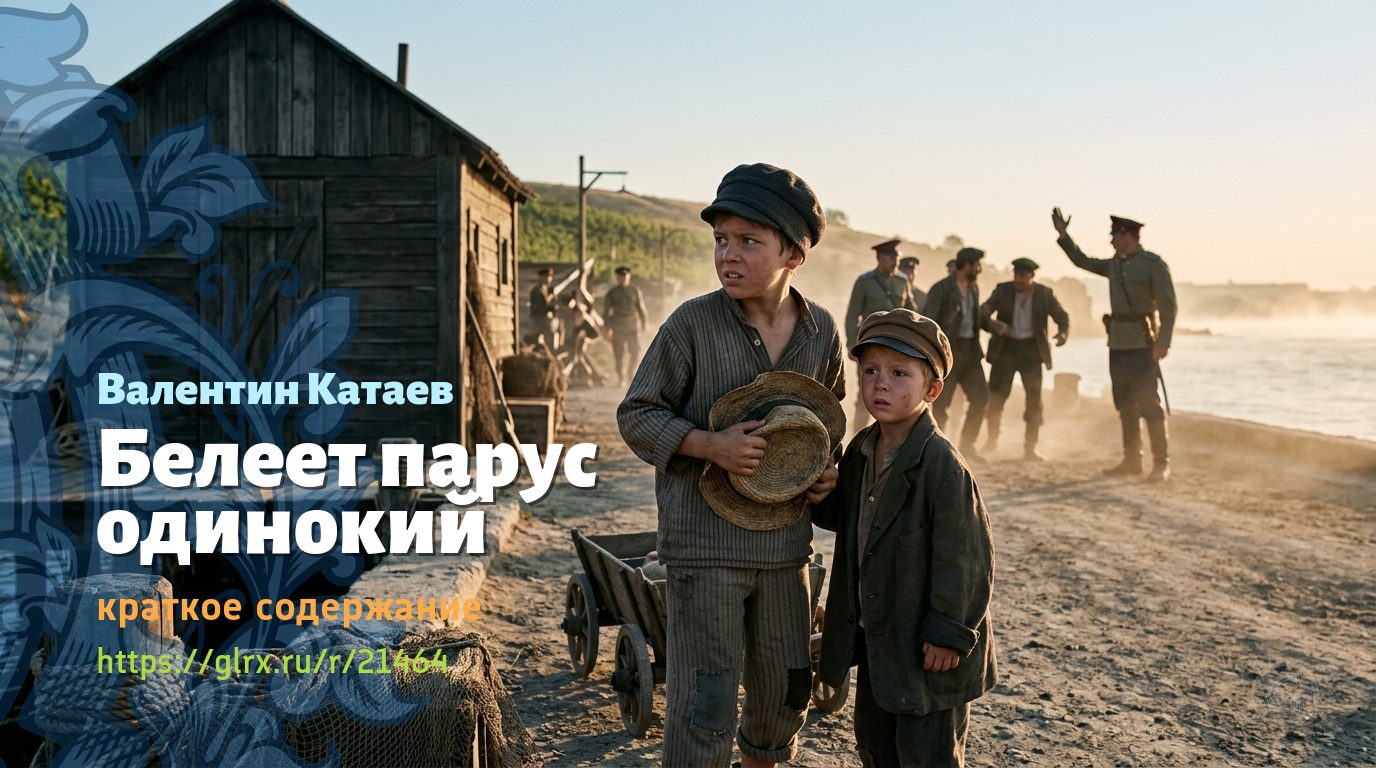
The family of Odessa teacher Vasily Petrovich Bachey leaves their summer cottage in the Bessarabian countryside. Eight-year-old Petya and his younger brother Pavlik bid farewell to their familiar surroundings. The boy keenly feels the chill of the early morning and the sadness of impending separation. The horse-drawn stagecoach ride to Ackerman is marred by an encounter with a patrol. The guards rudely stop the carriage. They are searching for a runaway sailor from the rebel battleship Potemkin.
A loud gunshot rings out on a dusty road among sun-baked vineyards. Suddenly, a breathless man in a peasant shirt and sailor boots leaps onto the stagecoach. Petya notices a blue tattoo of an anchor on his arm. The fugitive quickly hides under the seat. Vasily Petrovich remains completely calm, pretending that absolutely nothing has happened. A patrol of soldiers rushes past. Soon, the mysterious passenger quietly disappears.
The family boards the old paddle steamer "Turgenev." During the voyage, Petya observes a suspicious, mustachioed man wearing smoky pince-nez, clearly searching for someone. The mustachioed detective finds the fugitive sleeping on the lower deck and attempts to apprehend him. A desperate scuffle ensues among the tomato baskets. The sailor hits the agent with all his might with a wooden lath and quickly jumps overboard into the open sea. The captain refuses to stop the ship to apprehend the political prisoner.
Lead buttons
Early one morning in Odessa, a boy named Gavrik wakes up. He’s an orphan and lives with his grandfather in a squalid wooden shack right on the seashore. They go out on an old barge to check their fishing lines. The catch is extremely meager. Gavrik takes the caught gobies to the market, where a greedy merchant, Madame Storozhenko, shamelessly cheats him out of his payment. The boy is forced to wander the streets hungry.
That evening at sea, Gavrik and his grandfather rescue an exhausted and sick sailor. He is Rodion Zhukov, a fugitive from the steamship. The fishermen hide him in their shack. In a delirium, the sailor recalls the mutiny on the battleship, the firing of cannons into the city, and the forced surrender of the ship in the Romanian port of Constanta. The old man goes to the market, angrily quarrels with Storozhenko, and, in his grief, buys vodka. Gavrik decides to turn to his older brother, Terentiy, for advice.
Terentiy works as a mechanic in the carriage workshops at Blizhnie Melnitsy, a dusty neighborhood populated by workers and railroad employees. Gavrik accidentally encounters Petya, who has left the yard without permission. The boys go to Terentiy’s together. Petya meets the worker’s daughter, Motya, and develops a strong romantic attraction to her. The children play hide-and-seek while Terentiy quietly discusses Zhukov’s rescue with Gavrik.
Heavy backpack
That night, the shack is surrounded by police officers led by a mustachioed detective. Gavrik raises a loud cry, warning Terenty, the sailor, and the underground activist Sinichkin inside. The fugitives shoot back and escape through a secret passage in the Odessa catacombs. Enraged by their failure, the police officer brutally beats Gavrik’s grandfather and takes him to the police station. The boy is left completely alone, surviving on odd jobs and gambling.
Petya successfully passes the entrance exams for the preparatory class of the gymnasium. They ceremoniously buy him the long-awaited blue uniform. While showing off his new outfit, he meets Gavrik, who invites Petya to play "ears" — cut off uniform buttons. Petya quickly becomes entangled in a gamble and loses all his bets. The boy secretly empties his younger brother’s piggy bank and tears buttons off his father’s old uniform.
Left in Gavrik’s debt, Petya becomes his obedient assistant. He carries the bags of buttons Gavrik has won in his heavy calfskin schoolbag. The friends wander through the working-class suburbs, factory yards, and port streets. Social tensions mount in the city. Mass strikes break out, and the funeral of the murdered General Kondratenko turns into a large-scale political demonstration. Petya’s father reads the capital’s newspapers with increasing gloom.
Barricades and pogrom
In the fall, armed clashes break out. Barriers are erected on the streets. Gavrik hands Petya some heavy bags and asks him to carry them through the strict police checkpoint. His school uniform serves as reliable cover. Petya successfully enters the besieged building. There he sees a barricade of broken furniture, the sailor Zhukov firing from a window, Terentiy wounded in the head, and Sinichkin dead on the lime-covered floor. It turns out the bags contained live ammunition.
The boy runs away in panic. Before his eyes, mounted Cossacks hack to death with their sabers the bow-legged owner of a shooting gallery running with a red flag. Petya returns home. Soon, a brutal anti-Jewish pogrom begins in the city. A frenzied mob carrying a portrait of the emperor smashes small shops. Petya’s father boldly steps out onto the front staircase, protecting his hiding neighbors — the family of the shopkeeper Kogan. The pogromists brutally beat the teacher and tear his clothes.
Soon, the Tsar’s manifesto on civil liberties was announced. That evening, Petya hid the remaining cartridges in his knapsack. His enraged father found them, mistaking them for silly buttons for a game. He disgustedly threw the bags into the blazing kitchen stove. A powerful explosion ripped through the stove, destroying it. The trauma of the experience left Petya gravely ill with scarlet fever, which developed into pneumonia. The boy spent the entire long winter in bed.
Maritime May Day
In the spring, Petya recovers. Gavrik’s elderly grandfather dies. The funeral of the impoverished fisherman draws a huge crowd of sympathetic workers and sailors. Gavrik distributes a memorial kolyovo (memorial kolyovo) to those present. The next day, a secret May Day celebration takes place on the high seas. Hundreds of colorful fishing boats gather at the high shores of Arcadia. Sailor Zhukov, dressed like a dandy, delivers a fiery speech about social injustice, calling on those gathered to fight for the rights of the poor. The alarming appearance of the police interrupts the naval meeting.
Soon, Gavrik tells Petya some terrifying news: Zhukov has been accidentally arrested on Langeron. He faces the death penalty if the detectives reveal his real name. The underground fighters are hastily preparing an armed escape. On the appointed sunny morning, Gavrik takes the barge out to sea. Petya and Motya watch the dusty road from the cliff. The rumble of dynamite echoes through the thick prison wall.
Terentiy and the rescued sailor arrive in a wrecked cab. Zhukov is limping badly, his light-colored clothes are torn, but he is free. The fugitive quickly jumps into Gavrik’s rocking boat. Terentiy disappears without a trace into the city alleys. The small barge raises its taut sail and speeds away toward the Romanian border, saving the revolutionary from certain death. Petya and Motya watch it for a long time, standing behind a street artist painting a blue sea on a canvas.
You cannot comment Why?