"Winter Wind" by Valentin Kataev, summary
 Automatic translate
The novel, written in 1960, transports the reader into the thick of revolutionary events and describes the process of class self-determination among former high school students and soldiers against the backdrop of the disintegrating Russian Empire. The series inspired the television series "Waves of the Black Sea," which aired in 1975. The book is considered the third part of a tetralogy of the same name, comprising the novels "A Lonely White Sail," "A Farmstead in the Steppe," and "The Catacombs."
Carpathians and evacuation
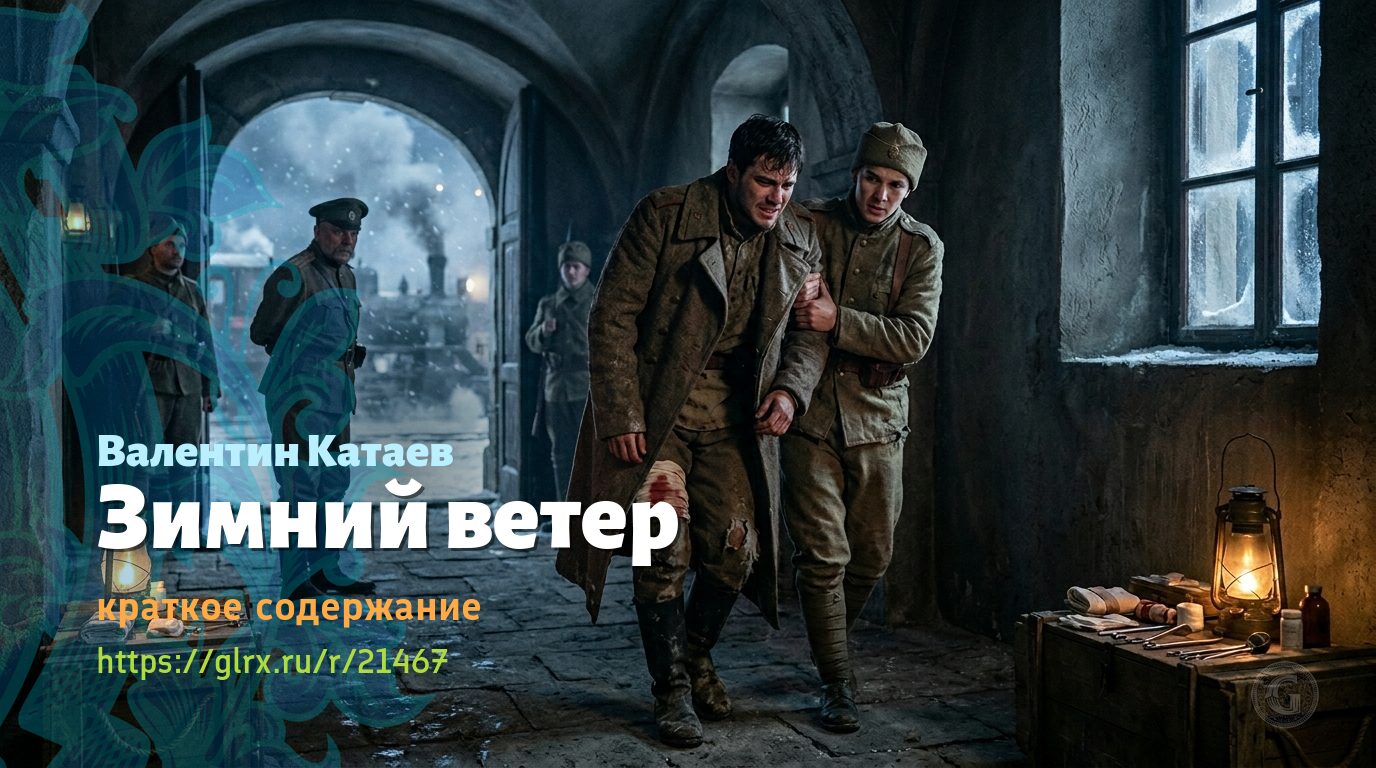
In the autumn of 1917, during an attack in the Romanian Carpathians, Ensign Petya Bachei is wounded in the leg. A shell fragment pierces his thigh completely. The wound is relatively minor. A field surgeon bandages the officer, gives him French cognac, and sends him to the rear. Chaban, a young Ukrainian soldier serving as an orderly, persuades the ensign to take him along.
On the way home, the hospital train stops in Iași. The railway junction is jammed with trains, and the wounded are temporarily housed in a gloomy Catholic monastery. Rumors circulate of a German breakthrough. Petya goes to the station commandant to demand immediate transfer to Russia. A Kornilovite officer, his tunic sleeve empty, accuses him of desertion.
A rally rages in the station square. Tired and embittered front-line soldiers demand peace. Petya succumbs to the general mood, goes up to the field kitchen, and delivers an angry speech against the rear authorities. That evening, armed men arrive at the hospital. The ensign is arrested for propaganda and locked in an empty room under guard. An officer of the death battalion promises to shoot the young man at dawn.
Petya lies awake that night, staring at the guttering candle and awaiting death. In the morning, an enraged crowd of mutinous soldiers frees the prisoners. Among the leaders of the rebellion, Petya recognizes Gavrila Chernoivanenko, a former farm laborer. Gavrila helps a wounded man board a Red Cross ambulance train bound for Odessa.
Odessa hospital
Petya wakes up in a spacious ward in the officers’ hospital on Marazlievskaya Street. He’s being cared for by Motya, a girl from Blizhnie Melnitsy who has known Petya since childhood. Motya tells him she’s married to Akim Perepelitsky, a fisherman from Malofontansk. The war seems far away, and his wound is healing quickly.
Soon, the sick man is visited by his aging father, Vasily Petrovich, wearing a faded cross-stitched blouse. His younger brother, Pavlik, arrives with him, sporting a black eye. Pavlik, a high school student, is already involved in street fights with counterrevolutionary Boy Scouts. Aunt Tatyana Ivanovna, married to an elderly Pole, Sigismund Tsezarevich, also visits her nephew. She reproaches the young man for his political carelessness and informs him that their old friend Marina, along with Gavrik Chernoivanenko, is in Petrograd, alongside the Bolsheviks.
The days in the infirmary pass in an atmosphere of carefree flirtation. Elegant young ladies visit the ward. Petya enjoys the temporary safety, courting the girls and trying to forget the filth of the trenches. His wardmates are Second Lieutenant Kostya, dying from a serious wound, and the frivolous hussar cornet Gursky.
The General’s Family
One day, Petya goes to visit his old pen pal Ksenia Seslavina, but runs away with the two Zarya-Zaryanitsky sisters.
Petya arrives at the Zarya-Zaryanitsky family’s dacha. The father commands a corps on the Romanian front. Career soldiers gather on the terrace. Petya meets the fourth daughter, Irina. From the very first moment, she captivates his thoughts. A whirlwind romance ensues. Petya forgets everything else, blinded by his feelings for Irina.
The October Revolution breaks out. Petya rejoices at the peace decree, hoping to avoid returning to the front lines. Irina’s mother, a general’s wife, is outraged by the Soviets’ actions and counts on the protection of General Shcherbachev and the Central Rada troops. Petya tries to avoid sensitive topics in conversations with his fiancée, reveling in his personal happiness. On New Year’s Eve, they drink champagne by candlelight.
Soon, Chaban brings Petya a pair of weekend boots and an officer’s greatcoat from the Haidamak unit. Demoralized troops from the front begin arriving in Odessa. The military commander refuses to send the soldiers back. Petya moves to live in Blizhnie Melnitsy with the Chernoivanenko family.
The Return of Gavrik
Gavrik and Marina return to Blizhnie Melnitsy from Petrograd. They’ve married and are now expecting a child. Marina is expecting a boy and plans to name him Marat. Gavrik brings stacks of Lenin’s decrees and a mandate from the Bolshevik leadership. He begins organizing an uprising in Odessa.
Petya meets Irina in Alexandrovsky Park near a column. Irina demands that Petya go with her family to the Don to see General Kaledin. She accuses the young man of betraying his officer’s uniform because of his sympathies for the workers’ detachments. Petya refuses. Irina shoots him with a handgun, and her escorts open fire from an ambush. The young man fires back with a heavy Colt pistol and escapes safely.
Having realized his place in the unfolding struggle, Petya joined the Red Guard. He took on the training of youth workers’ brigades. The Railway Council appointed him chief of staff of a combined detachment. A little later, Petya assumed command of the homemade armored train "Lenin."
January battles
In mid-January, workers’ detachments peacefully occupy strategic points in Odessa. Gavrik and his fighters disarm the military district headquarters without a fight. General Zarya-Zaryanitsky signs a pledge not to oppose Soviet power, and Gavrik allows him to go home.
However, the next day, the Haidamakas and cadets treacherously violate the ceasefire. Fierce street fighting ensues. An armored train under Petya’s command supports the workers with artillery fire from the direction of the Odessa-Tovarnaya station.
At the corner of Pushkinskaya and Troitskaya Streets, Gavrik’s detachment builds a barricade. A fragment of an enemy shell fatally wounds Marina in the head. She falls onto the steps of the Rhine cellar. Gavrik carries her to the pharmacy, which has been converted into a first-aid station, but Marina cannot be saved. Blinded by grief, Gavrik finds General Zarya-Zaryanitsky and shoots him dead at a drainpipe.
The Haidamaks seize the Fifth Gymnasium. In the courtyard, they execute captured teenagers from the Red Guard detachment. Among the dead are Pavlik Bachey and Zhenya Chernoivanenko.
Victory and retreat
The Red Guard launches a counteroffensive. The navy joins the rebels. The battleships Sinop and Rostislav open fire on the Haidamak positions with heavy guns. Rodion Zhukov, a former sailor from the battleship Potemkin, directs the fire.
The Haidamak regiment soldiers refuse to fight. Chaban escorts their delegation to Petya’s armored train for surrender negotiations. The counterrevolutionary troops surrender their arms.
A mass funeral for the victims of the January battles is held at Kulikovo Field. Petya and Vasily Petrovich bury Pavlik in a common grave. Gavrik bids farewell to Marina. A plow painted with red lead is placed over the mass grave.
In the spring, a massive offensive by German and Austro-Hungarian troops begins. The forces are unequal. The Red Guards are forced to abandon Odessa. The crew blows up an armored train, firing all its shells. On the shore of Maly Fontan, Motya sees off his retreating comrades. Petya, Gavrik, Akim Perepelitsky, and Rodion Zhukov board a fishing boat. They raise the sails and set out into the stormy seas to meet the squadron’s warships.
- Искусство создания зимнего интерьера
- Санкт-Петербург: Зимний дворец
- Валентин Серов: русский портретист и импрессионист
- Мегалитическая гробница Ньюгрейндж: история и гравюры
- Государственный Эрмитаж
- Экспозиция картин и гравюр
- Развитие европейской портретной живописи
- Развитие портретной живописи в эпоху Возрождения
- Хранение картин
You cannot comment Why?