Ivan Turgenev’s "Bezhin Meadow," a summary
 Automatic translate
Ivan Turgenev’s story, written in 1851, recounts a hunter’s nighttime encounter with peasant children. The author shifts the narrative focus to the inner world of simple village boys, exploring their deepest fears and folk beliefs through mystical tales told around a nighttime campfire. The work is part of the extensive literary cycle "A Hunter’s Sketches." This renowned series also includes the stories "Khor and Kalinych," "Yermolai and the Miller’s Wife," "Biryuk," and other texts that faithfully depict the everyday life of Russian peasants.
A summer day and a long road
It was a beautiful July day. The weather had settled in clear, without oppressive heat or thunderclouds. The narrator was hunting black grouse in the Chernsky district of the Tula province. He had shot a lot of game, his game bag was cutting into his shoulder, and that evening the traveler decided to return home. The hunter passed through the bushes, climbed a hill, but completely failed to recognize the terrain. Instead of the familiar plain with its oak forest and white church in the distance, he saw a narrow valley and a steep aspen grove. The man descended, finding himself in the unpleasant, still dampness of the lowland. The thick, wet grass lay like a smooth white tablecloth.
The traveler tried to find his way, turning left along the trees. Bats were already swooping above the sleeping tops of the aspen trees. After a detour of about a kilometer, the man emerged into an unfamiliar, deserted field. Night had fallen, and the darkness was rapidly thickening and growing. The hunter, accompanied by his dog, Dianka, wandered at random. He rounded a dark hillock and found himself in a hollow resembling a cauldron with gently sloping sides and large rocks jutting out at the bottom. Completely lost, the traveler followed the stars for about half an hour until he found himself at the edge of a terrifying abyss.
Meeting by the fire
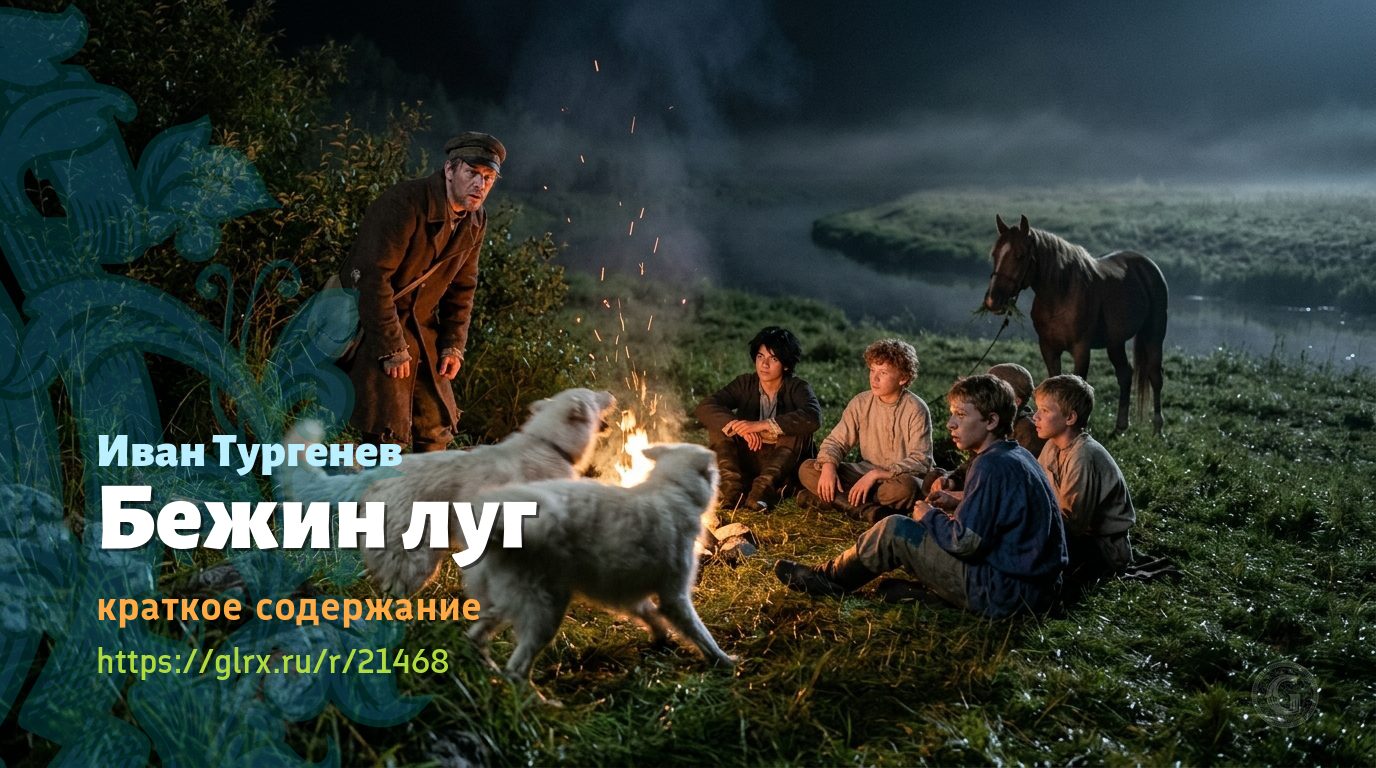
From a high, sheer cliff, the narrator saw a vast plain. A wide river curved around it in a semicircle. Just beneath the hill, two fires burned and smoldered, around which people swarmed and shadows flickered. The hunter immediately recognized the place — the meadow was famous in those parts as Bezhin Meadow. His legs were so tired and it was late, he decided to descend to the fire. As soon as he let go of the last branch, two shaggy white dogs rushed at him, barking viciously. The children’s ringing voices quickly called the dogs back.
Peasant children from neighboring villages sat by the fire. In the hot summer months, they drove their horses into the fields at night, protecting the herd from daytime flies and horseflies. For the children, this nighttime vigil was considered a great joy. The narrator explained his sudden appearance, lay down under a bush, and began to observe the children. The scene of the night was mesmerizing: the flames fought against the darkness, casting long shadows, and the horses occasionally approached the light and nimbly munched the grass. The distinctive, languid scent of a Russian summer night filled the clean air.
Village boys
There were five boys sitting around the fire: Fedya, Pavlusha, Ilyusha, Kostya, and Vanya. Fedya looked to be about 14 years old. He had a slender build, fine, beautiful features, light eyes, and curly hair. His colorful cotton shirt with a yellow border and new boots marked him as coming from a wealthy family. Pavlusha was about 12 years old. He had tousled black hair, gray eyes, high cheekbones, and a pale, pockmarked face. Despite his unprepossessing appearance, awkward frame, and poor clothing, he stood out for his intelligence, direct gaze, and inner strength.
Ilyusha was also about 12 years old. His hooked nose and half-blind face constantly expressed a dull, painful solicitude. He wore new bast shoes, footcloths, and a neat black svitka, held together with a thick rope. Kostya was 10 years old, and he attracted attention with his thoughtful, sad gaze. His face was small, freckled, and pointed. The child’s large black eyes created a strange impression, as if they wanted to express something inexpressible. The narrator did not immediately notice the youngest, Vanya, 7 years old. The child lay quietly on the ground, cuddled under an angular mat.
Stories about evil spirits
The children were boiling potatoes in a small pot and quietly chatting. Fedya asked Ilyusha about the brownie. Ilyusha replied that he worked with his brother at the paper mill. One night, they stayed there with the other children because the overseer forbade them to go home before working hard. That night, someone began to walk heavily over the boards above their heads. Then, suddenly, a water wheel began to hum and start, even though all the lights were down. The invisible visitor descended the stairs, flung open the door, stirred the mold near the vat, and coughed loudly.
Kostya then recounted in a thin voice the story of the village carpenter Gavrila. Gavrila had once gone into the forest to pick nuts, gotten lost, and decided to wait for the morning under a tree. That night, he heard a strange call. A mermaid was perched on a tree branch, swinging and calling him to her, laughing loudly. The carpenter was terrified, but found the strength to cross himself. The mermaid immediately stopped laughing, wept bitterly, wiping her green hair, and predicted that Gavrila would grieve for the rest of his days. Since then, the man has been sad.
Night alarm and superstitions
The children’s conversation was interrupted by a prolonged, ringing sound over the river. The dogs suddenly jumped up and, barking frantically, raced off into the darkness. The restless scurrying of a disturbed herd could be heard. Pavlusha screamed loudly, leaped onto his horse without the slightest hesitation, and galloped after the dogs, thinking a wolf had approached the herd. He soon returned safely, attributing the animals’ nocturnal agitation to a faint scent. The hunter couldn’t help but admire the boy, admiring his extraordinary courage and firm determination.
After his friend’s return, Ilyusha began talking about a secluded spot on a broken dam called Varnavitsy. The late master, Ivan Ivanovich, wanders there in a long caftan. He searches the ground for rupture grass to lift the weight of the grave forever. Ilyusha confidently added that on Parents’ Saturday, one can encounter people destined to die this year. Grandma Ulyana was once sitting on the church porch at night and saw a boy named Ivashka walking along the path. He had indeed died in the spring. And then, with horror, Ulyana recognized herself in the next figure.
Solar eclipse and Trishka
Fedya asked Pavel about the celestial prophecies in their native village. Pavel told him how, during a recent solar eclipse, their master had become terrified. The cook had smashed all the pots in the stove with a fork, thinking the end of the world had arrived and that no one would need the food they’d prepared. Rumors quickly spread among the villagers that white wolves would eat people, birds of prey would fly, and Trishka himself would appear.
Ilyusha passionately explained that Trishka was a cunning and amazing man who would inevitably come in the end times. It was completely impossible to capture him, put him in heavy chains, or imprison him. During the eclipse, the local cooper, Vavila, came down from the mountain. He bought a new, empty jug and, as a joke, put it on his head. The peasants mistook the cooper for Trishka and scattered in a wild panic. The village elder crawled into a deep ditch, and the village elder’s wife got stuck in a gateway, screaming loudly. The children laughed merrily, recalling the general commotion.
Voices from the water
After some time, a strange, pained heron’s cry rang out twice over the river. Kostya remembered passing a buchilo — a deep pit of water thickly overgrown with reeds. A pitiful, painful groan suddenly emanated from it. Pavel calmly explained that thieves had once drowned the forester Akim in that very buchilo. The boys also remembered the local fool Akulina. She had thrown herself into the river because of a lover’s cunning deception; a water spirit had corrupted her at the bottom, and since then she had lost her mind. Now she wore old rags and only occasionally laughed convulsively.
Kostya sadly told the story of Vasya, a wonderful boy who tragically drowned in the river. His mother, Feklista, loved her son dearly and, as if sensing trouble, was always afraid to let him swim. The child was playing carefree on the shore and suddenly disappeared, leaving only his little cap floating in the water. After her son’s death, Feklista lost her mind. She often visited the scene of the tragedy, lay down on the cold ground, sang Vasya’s favorite song, and wept bitterly.
Omen
Pavel took his empty pot and went to the river to draw fresh water. Ilyusha called loudly after him, warning him against encountering the water spirit. When Pavel returned safely, he silently sat by the fire and informed his comrades of the trouble. As soon as he leaned over the water, the boy distinctly heard the drowned Vasya’s voice calling him. The sound seemed to come from underwater, saying, "Pavlusha, come here."
The other boys were terrified and began crossing themselves hastily. Ilyusha, with a trembling voice, called this an extremely bad omen. Pavel reacted to what had happened completely calmly, confidently declaring that one could not escape one’s true fate. The children fell silent, deeply impressed by their friend’s words, and slowly began to settle down to sleep. The whistling of sandpipers in flight filled the night sky. According to the wise Pavel, the birds were heading far beyond the warm seas, where winter never occurs.
The coming of morning
More than three hours had passed since the storyteller’s arrival at the fire. The narrow moon had risen very late. The night remained as magnificent as ever, but the children’s conversations had faded completely. The dogs dozed peacefully by the smoldering embers. The horses stood absolutely still, their heads bowed in pre-dawn slumber. The storyteller gradually fell into a light drowsiness until a fresh breeze of morning brushed across his face.
The sky began to quickly brighten, cool, and turn blue. The stars flickered faintly and vanished without a trace in the sky. The first signs of dawn appeared everywhere, the vibrant sounds and voices of awakening birds resounded. The hunter quickly rose and quietly approached the soundly sleeping boys. Only Pavel half-rose and gazed intently at his guest. The man silently nodded to the child and set off along the river, smoked by a light fog.
Having traveled about two kilometers, the traveler saw golden streams of hot, young light rapidly flood the wide, wet meadows, green hills, and bushes. Everything around him stirred, awakened, and began to sing loudly, the morning dew sparkling brightly like radiant diamonds. At that moment, a rested herd of horses raced past the hunter, driven by familiar lads. At the very end of the story, the narrator bitterly shares the sad news. That same year, the brave and intelligent Pavel died, killed in an accidental fall from his horse.
- Иван Черный – новый абстракционизм
- Иван Морозов, русский коллекционер искусства
- Иван Крамской: Русский художник-портретист
- Иван Иванович Шишкин, русский художник и мастер лесных видов
- Музеи, которых нет: галерея Ивана Евменьевича Цветкова
- Мамонтовский кружок
- Украинская католическая церковь
- Экспозиция картин и гравюр
- Развитие европейской портретной живописи
You cannot comment Why?